






Scaling Agentic ITOps: From AI pilots to autonomous IT operations


For enterprise IT leaders, the question is no longer whether AI agents can help run IT operations, but how to scale them beyond pilots and into the everyday work of keeping the business online. It’s no coincidence that this year’s Gartner IT Infrastructure, Operations & Cloud Strategies Conference (IOCS) opens with a keynote dedicated to scaling agentic AI to enable autonomous IT operations.
At BigPanda, we’ve seen a shift from the ITOps leaders we work with every day. The conversation has moved from “what are Agentic ITOps?” to “how do we scale them across our enterprise?”
Scaling Agentic ITOps isn’t a matter of simply deploying more AI agents. A handful of successful AI pilots won’t keep pace with environments that grow more distributed, more dynamic, and more AI-accelerated every quarter. As our CEO, Assaf Resnick argues, the real roadblock is the continued reliance on and structuring around an operating model still constrained by human speed. This article explores why that operating model fell behind, what it takes to scale Agentic ITOps, and how BigPanda helps IT leaders turn agentic AI from a promising experiment into the foundation of their automated IT operations future.
Why human-speed IT operations can’t scale
Over the past decade, enterprises have modernized nearly everything about their technology stack. Scheduled releases gave way to continuous delivery, and IT infrastructure became distributed, cloud-native, and dynamic. Services are more interconnected, teams depend more on other teams, and operational data pours in from more sources than any one person can reasonably review.
The enterprise changed, but the ITOps that keep everything running didn’t. Enterprises demanded agility and velocity, and technology delivered it. The way that enterprises operate, however, hasn’t evolved nearly as quickly.
This “operating model gap” was manageable when change happened at a human pace, but AI has dramatically accelerated software delivery, and the downstream effects are landing squarely on ITOps.
Google’s 2025 DORA report found that 90% of technology professionals now use AI at work, and that AI adoption is boosting software delivery throughput. It also reduces delivery stability because AI-assisted teams are shipping more changes faster, and some of those changes are breaking things.
When an incident follows a change, someone still has to manually figure out what changed, what depends on it, who’s affected, and who can act. If that investigation still runs by having people manually search one system at a time, faster development just builds a bigger queue in operations. As Assaf puts it, “The work hasn’t disappeared. It’s moved downstream.”
That queue is already overflowing. Our research found that enterprises handle roughly 25,000 L1 NOC incidents per month across an average of 19 monitoring and observability tools. These same enterprises spend an average of $5.4 million a year on outsourced IT operations support, yet 34% of L1 issues are still misrouted, and 24% are resolved incorrectly or need rework.
The traditional answer to rising volume has been to add people, either in-house or through another outsourcing contract. That approach scales cost, but doesn’t necessarily scale capability. As Assaf said, “headcount can increase capacity. It cannot, by itself, change the structure of the work.”
If you want IT operations that scale with the business, you have to change the structure of the work itself. That’s the promise of Agentic ITOps, and it’s why scaling it has become such an urgent priority for I&O leaders.
Why so many agentic AI initiatives stall before they scale
Gartner® predicts that more than 40% of agentic AI projects will be canceled by the end of 2027, citing escalating costs, unclear business value, and inadequate risk controls. Gartner also warns of widespread “agent washing,” in which existing chatbots and assistants are rebranded as agentic without meaningful new capabilities.
The picture inside I&O specifically is just as murky. A Gartner® survey of 782 I&O leaders found that only 28% of AI use cases in infrastructure and operations fully succeed and meet ROI expectations, while 20% fail outright. Among the 57% of I&O leaders who reported at least one failure, many said their AI initiatives failed because they expected too much, too fast.
Failures clustered in the most ambitious use cases, such as auto-remediation, self-healing infrastructure, and agent-led workflow management, and 38% of leaders who faced setbacks cited poor data quality or availability as a direct cause.
At BigPanda, we see three patterns behind stalled agentic AI initiatives in ITOps:

Agents bolted onto a broken operating model
An AI agent that drops into the same fragmented, handoff-heavy workflow inherits all of its problems. Gartner’s research backs this up: the I&O leaders who succeed embed AI into the systems and processes their teams already use, rather than running it as a side project.

Autonomy is a dial, not a switch.
Jumping straight to fully autonomous remediation in complex, unpredictable environments is a recipe for disappointment. Agents need to prove they’re reliable on well-understood work before they earn more responsibility.

Waiting for perfect data.
Many teams assume they need a pristine CMDB before agentic AI can deliver value. That assumption turns a quick win into a multi-year data project that never quite finishes.
The good news is that the success factors are just as clear as the failure modes. Notably, 53% of I&O leaders in that same Gartner survey reported their AI wins in IT service management, a mature domain with well-defined workflows and measurable outcomes. In other words, the path to scaling agentic AI in IT operations runs straight through the incident lifecycle.
What it takes to scale Agentic ITOps across the enterprise
The stakes are rising quickly. Gartner’s® Predicts 2026 research on AI agents in I&O predicts that 70% of enterprises will deploy agentic AI as part of their IT infrastructure operations by 2029, up from less than 5% in 2025. The enterprises that get there first won’t be the ones running the most pilots. They’ll be the ones that rethink four things at once: their people, their operating model, their governance, and their data foundation.
People and teams: Put human judgment where it matters most
Scaling Agentic ITOps doesn’t mean removing people from IT operations. It means changing what they spend their time on. In Assaf’s framing, agents take on the work that is repetitive, pattern-based, and governed by known procedures, while people own the decisions that require judgment: what level of impact the business can tolerate, how to handle genuinely novel failures, and what should change so an incident doesn’t repeat.
In practice, that shifts L1 teams away from acknowledging alerts and copying context between tools, and shifts L2, L3, and SRE teams away from reconstructing what happened before they can start fixing it. Your most experienced engineers stop acting as human search engines and start supervising, guiding, and improving the system.
Operating model: Change the work, not just the tools
The biggest mistake IT leaders can make is to drop agents into an unchanged workflow and expect transformational results. As Assaf argues, the goal isn’t to make a human process run marginally faster while leaving the same manual sequence intact. The goal is to remove repeated context assembly entirely from the default path.
That means designing workflows in which agents gather context across the environment, connect related signals, preserve the investigation paths they’ve already examined, and hand off a complete picture to the next person or agent involved. Every handoff carries everything the last one learned. That’s what makes an operating model scale.
Governance and trust: Let agents earn the right to act
Agent sprawl is already here. According to Salesforce’s MuleSoft 2026 Connectivity Benchmark, the average organization runs 12 AI agents and expects that number to grow 67% within two years, with half of those agents operating in isolated silos. In ITOps, nearly every observability, cloud, ITSM, and on-call vendor has shipped its own agent, and each one only sees its own slice of the environment.
I recently wrote an article in which I outlined a scenario in which five agents produce five confident, conflicting answers, and the bridge call reconvenes to sort them out. In other words, you’ve automated incident investigation, but you’ve kept the argument.
Scaling Agentic ITOps safely requires governance that answers a few critical questions before any agent takes action. You need four conditions to be in place to be successful: a shared model of the environment, a determination step before any action, a single owner for each action, and a scored record of each agent’s conclusions. You can expand autonomy as agents prove they’re reliable, starting with well-understood, high-volume work and growing from there.
Data and technology: Build on shared context, not perfect data
Agents are only as good as the context they can access. But that doesn’t mean you need a perfect CMDB before you start. As we explored in How to lay the data foundation to support Agentic ITOps, agentic AI can work with messy, incomplete, and unstructured data, and treats data quality as an output of daily operations rather than a prerequisite.
The knowledge your agents need already exists in observability tools, ITSM platforms, historical incident records, change logs, and the chat threads where your team worked out how they actually fixed it. The technology decision that matters most is whether your agents share a single connected model of that knowledge, or each one reasons from its own partial view.
How BigPanda helps IT leaders scale Agentic ITOps
BigPanda was built for exactly this moment. Our Agentic ITOps platform helps enterprises move beyond isolated AI experiments to an operating model in which agents and people work from the same context at machine speed. The enterprises scaling fastest follow a phased path, with each phase building on the last.
Phase 1: Scale L1 operations without scaling headcount
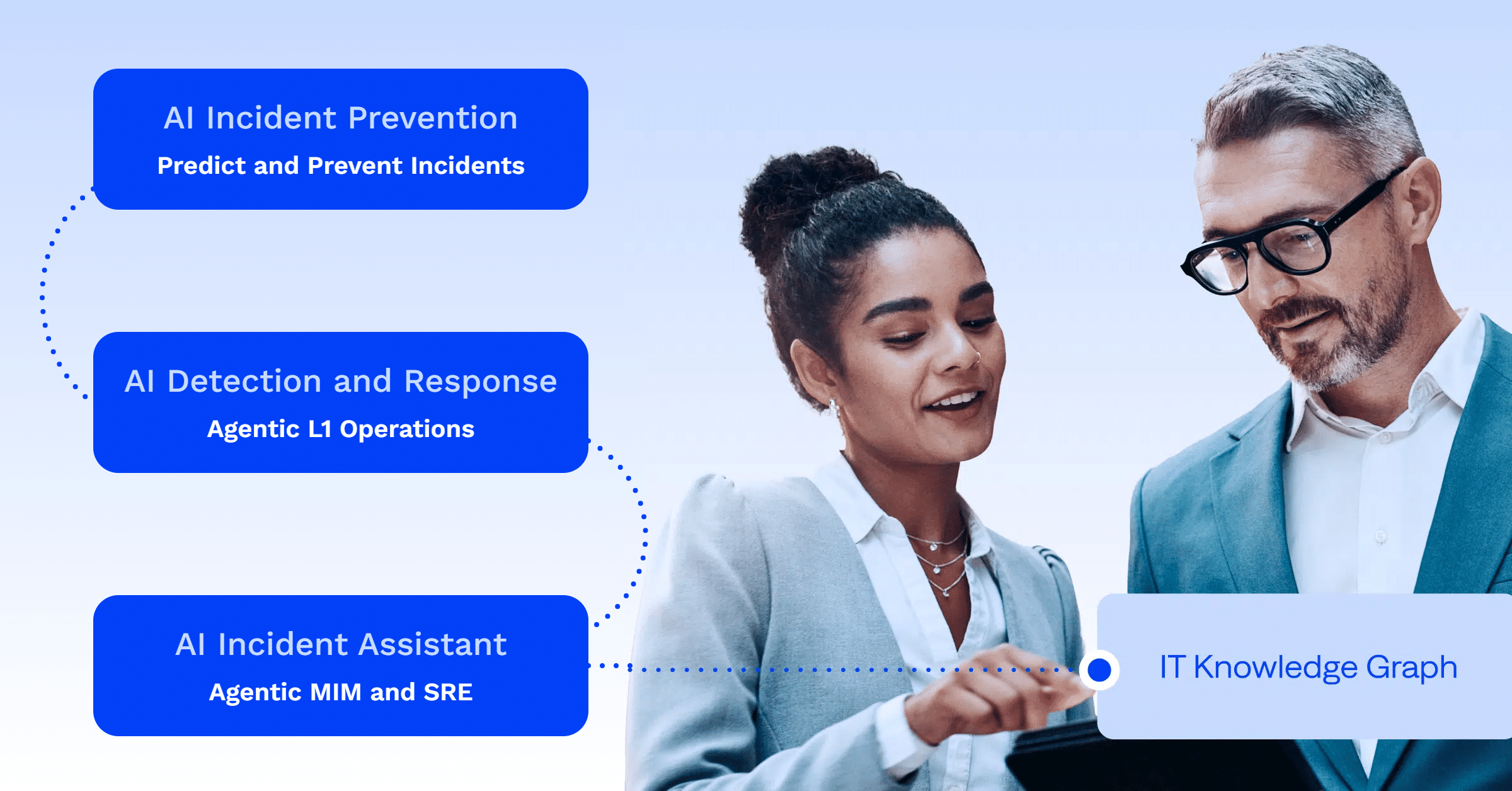
L1 is where human-speed operations break down first, and where agentic AI delivers value fastest. The BigPanda L1 Agent, part of AI Detection and Response, automates L1 workflows end-to-end. It analyzes, prioritizes, suppresses, and routes incidents using AI reasoning over real-time data, historical outcomes, and operational knowledge, without rigid rules or manual configuration. Incidents are routed correctly the first time, more issues are resolved at L1, and anything that does escalate arrives with full context. Gamma Communications, for example, is embedding automation at L1 to build what its Head of IT Operations calls “a more resilient, scalable, and cost-efficient operating model.”
Phase 2: Give every expert an AI teammate
Once L1 is running at machine speed, the next bottleneck is the escalation path. The BigPanda AI Incident Assistant works alongside L2, L3, and SRE teams so responders arrive at every incident with the investigation already underway, the context already assembled, and next steps already suggested. With Swarm Investigation, BigPanda agents decide which specialist agents to invoke, and in what order, to drive an investigation forward. That means fewer bridge calls, fewer unnecessary escalations, and more expert time spent on the decisions that only people can make.
Phase 3: Prevent incidents before they happen
With AI-assisted development accelerating change across the enterprise, the most scalable incident is the one that never occurs. BigPanda AI Incident Prevention analyzes change records, ticket history, and past incidents to flag high-risk changes before they reach production. Teams move from reactive firefighting to proactive reliability, without slowing the pace of delivery.
The foundation: One shared context for every agent
Underpinning every phase is the BigPanda IT Knowledge Graph. It continuously connects monitoring signals, topology, change records, ticket history, and unstructured operational knowledge across your entire environment, not just one platform’s slice. Adaptive Memory retains what each incident teaches, so every investigation starts smarter than the last. With Custom Agents and agent-to-agent interoperability, your teams can build agents that work from that same shared context.

BigPanda doesn’t ask you to turn off the agents you already have. It gives them one picture of your environment and one place where decisions get made, so five competing answers become inputs to a single determination. That’s how Agentic ITOps scales from a handful of pilots into the operating model for your entire enterprise.
How enterprises can prepare for Agentic ITOps
The enterprise changed first. Now it’s time to change the work of keeping it running. The good news is that you can start preparing for Agentic ITOps today, without a multi-year data cleanup project or a rip-and-replace of the tools you already rely on. Here’s where the IT leaders moving fastest are focusing:
- Start with high-volume, well-understood work. L1 detection, triage, and routing offer the fastest path to measurable ROI and provide agents with a proving ground to earn trust before taking on more autonomy. Check out The Four Decisions: A 90-Day Leadership Playbook for Agentic ITOps to learn how to take your enterprise to proactive, agentic operations in three months.
- Inventory the agents you already run. List every operations agent across your observability, cloud, ITSM, and on-call tools, along with what data it sees, what actions it can take, and who owns it. You can’t govern what you can’t enumerate.
- Decide where determination lives. Name the one place where signals become incidents and incidents get owners, so your agents feed a single decision rather than five competing ones.
- Work with the data you have. Your tickets, change records, chat logs, and monitoring data are already the raw material agentic AI needs. Our e-book, Laying the data foundation for Agentic ITOps: A strategic guide for enterprise IT leaders, shows you how to build on it.
Ready to see how Agentic ITOps can help you scale IT operations? Come meet our team at Gartner IT Infrastructure, Operations & Cloud Strategies Conference (IOCS) North America 2026, taking place December 8–10 in Las Vegas, NV. Stop by our booth for live demos and to learn how enterprises are using Agentic ITOps to improve MTTR, reduce L1 and MSP spend, prevent escalations, and build an operating model ready for their automated IT operations future.
Five key takeaways from this article
- The ITOps operating model hasn’t kept pace with the enterprise. Technology moved to continuous delivery and distributed infrastructure, but incident response still depends on people rebuilding context from fragments, one handoff at a time.
- Human-speed operations can’t scale with AI-accelerated change. AI is increasing both delivery throughput and instability, and enterprises already handle roughly 25,000 L1 NOC incidents per month. Adding headcount scales cost, not capability.
- Most agentic AI initiatives stall because of how they’re deployed, not because the technology falls short. Gartner found that only 28% of AI use cases in I&O fully meet ROI expectations. Success comes from embedding AI into existing workflows, gradually earning autonomy, and starting where outcomes are measurable.
- Scaling Agentic ITOps requires changes across people, operating model, governance, and data. People’s own judgment, agents’ own repeatable work, governance defines when agents can act, and a shared context keeps every agent working from the same picture of your environment.
- BigPanda helps IT leaders scale in phases. Start by automating L1 with the BigPanda L1 Agent, extend AI assistance to L2, L3, and SRE teams, prevent change-related incidents, and connect it all through the IT Knowledge Graph.