





The enterprise changed. ITOps didn’t.
The modern enterprise runs on a technology stack that changes faster than the operating model responsible for keeping it available.
Applications that once moved through scheduled releases now change continuously. Infrastructure is distributed and dynamic. Services depend on other services, teams depend on other teams, and operational data arrives from more places than any individual can reasonably inspect.
The business asked for agility, flexibility, and velocity, and the tech delivered.
But the work of operating that technology still follows a familiar pattern.
The operating model stayed behind
An alert appears. Someone decides whether it matters. Someone searches dashboards and ticket history. Someone looks for a runbook, identifies the likely owner, checks for recent changes, and decides whether to resolve or escalate.
If the problem is serious enough, someone opens a bridge call and begins assembling the picture for everyone else.
The tools may have changed, but the handoff still depends on people rebuilding context from fragments.
That’s the operating model gap.
The issue isn’t that the people doing the work aren’t capable, but the process asks them to assemble context one conversation at a time, even as the environment becomes more distributed and more dynamic.
Why human-speed operations can’t keep up
Applications change in seconds. Understanding what broke can still mean finding an owner, searching ticket history, and waiting for the right person to join a bridge call.
One person checks the deployment history. Another checks the service map. Someone else remembers a similar incident. A fourth person knows who owns the dependency, but is in another meeting. By the time the relevant people are connected, the early work may already have been repeated several times.
Adding another engineer gives the process another pair of hands. It doesn’t make the next handoff carry everything the last person learned. It doesn’t make a stale ownership record current. It doesn’t make the right context appear at the moment a decision is needed.
Headcount can increase capacity. It cannot, by itself, change the structure of the work.
That distinction matters because the people searching for context are also the people the business needs to make higher-value decisions: what level of impact is acceptable, which tradeoff protects customers, whether a familiar remediation is safe in this situation, and what should change so the incident doesn’t repeat.
Every repeated search takes time away from those decisions.
Agentic ITOps changes the model
Changing the operating model means changing the work people are asked to do.
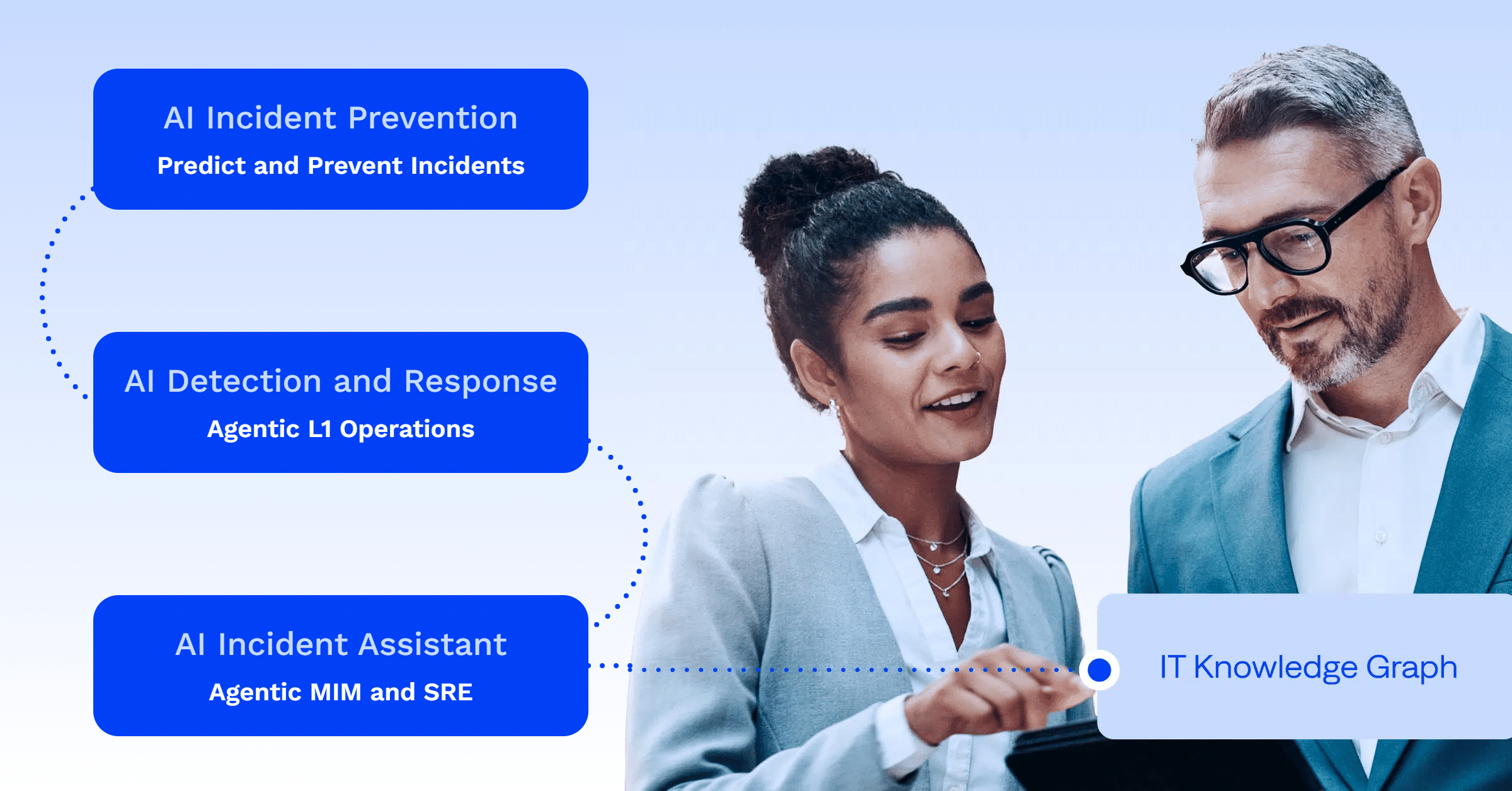
A team of specialized agents can assemble context across the environment, identify relevant relationships, reason over what’s happening, and carry an investigation forward. The point isn’t to make a human process move marginally faster while leaving the same manual sequence intact.
The point is to remove repeated context assembly from the default path.
Agents can handle work that is repetitive, pattern-based, and governed by known procedures. They can connect signals that would otherwise remain fragmented, preserve the paths already examined, and make the reasoning available to the next person or agent involved.
People still own judgment. They decide what the business can tolerate, handle genuinely novel situations, set policy, improve the environment, and guide the system when the familiar answers fail.
That division of work is the important change. Human expertise isn’t a substitute for a missing operating model—it’s applied where it matters most.
The enterprise changed first. The next step is to change the work of keeping it running.