





How to lay the data foundation to support agentic ITOps

Agentic IT operations have arrived. It’s no longer a question of if enterprise IT departments will adopt agentic ITOps, but how quickly. Every year, IT environments grow more distributed, complex, and difficult to monitor with legacy tools and processes. At the same time, the pace of AI development is accelerating the volume of changes and incidents, straining teams that are still trying to manage them manually, reactively, and one alert at a time.
ITOps leaders know this approach doesn’t scale, and forward-thinking ITOps professionals are done waiting for perfect conditions to fix it. The question we hear most often at BigPanda isn’t “what are agentic ITOps” (but, if you’re wondering, we’ll leave the link to that blog right there.) Rather, it’s “what data do we actually need to get started?”
That’s the right question to ask. Agentic AI is only as good as the data and context it can access. Get the foundation wrong, and you end up with agents that are fast, confident, and make frequent mistakes. Get it right, and you unlock AI agents that can detect, diagnose, and resolve incidents with minimal human intervention. This article breaks down what that foundation looks like and how to build it without a multi-year data cleanup project standing in your way.
The CMDB is no longer enough
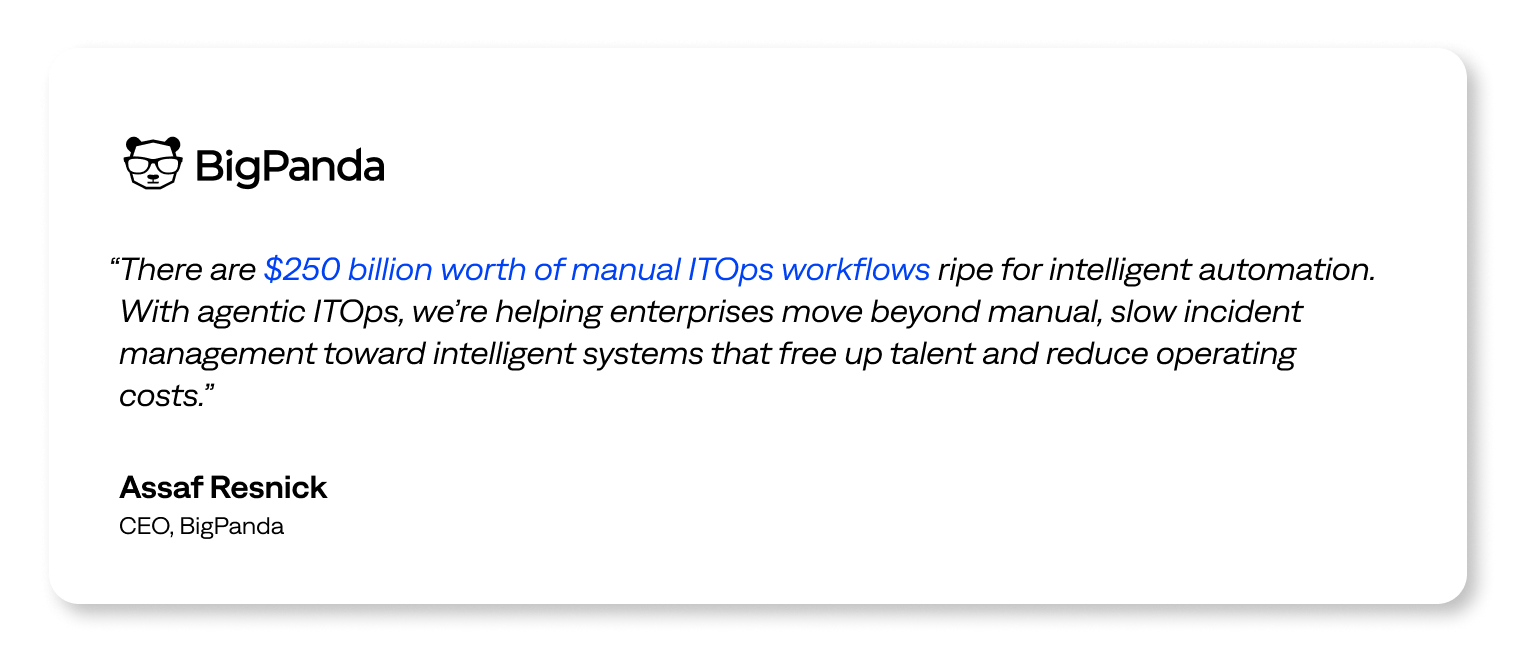
For years, the assumption was that automation required perfect data: clean the Configuration Management Database (CMDB), normalize every source, and get the foundation “right” before doing anything else. That multi-year data project became the reason automation stalled, and why the $250 billion problem of manual ITOps workflows never got solved.
The numbers back this up. Despite a 20% year-over-year increase in spending on observability and ITSM tools, incident detection remains poor. End-users, not system telemetry, still report 65% of all incidents. A CMDB was sold as a complete, up-to-date map of every service and component in the environment. In practice, it almost never is.
“We’ve reached peak frustration with getting your ITOps or ITSM teams all the fragmented, siloed CIs into a CMDB,” said Jason Walker, Chief Innovation Officer at BigPanda. “Agentic AI can ingest and index all the valuable, unstructured data from your organization and convert it into data that can be leveraged to improve your operations.”
This is the shift agentic AI makes possible: instead of treating data quality as the gatekeeper, it treats data quality as an output. AI can observe patterns, infer relationships, and fill in gaps through daily operations. Every incident it touches strengthens the knowledge layer underneath it. The CMDB becomes one input among many, rather than the single source of truth that everything else depends on.
Critically, agentic ITOps doesn’t require highly structured data inputs to function. Rather than relying on static, highly structured configuration management databases (CMDBs), agentic AI can transform messy, scattered data into adaptive intelligence. Agentic ITOps eliminates the need for structured data and rules, opening the floodgates to various unstructured data sources that can provide unprecedented understanding and visibility. This rich, tacit data holds the keys to transforming ITOps and ITSM. Enterprises can harness a broad, differentiated dataset that unlocks the vital information buried in chat histories, call transcripts, ITSM logs, and more to detect, respond to, and prevent incidents at machine speed.
Enterprises can prepare for agentic ITOps with an incremental approach to an AI-first data strategy
What makes agentic ITOps fundamentally different is the ability of AI agents to access and harness critical operational context that rules-based automation never had access to.
The knowledge required to resolve most incidents already exists inside the enterprise. However, this context is locked away in incident records, change logs, post-mortems, chat threads, and the heads of your most experienced engineers. Rules-based automation couldn’t touch any of that information, but agentic ITOps can.
You might be worried that implementing an AI-first data strategy will be too difficult, or that your enterprise isn’t ready to deploy agentic ITOps. You can get started right away with agentic ITOps using your existing data. In fact, one of the key capabilities that agentic AI offers enterprise IT is the ability to aggregate, analyze, and correlate data from previously diverse and unstructured data sources. There is no need to clean your data first; agentic AI can work with and handle messy, incomplete data, regardless of its state.
The data sources that feed agentic ITOps include:
Observability and monitoring tools
showing details of specific actions within an application or system.
ITSM platforms
contain incident tickets, knowledge bases, runbooks, and change records that reveal recurring issues and trends.
Historical incident data
helps provide context on classification, priority, duration, assignments, and closure codes from comparable incidents, accelerating investigations.
Collaboration and communication platforms
contain the unstructured data in chat threads, emails, and meeting transcripts that reveal “how we actually fixed it.”
Critically, this data is already available within every enterprise, and thanks to advances in agentic AI, none of it needs to be cleaned before you start. Agentic AI is designed to work with messy, incomplete, and scattered inputs, and to get smarter through daily use.
Start with a phased approach, rather than rip-and-replace
You don’t need every data source connected on day one. The enterprises moving fastest with agentic ITOps aren’t the ones with the cleanest data; they’re the ones who adopted a phased approach that is tied to specific operational goals, such as:
Accelerating incident detection and response.
By ingesting observability, service desk, and external dependency data, teams can move from patchy, delayed alert visibility to a complete, contextualized view of incidents as they unfold. This improves first-contact resolution and prevents disruptive, expensive escalations.
Reduce the volume and risk of change-related incidents.
Changes remain the single biggest driver of IT outages. By ingesting ITSM data—ticket history, change records, CMDB—teams can automatically flag high-risk changes before they go live, without building complex integrations across dozens of tools first.
Augment IT experts with AI assistance.
By connecting ITSM, on-call, and chat tool data, teams give incident commanders, SREs, and L2/L3 engineers instant access to institutional knowledge that used to live only in someone’s memory—reducing bridge calls and unnecessary escalations.
Each phase builds on the last, feeding a continuously evolving knowledge base rather than requiring a single, all-or-nothing data migration.
The BigPanda IT Knowledge Graph: The engine powering agentic ITOps
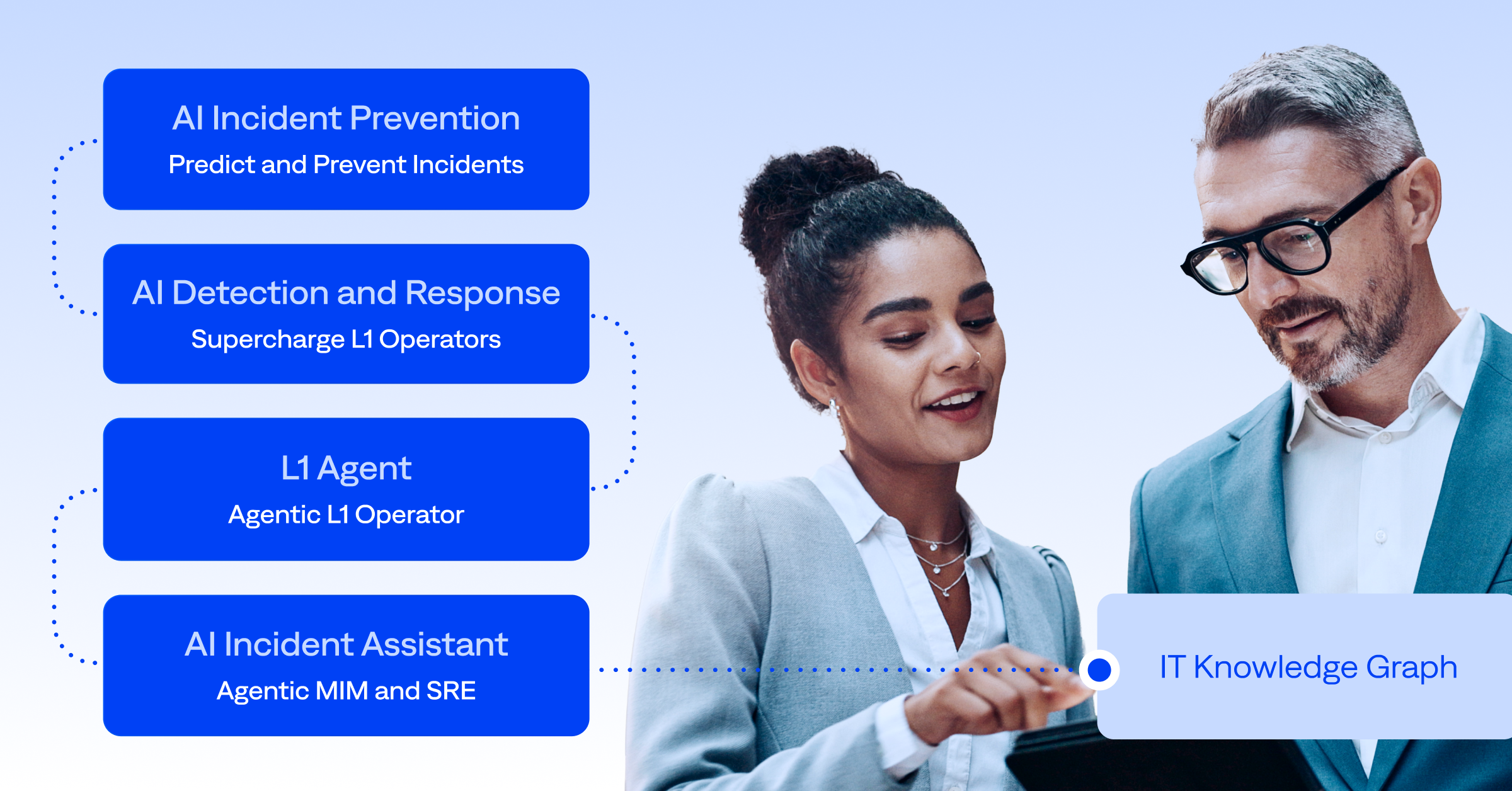
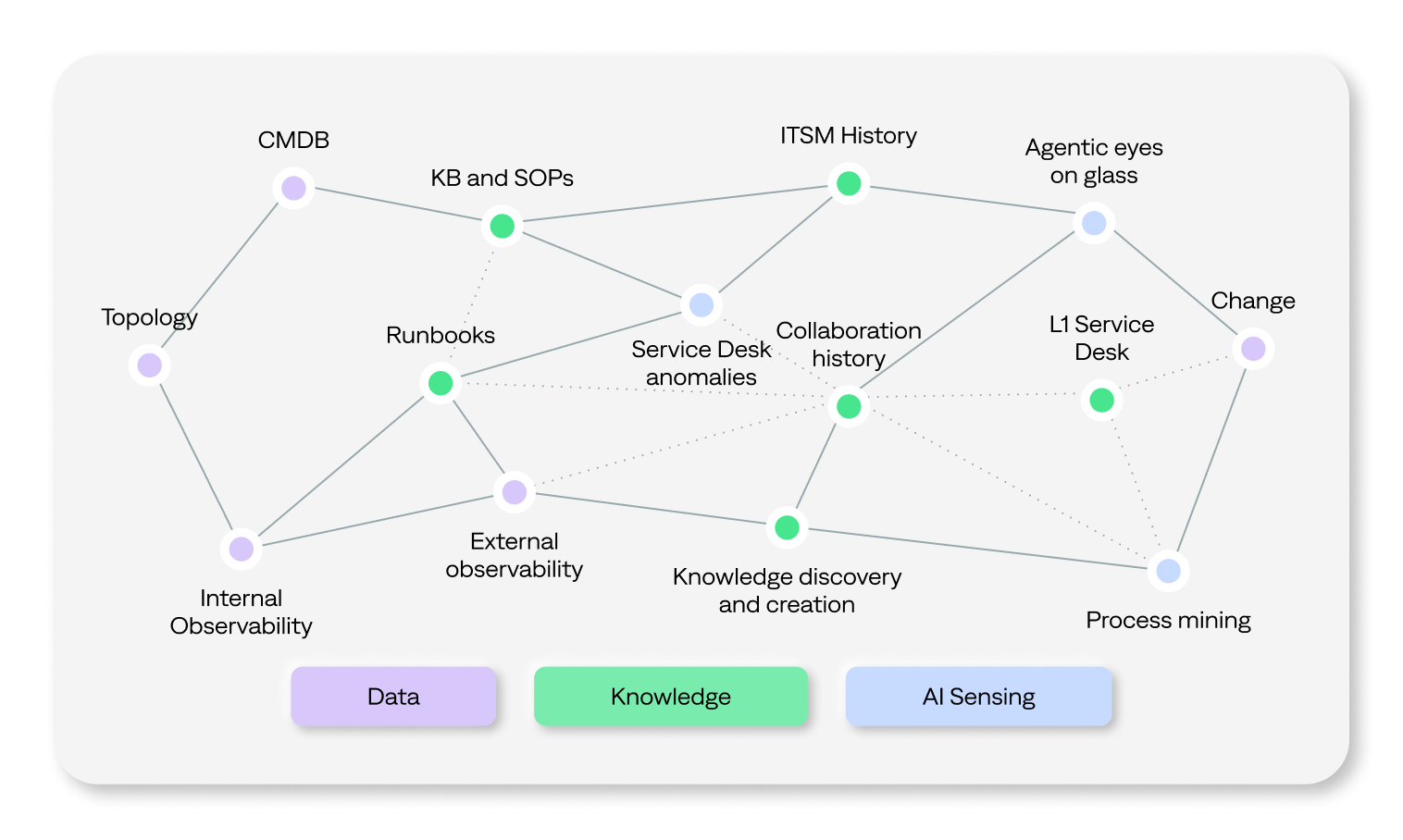
By unifying these diverse data sources, agentic ITOps platforms like BigPanda can build a real-time intelligence engine we call the IT Knowledge Graph. It continuously ingests and connects data previously buried in fragmented systems and silos across the enterprise to build an intelligent, living model of your IT environment.
Designed to enable an AI-first data strategy, the IT Knowledge Graph allows your enterprise to evolve from reactive IT operations to proactive, agentic AI-powered decisions.
To help you get started, BigPanda released our new ebook, Laying the data foundation for agentic ITOps: A strategic guide for enterprise IT leaders. This guide will help enterprise IT leaders prepare their organization for agentic ITOps and lay the groundwork for advanced features like AI Detection and Response, AI Incident Prevention, and AI Incident Assistant.
Get your copy today to learn how your organization can lay the data foundation for agentic AI-powered ITOps that improve mean time to resolution (MTTR), reduce L1 spend, prevent escalations, and improve SLAs and uptime.
Key takeaways from this blog:
- Getting started with agentic ITOps doesn’t require perfect data. Enterprises spent years assuming automation required a perfectly clean CMDB. That mindset stalled adoption, and left the $250 billion problem of manual ITOps workflows unsolved.
- A perfect CMDB was never realistic, and agentic AI doesn’t need one. Despite a 20% year-over-year rise in observability and ITSM spend, end-users still report 65% of incidents. Agentic AI can use unstructured, siloed, and imperfect data to build an intelligent, living model of your IT environment.
- Critical operational context has always lived outside the CMDB. Incident records, change logs, post-mortems, and chat threads hold the tacit knowledge that rules-based automation could never touch. Agentic AI can finally ingest and use it.
- Your enterprise’s messy, unstructured data is an asset, not a blocker. Observability tools, ITSM platforms, historical incident data, and collaboration platforms can all feed agentic ITOps as-is, with no cleanup project required before achieving value.
- A phased rollout beats a rip-and-replace data strategy. Enterprises can sequence adoption around specific goals, accelerating detection and response, reducing change-related incidents, and augmenting IT experts, letting each phase build on the last.
- The IT Knowledge Graph is what turns fragmented data into a living foundation. By continuously connecting siloed systems and data sources, it builds an intelligent model of the IT environment that gets smarter with every incident, powering the shift from reactive operations to proactive, AI-driven decisions.