






Building Reliable IT Infrastructures
Downtime is expensive, and it’s getting harder to avoid. Every year, enterprise IT environments grow more distributed, dynamic, and difficult to maintain with legacy tools and manual processes. With unplanned outages costing enterprises nearly $25,000 per minute, establishing and maintaining a resilient IT infrastructure is essential.
Enterprises have already invested heavily in resilient architecture. They’ve spread workloads across regions, built in redundancy, and moved to scalable cloud infrastructure. However, technology is evolving far faster than the operating model that keeps it available. Applications change in seconds, but rapid application changes still cause delays in failure analysis.
Agentic IT operations offers a solution to rising costs and complexity by using purpose-built AI to detect, diagnose, and resolve incidents at machine speed, bridging the gap between resilient infrastructure and operations.
This article breaks down what IT resilience looks like today, and how BigPanda helps enterprises build IT operations that bounce back faster, protect revenue, and preserve customer trust.
The four pillars of a resilient IT infrastructure
A reliable IT foundation starts with four core characteristics. Each one plays a role in keeping services available when the unexpected happens, and each one creates new operational demands that teams need to manage.

Distributed
Spreading workloads, applications, and data across multiple locations and systems removes central points of failure and reduces the risk that a localized outage becomes a full-blown disruption. The tradeoff? More services, more dependencies, and more places for things to go wrong.

Redundant
Duplicate servers, mirrored databases, and backup network routes keep operations running through hardware and software failures. Redundancy can feel expensive, but at $25,000 per minute of unplanned downtime, it pays for itself quickly.

Scalable
Resilient infrastructure adapts to traffic spikes and business growth without compromising performance or availability. In a cloud-first world, the ability to respond to demand dynamically is often the difference between seamless operations and an outage.

Recoverable
No system is perfect. Failures can and will happen. Recoverable infrastructure bounces back quickly, with backup, disaster recovery, and business continuity plans that minimize downtime and data loss.
Together, these pillars make up the architecture of resilience. But architecture is only half the equation.
Why resilient architecture needs agentic ITOps
There’s a paradox in establishing IT resilience in the modern enterprise. The same distributed, dynamic architecture that protects against failure also makes failures harder to understand. Services depend on other services, teams depend on other teams, and operational data arrives from more sources than any individual can reasonably interpret.
Meanwhile, incident response often relies on manual workflows, which can be time-consuming. Agentic ITOps reduces this burden, helping teams act faster and freeing up valuable time for strategic work.
The numbers show how much this approach costs enterprises. Despite a 20% year-over-year increase in spending on observability and ITSM tools, end users, not system telemetry, still report 65% of all incidents. More monitoring hasn’t translated into more resilience, because observability tools provide raw signals without the context teams need to act on them.
Adding headcount won’t close this gap. Another engineer adds another pair of hands, but doesn’t change the structure of the work. Every minute your most experienced people spend reassembling context is a minute they aren’t spending on the decisions that actually protect the business.
True IT resilience requires adaptable and resilient operations, not just resilient infrastructure, and that means changing how the work gets done.
How agentic ITOps from BigPanda builds IT resilience
Agentic ITOps changes the operating model itself. Instead of requiring human responders to assemble context one conversation at a time, a team of specialized AI agents gathers context across the environment, identifies relevant relationships, reasons over what’s happening, and carries investigations forward. Humans remain in the loop, so they can apply their experience and judgment where it matters most.
“Agentic IT operations is a complete reimagining of the L1 function,” said Jason Walker, Chief Innovation Officer at BigPanda. “Our AI doesn’t just detect, it understands. It acts, and most importantly, it learns from every incident to improve over time.”
Here’s how BigPanda strengthens resilience across every stage of the incident management lifecycle.
Detect incidents before they impact your customers
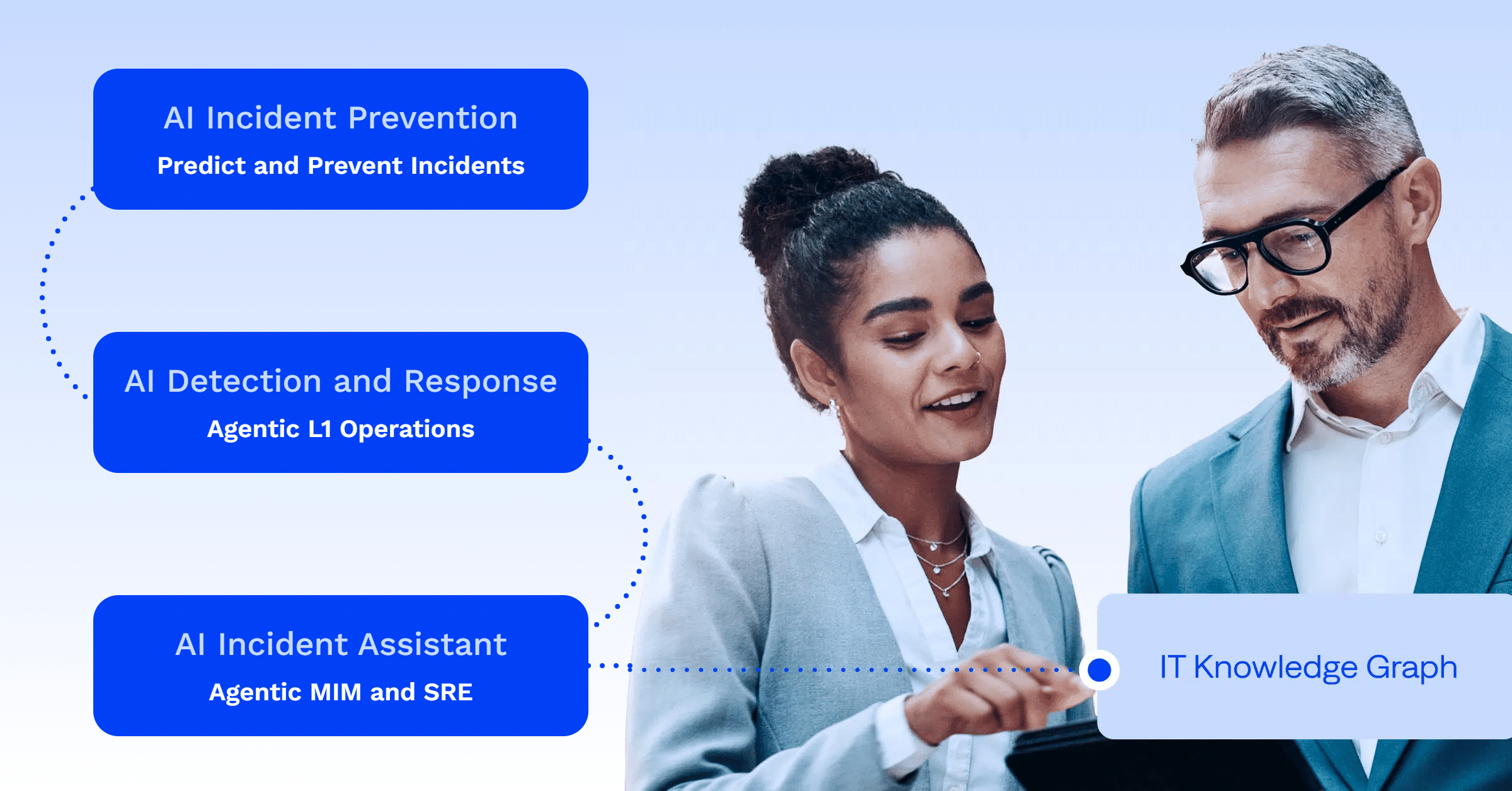
Event management is the first line of defense for IT resilience. BigPanda AI Detection and Response ingests observability, service desk, and external dependency data to give teams a complete, contextualized view of incidents as they unfold. Rather than chasing thousands of disconnected alerts, teams see what’s actually happening in real time, what’s affected, and what matters most. This translates into fewer incidents reported by end users and more issues caught before they become outages.
Prevent incidents before they happen
Changes remain the single biggest driver of IT outages, and BigPanda AI Incident Prevention helps teams flag high-risk changes before they go live by analyzing ticket history, change records, and past incidents. This allows your teams to move from reactive firefighting to proactive risk management, protecting uptime without slowing the pace of innovation.
Automate L1 triage and response
Historically, L1 operations have relied on manual, resource-intensive work such as reviewing alerts, enriching tickets, routing incidents, and escalating issues when in doubt. BigPanda uses purpose-built agentic AI to automate L1 detection and response, handling the repetitive, pattern-based work governed by known procedures. Critical functions are executed consistently and accurately, first-contact resolution improves, and there are fewer expensive escalations.
Give experts the context to resolve incidents faster
When a complex incident hits, context is everything. BigPanda AI Incident Assistant gives incident commanders, SREs, and L2/L3 engineers AI-informed root cause investigation, recommended remedial actions, and comparisons to similar past incidents in seconds. Institutional knowledge that used to live only in someone’s memory becomes available to every responder, reducing bridge calls and helping teams recover services faster.
Continuously enhance IT infrastructure resilience with agentic intelligence
Enterprise IT infrastructure is never static. Architecture, telemetry, and operational processes all evolve, and the platforms you depend on need to evolve with them. Resilience isn’t an end state; it’s a capability you continuously improve.
That’s the role of the BigPanda IT Knowledge Graph. It continuously ingests and connects data previously buried in fragmented systems and silos, including observability tools, ITSM platforms, historical incident records, change logs, and the chat threads and call transcripts that reveal “how we actually fixed it.” The result is an intelligent, living model of your IT environment that powers every agent on the platform.
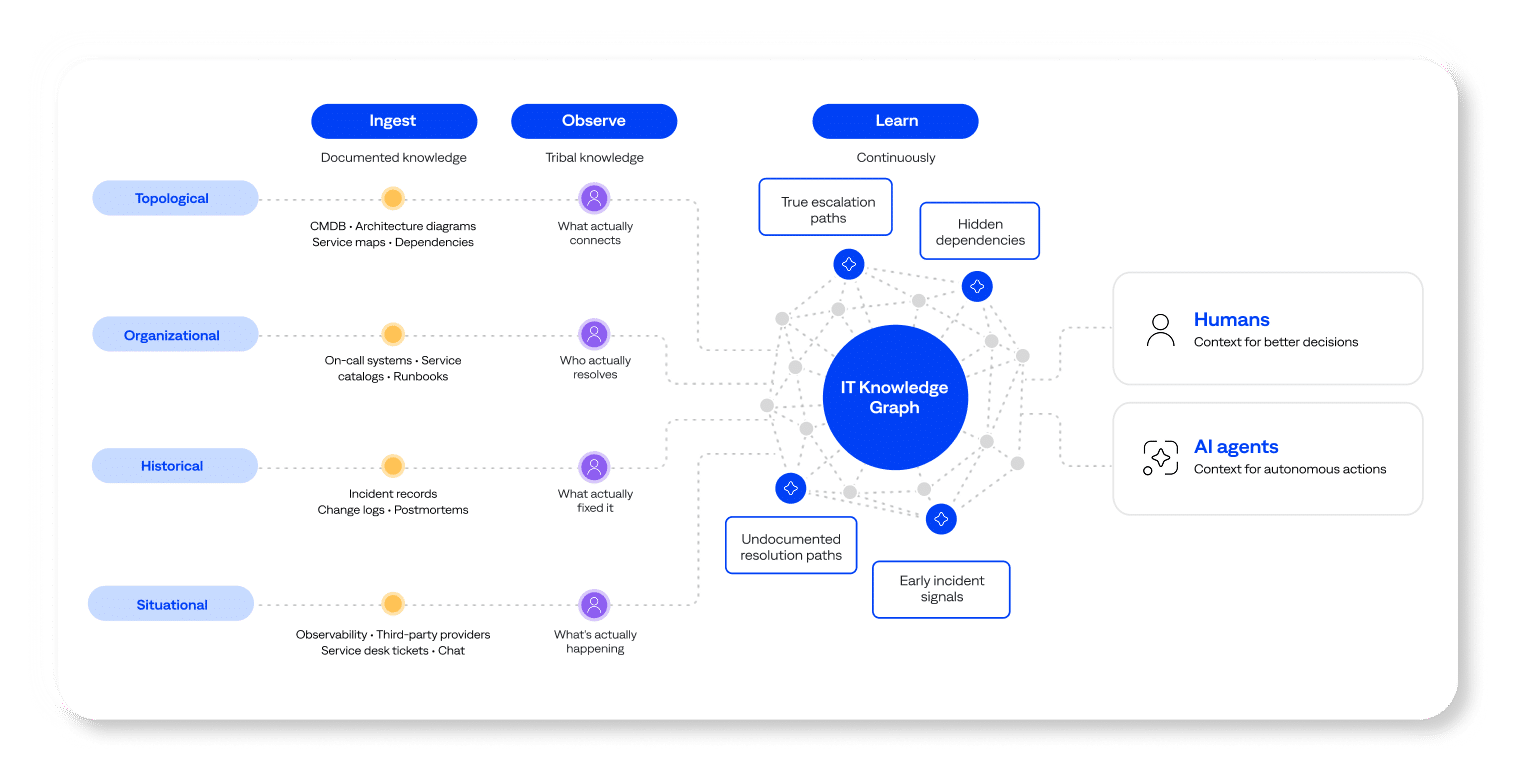
Every incident BigPanda touches strengthens that knowledge layer. AI observes patterns, infers relationships, and fills in gaps through daily operations, so data quality becomes an output of agentic ITOps rather than a prerequisite. Your CMDB becomes one input among many, rather than the single source of truth that everything else depends on.
Combined with Unified Analytics, teams also get the empirical data they need to make objective infrastructure decisions, spot recurring problems, and identify where automation can free up valuable time. The longer you run agentic ITOps, the more resilient your operations become.
How enterprises can prepare for agentic ITOps
The good news is that you don’t need perfect conditions to get started. There’s no multi-year data cleanup project standing in your way, because agentic AI is designed to work with messy, incomplete, and scattered data, and to get smarter through daily use. The enterprises moving fastest with agentic ITOps take a phased approach tied to specific resilience goals, such as accelerating detection and response, reducing change-related incidents, and augmenting their experts with AI assistance. Our ebook, Laying the data foundation for agentic ITOps: A strategic guide for enterprise IT leaders, walks through exactly how to build that foundation.
Want to see agentic ITOps from BigPanda in action? Come meet the team at Gartner IT Infrastructure, Operations & Cloud Strategies Conference (IOCS) North America 2026, from December 8–10 in Las Vegas, NV. Stop by to learn how enterprises are using agentic ITOps to improve MTTR, reduce L1 and MSP spend, prevent escalations, and build resilient IT operations.
Key takeaways from this blog
- Resilient infrastructure starts with four pillars. Distributed, redundant, scalable, and recoverable architecture protects against failure, but it also adds complexity that manual operations struggle to manage.
- Observability alone doesn’t guarantee resilience. Despite a 20% year-over-year rise in observability and ITSM spend, end users still report 65% of incidents. The operating model hasn’t kept pace with the technology.
- Agentic ITOps changes how the work gets done. Specialized AI agents assemble context, reason over incidents, and carry investigations forward, so people can focus their judgment where it matters most.
- BigPanda strengthens resilience across the incident lifecycle. AI Detection and Response, AI Incident Assistant, and AI Incident Prevention help teams detect incidents earlier, automate L1 work, resolve issues faster, and prevent change-related outages.
- Resilience improves with every incident. The IT Knowledge Graph continuously connects fragmented data into a living model of your environment that gets smarter through daily operations.