






The 5 Moments of a major IT incident: Where agentic AI fits in the incident lifecycle


When IT leaders consider bringing AI agents into major incident management, the question we hear most often is “can we trust AI with a Sev1?”
It’s a reasonable question, but its framing lacks nuance and context. A major incident isn’t a single monolithic task that you hand to AI or withhold from it. It’s a sequence of distinct moments, from detecting the problem, assembling the responders, investigating the cause, communicating with stakeholders, and capturing what was learned. Each moment carries its own risk profile, its own time sinks, and its own opportunity for AI to accelerate and improve the process.
That reframing has a significant impact on ensuring the success of your Agentic ITOps program. In the last article in this series, we made the case that scope is the first of four decisions every IT leader must make before deploying Agentic ITOps, and that scope should follow data confidence. This post goes one level deeper by giving you a walkthrough of the five moments of a major incident, where AI agents add value in each, and which moments your pilot should start with.
Choosing where AI operates in major incident management isn’t about picking low-severity incidents. It’s about picking low-risk moments within your highest-severity incidents. For example, automatically and instantly summarizing what changed before the bridge call convenes is safe work that carries enormous value when the incident is a Sev1 burning thousands of dollars a minute. Pushing a configuration change to production is not.
Let’s walk through the five moments in order.

Moment 1: Detection
When a major incident kicks off, monitoring tools fire dozens or hundreds of alerts, service desk tickets start trickling in, and somewhere in that noise is the signal that a critical service is failing. The traditional process relies on humans to manually uncover the pattern, which is why detection so often lags. In fact, end users still report 65% of all incidents before monitoring catches them. When your customers serve as your detection layer, you’ve already lost critical response time and customer trust.
This is where AI agents earn their first job: correlating the flood of alerts. AI-driven detection compresses alerts from observability tools, service desk activity, and external dependencies into a single, clearly described incident with situational awareness attached. With this context, responders can instantly understand what’s affected, how widely, and how it maps to business services. Instead of twelve teams investigating twelve alert storms, there is one incident that paints a clear picture of the total impact to your IT environment.
AI also sharpens the hardest judgment call in this moment: whether to declare or not. Declaring a major incident is expensive, as it wakes people up, spins up the process, and puts leadership on alert, but declaring late is worse. An AI agent can instantly compare the current pattern against your incident history, giving the on-call leader something no runbook provides: evidence. For example, the agent can tell the on-call leader that the last three times this signature appeared, it became a Sev1 within forty minutes.
Where it starts on the autonomy ladder: Correlation and summarization can run at high autonomy almost immediately. A mis-grouped alert costs little and gets caught early, and the declaration call itself stays human, with AI advising.
The metrics to measure success with: Mean time to detect (MTTD), and the share of major incidents your monitoring caught before your users did.

Moment 2: Assembly
Once an incident is declared, the race begins to engage the right people. The traditional method is a mix of paging by on-call rotation and educated guessing, and because nobody knows for certain which team has the answers, the safe move is to page every team that might. That’s how a Sev1 bridge ends up with dozens of responders, most of whom spend the call waiting to find out whether they’re needed. Every one of them represents interrupted work, a degraded on-call experience, and significant operational costs.
AI agents change the assembly calculus because they can reason about information that no rotation schedule contains, such as who owns the failing service today, who resolved the last three similar incidents, and which adjacent teams were involved when a similar incident occurred last time. Instead of paging broadly and hoping for the best, an AI incident assistant automatically identifies the specific experts the incident requires and pulls them in with context already attached, so they arrive knowing why they were paged and what’s known so far.
A smaller bridge isn’t just cheaper; it’s faster. Fewer people on the call means less time spent on roll call, fewer status recaps for late joiners, and an incident commander who can focus on decisions that get your services back online faster.
Where it starts on the autonomy ladder: Supervised. The assistant suggests who to page, and a human approves. As paging accuracy proves out, assembly graduates to running on its own with after-the-fact review.
The metrics to measure success with: Time-to-assemble (first page to right experts engaged) and responders per major incident. If your AI agents are doing their job correctly, both of these numbers should fall over time.

Moment 3: Investigation and remediation
Here’s where the most expensive minutes of a major incident have traditionally been spent hunting for answers. What changed last night? Which of these forty alerts is the cause and which are symptoms? Have we seen this before, and what fixed it? The answers exist, but they’re scattered across observability consoles, change records, old tickets, and the memory of senior engineers. Rather than focus on repairing, responders are forced to tool-hop and reconstruct while the outage clock runs.
AI agents dramatically accelerate investigation. They can scan recent changes, correlate them with the failure, translate raw telemetry into plain language, and retrieve similar past incidents and their resolutions. And with BigPanda Swarm Investigation, multiple agents pursue multiple hypotheses in parallel to collect evidence across systems, reason over it, and send each other back out with follow-up queries. They operate like a war room, only at machine speed. Responders stop pivoting between consoles and can simply ask the assistant questions in natural language.
We’ve seen what this looks like under real-world conditions. A Fortune 500 global hospitality enterprise was two hours into a major incident when the team handed the investigation to the assistant’s agent swarm. The root cause surfaced in roughly fifteen minutes.
Remediation, or actually executing the fix, sits at the far end of the trust spectrum, and it should. Keep remediation gated by incident type and approval, and start with low-risk, reversible actions for lower-severity incidents. As we covered in The four decisions every IT leader must make before deploying Agentic IT Operations, any vendor promising fully autonomous remediation of critical incidents within a month has handed you a red flag, not a roadmap.
Where it starts on the autonomy ladder: Investigation runs at high autonomy early, where a wrong hypothesis is visible and cheap, and responders remain the decision-makers. Remediation starts at the bottom rung and climbs slowly, with human approval before anything touches production.
The metrics to measure success with: You should measure investigation duration, from declaration to identified probable cause, segmented by AI-assisted versus not.

Moment 4: Communication
During a major incident, the people fixing the problem and the people demanding updates are locked in a quiet competition for the same precious minutes. Executives, account teams, and business stakeholders have a legitimate need to know what’s happening. However, in the traditional model, every status update is drafted by hand, usually by the engineers closest to the fix, because they’re the only ones who know enough to write it. With major outages costing enterprises up to $25,000 per minute, pulling your best responders into reporting duty is an expensive and wasteful way to produce an email.
AI agents can save significant time during this phase because the assistant already has the incident’s live state. Your agents know what’s impacted, what’s been tried, what’s in progress, and can draft stakeholder updates continuously and distribute them on a cadence tuned to each audience. Leadership gets the business impact view, while technical teams get the details. Critically, this runs on workflows that encode your existing communication, escalation, and approval protocols by incident type, with the AI adapting to how your organization already communicates, not the other way around.
Updates begin as drafts that a human approves before sending. As the approval-without-edit rate climbs, defined audiences and templates graduate to auto-send. Trust is earned one update at a time, and you can watch it happen in the data that you track.
Where it starts on the autonomy ladder: Drafted with human send approval, promoted to auto-send per audience and template, as long as accuracy and tone hold.
The metrics to measure success with: Time-to-first-stakeholder-update, and the approval-without-edit rate on AI-drafted communications. This is one of the clearest trust signals your program will produce.
Moment 5: Learning
Once an incident is resolved and service is restored, the most commonly skipped moment of the IT incident lifecycle begins. The post-mortem that should capture what happened and why sits in a backlog for weeks, while the bridge recording nobody will replay gets archived. As a result, the hard-won knowledge of how an incident was actually solved lives on only in the heads of the responders who solved it, until they change teams or companies, and then it’s gone.
This is the moment where AI agents deliver perhaps their least glamorous and most compounding value. Because the assistant was present for the entire incident, it can generate the post-mortem and executive summary at resolution, while the details are fresh. The review happens after the pressure is off, with no three-week backlog or reconstruction from memory.
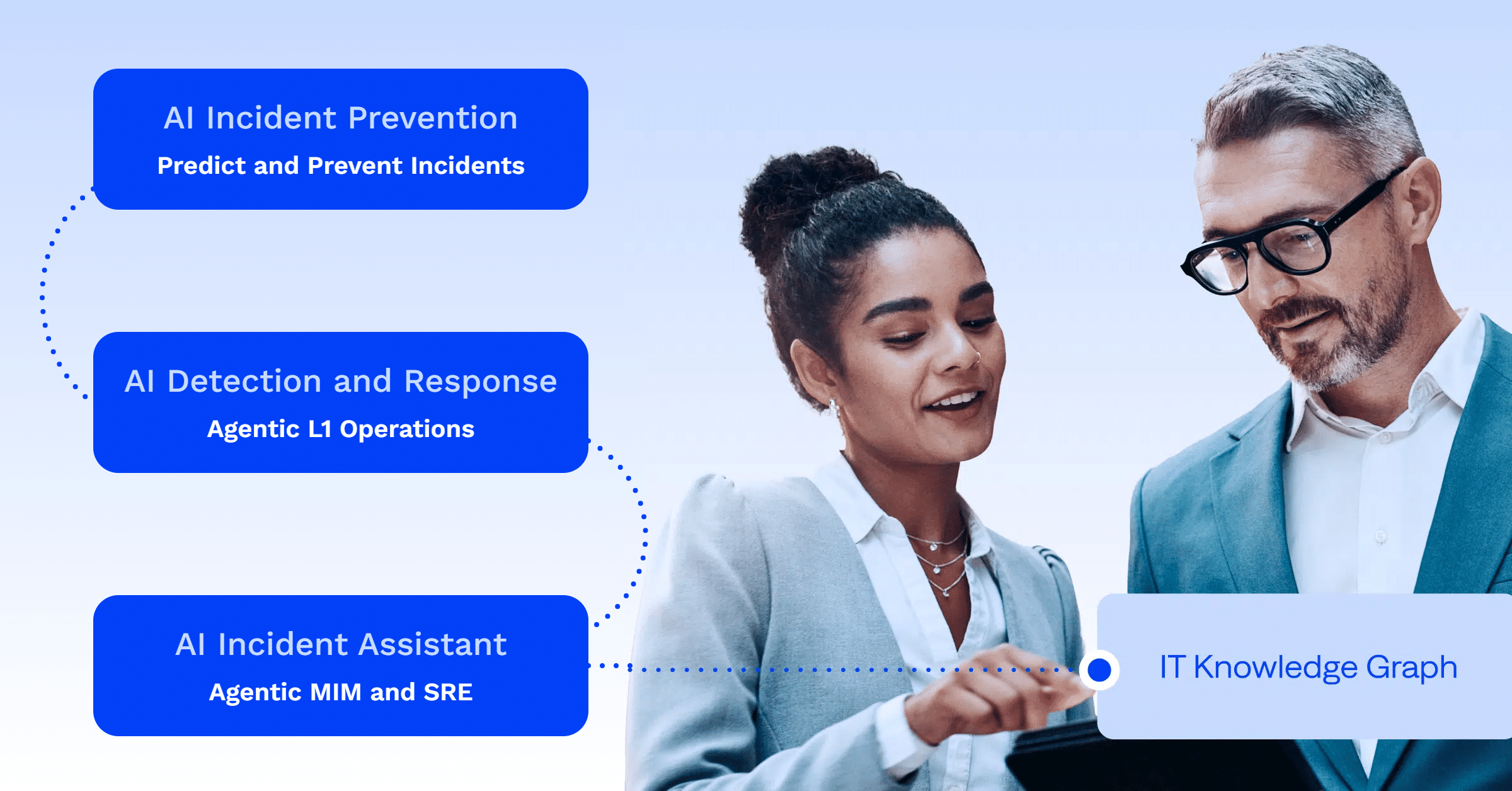
More importantly, what’s learned doesn’t stop at a document. Contributing factors, ownership corrections, and resolution steps flow back into the BigPanda IT Knowledge Graph, which creates a living intelligence layer that powers every other moment in this lifecycle.

That’s the flywheel: the learning moment feeds detection (this signature now has history), assembly (these experts solved it), investigation (this fix worked), and communication (this is how we described it). This helps ensure that lessons from every major incident are applied to resolve the next one faster. And the verification tax that stalls most AI programs shrinks because context learned from live operations doesn’t need humans to constantly re-verify it.
Where it starts on the autonomy ladder: This is the earliest full-autonomy win in the lifecycle. Documentation generated at resolution carries essentially no operational risk, as humans review the output after the incident rather than during it.
The metrics to measure success with: Track post-mortem completion time, and over the longer arc, your repeat-incident rate. This is the clearest evidence that your organization is learning from incidents, not just resolving them.
How to introduce agentic AI into your IT incident management processes
Five moments, five different risk profiles — so where do you begin? Two principles from our Four Decisions framework answer that question.
First, scope follows data confidence. AI reasons well where your knowledge foundation is dense: services with validated topology, rich incident history, and change data connected to incident response. Before scoping any moment in, run a quick self-check:
- Can you trace an alert to a service, and that service to business impact?
- Does your change data connect to incident response?
- Can responders search past post-mortems during an incident, not just after?
- Do you know your true bridge-call cost?
A “no” doesn’t disqualify you — it identifies your first data project, and it will be far smaller than a CMDB overhaul.
Second, knowledge work climbs before actions do. Across the five moments, the safest early wins share a trait: when the AI is wrong, a human notices immediately and nothing breaks. That points to a consistent starting order. Context and summarization, which are at the heart of detection and investigation, operate with a high degree of autonomy from the first week. Coordination and assembly are supervised and earn their way up, while communication graduates from drafts to auto-send as the approval data accumulates. Documentation is an early win for full autonomy, while remediation remains gated and deliberate.
Notice what that sequence delivers: by the time your organization faces the genuinely hard autonomy questions, your teams have seen the assistant be right across hundreds of lower-stakes interactions. The trust conversation becomes much easier, because you have evidence gleaned from hundreds of interactions.
How Agentic ITOps transforms the IT incident management cycle
It’s tempting to read the five moments as a menu. In practice, they’re a loop. Detection sets up assembly, assembly feeds investigation, investigation powers communication, and learning strengthens all four for the next incident. An AI agent that participates across the full lifecycle compounds in a way that point solutions never will — because the knowledge captured in moment five is precisely what makes moments one through four sharper next time.
That’s also why the scope decision deserves real leadership attention rather than a default. Where you let AI reason first determines where the evidence accumulates, where trust gets earned, and how quickly the flywheel starts turning.
We’ve mapped all of it — the five moments, the autonomy ladder with promotion criteria and circuit breakers, the metrics that prove it’s working, and a phase-by-phase plan for your first 90 days — in The Four Decisions: A 90-Day Leadership Playbook for Agentic ITOps. If your organization is weighing where AI agents belong in your incident process, it’s the operating manual for getting from that question to a running program.
The question was never whether AI belongs in your war room. It’s which moment it should own first — and now you have the map.
Key takeaways from this blog:
- Scope AI by moment, not by severity. A major incident spans five distinct moments — detection, assembly, investigation and remediation, communication, and learning — and several of them are low-risk, high-value AI territory even at Sev1. The lifecycle view lets you say yes to safe moments without saying yes to risky ones.
- Detection and investigation are where AI reasons first. Correlating the alert flood into one clear incident and running parallel, machine-speed investigation are high-autonomy work from early on — a wrong suggestion is cheap, visible, and immediately corrected by responders who remain the decision-makers.
- Assembly and communication are where trust gets built. Precision paging shrinks the bridge, and AI-drafted stakeholder updates graduate from human-approved to auto-send as the approval-without-edit rate climbs — trust earned one interaction at a time, visible in the data.
- Learning is the flywheel. Post-mortems generated at resolution and findings fed back into the knowledge foundation make every subsequent incident shorter — and shrink the verification tax that stalls most AI agent programs.
- Remediation climbs last. Keep fix execution gated behind approvals by incident type, starting with low-risk, reversible actions on lower severities. Autonomous remediation on critical incidents in month one is a red flag, not a differentiator.