






E-BOOK
Laying the Data Foundation for Agentic ITOps:
A Strategic Guide for Enterprise IT Leaders
Reduce incident volume and duration with agentic ITOps.

1
IT Operations has hit a turning point with agentic AI
2
How agentic ITOps delivers the promised value of AIOps
3
Lay the data foundation for agentic ITOps with an incremental approach to revising your data strategy
3.1
Operational goal: Accelerate incident detection and response
3.2
Operational goal: Reduce the volume and risk of change-related incidents
3.3
Operational goal: Augment your IT experts with AI assistance
4
Agentic AI is the future of ITOps, and BigPanda powers that future
IT Operations has hit a turning point with agentic AI

“The tasks of IT incident management are still burdensome, complex, and manual. Processes like collecting and correlating data are difficult and time-consuming, especially if you have to do them manually.”

Hybrid cloud infrastructures and modern software development practices such as continuous integration/continuous delivery (CI/CD), microservices, and agile methodologies revolutionized enterprise IT. These innovations power the modern world, but they introduced unprecedented challenges in scale, fragmentation, and operational complexity.
To manage this complexity, enterprises invested billions into observability tools, IT Service Management (ITSM) platforms, and L1 operations teams. However, incident detection remains poor despite a 20% year-over-year increase in spending on observability and IT Service Management (ITSM) platforms.
End-users, rather than system telemetry, still report 65% of all incidents. Enterprises continue to rely on human-driven workflows to manage these systems, and responders must manually interpret data to diagnose issues and take action. This results in slow, reactive incident response and spiraling headcount, observability, and ITSM costs to sustain cumbersome ITOps workflows.
Legacy tools and processes designed for monolithic systems and static infrastructures cannot meet these challenges. Enterprise ITOps requires a more agile and intelligent approach that leverages advances in AI and automation to remain scalable, effective, and sustainable.
Agentic ITOps offers a path forward by transforming manual and reactive ITOps processes into intelligent, autonomous systems. These systems can adapt to changing environments, learn from experience, and collaborate with humans to detect, respond to, and prevent incidents at machine speed. With intelligent, automated workflows, enterprises can achieve faster mean time to resolution (MTTR), reduced L1 spend, fewer escalations, and improved SLAs and uptime.
Taking advantage of these advancements requires a fundamental shift in how enterprises approach their IT data strategy. This approach requires moving beyond static configuration management databases (CMDBs) and embracing AI-powered insights from diverse data and knowledge sources. Critically, agentic AI doesn’t require highly structured inputs to function, and can transform messy, scattered inputs into adaptive intelligence.
“We’ve reached peak frustration with getting your ITOps or ITSM teams all the fragmented, siloed CIs into a CMDB,” said Jason Walker, Chief Innovation Officer at BigPanda. “Agentic AI can ingest and index all the valuable, unstructured data from your organization and convert it into data that can be leveraged to improve your operations.”
This ebook is a strategic guide to help enterprises understand the capabilities and lay the data foundation to deploy and see rapid value from agentic ITOps.
“The tasks of IT incident management are still burdensome, complex, and manual. Processes like collecting and correlating data are difficult and time-consuming, especially if you have to do them manually.”
How agentic ITOps delivers the promised value of AIOps

“Centralizing our operations with BigPanda allowed us to have a much earlier MTTD (mean time to detection), which gave us a head start to resolve operational incidents.”

Agentic ITOps represents significant advancements over traditional artificial intelligence for IT Operations (AIOps) by incorporating autonomous decision-making and action. Advances in agentic AI can transform ITOps and IT service management (ITSM), delivering orders-of-magnitude improvements in efficiency and capability. By harnessing these advancements, enterprises can reduce costs and risks and accelerate growth.
AIOps platforms, which Gartner refers to as event intelligence solutions (EISs), apply artificial intelligence (AI) and machine learning (ML) to IT operations to streamline and optimize IT processes. The primary outcomes of traditional AIOps are noise reduction, improved alert and event correlation, accelerated root cause analysis, and improved incident workflows.
AIOps relies on structured data housed in a CMDB and processed through rule-based systems. This makes it challenging to keep up with tech stack visibility while maintaining an accurate CMDB. CMDBs also omit most of your organization’s institutional knowledge. Vital information and operational knowledge, such as team expertise, unstructured tickets, and chat logs, remain buried and unusable. This lack of information leaves your responders without the actionable context to detect, triage, and respond to IT incidents quickly and effectively.
“A CMDB was sold as an inventory and up-to-date map of the entire universe of your services and components, and it almost always falls short of that,” said Walker. “Now you can take in information from all sources and convert it into usable data that an agentic AI assistant can incorporate into its assistance with day-to-day operations.”
Agentic ITOps significantly expands AIOps capabilities by eliminating the need for structured data and rules. This opens the floodgates to various unstructured data sources that can provide unprecedented understanding and visibility. Agentic ITOps creates autonomous systems that can make decisions and perform tasks without constant human intervention. These systems, also known as AI agents, can adapt to changing environments, learn from experience, and collaborate with humans to detect, respond to, and prevent incidents at machine speed.
“Centralizing our operations with BigPanda allowed us to have a much earlier MTTD (mean time to detection), which gave us a head start to resolve operational incidents.”
These AI agents can do more than analyze data. They can automatically detect potential issues, rapidly diagnose them, assess impact, prioritize accordingly, trigger automated fixes or suggest next steps, and even predict and prevent IT incidents.

Agentic ITOps marks a shift towards delivering on the promise of AI-powered, proactive IT operations. Your teams can automatically detect potential issues, rapidly diagnose them, assess impact, prioritize accordingly, and trigger automated fixes or suggest next steps.
In short, agentic ITOps transforms AI from a tool to improve efficiency into an autonomous digital operator that allows your organization to reduce costs, limit risk, and accelerate growth. The following table shows that agentic ITOps offers several critical capabilities improvements over traditional AIOps.

Lay the data foundation for agentic ITOps with an incremental approach to revising your data strategy

“There are $200 billion worth of manual ITOps workflows ripe for intelligent automation. With agentic ITOps, we’re helping enterprises move beyond manual, slow incident management toward intelligent systems that free up talent and reduce operating costs.”

You might be worried that implementing an AI-first data strategy will be too difficult, or that your enterprise isn’t ready to deploy agentic ITOps. You can get started right away with agentic ITOps using your existing data. In fact, one of the key capabilities that agentic AI offers enterprise IT is the ability to aggregate, analyze, and correlate data from previously diverse and unstructured data sources. There is no need to clean your data first; agentic AI is designed to work with and handle messy, incomplete data, regardless of its state.
Agentic ITOps allows enterprises to harness a broad, differentiated dataset that unlocks the vital information buried in chat histories, call transcripts, ITSM logs, manual workflows, and more. The key to success is identifying and adopting a phased implementation approach that will allow your organization to progressively expand its agentic capabilities while reducing adoption friction.

“There are $200 billion worth of manual ITOps workflows ripe for intelligent automation. With agentic ITOps, we’re helping enterprises move beyond manual, slow incident management toward intelligent systems that free up talent and reduce operating costs.”
By unifying these diverse data sources, agentic IT operations platforms like BigPanda can build a continuously evolving knowledge base that powers end-to-end operational visibility, predictive insights, and intelligent automation capabilities.
We call this real-time intelligence engine the BigPanda IT Knowledge Graph. Designed to enable an AI-first data strategy, the IT Knowledge Graph continuously ingests and connects data that lies buried in fragmented systems and silos across large enterprises. This data is used to build an intelligent model of your IT environment, enabling your enterprise to evolve from reactive IT operations to proactive, AI-powered, agentic decisions.
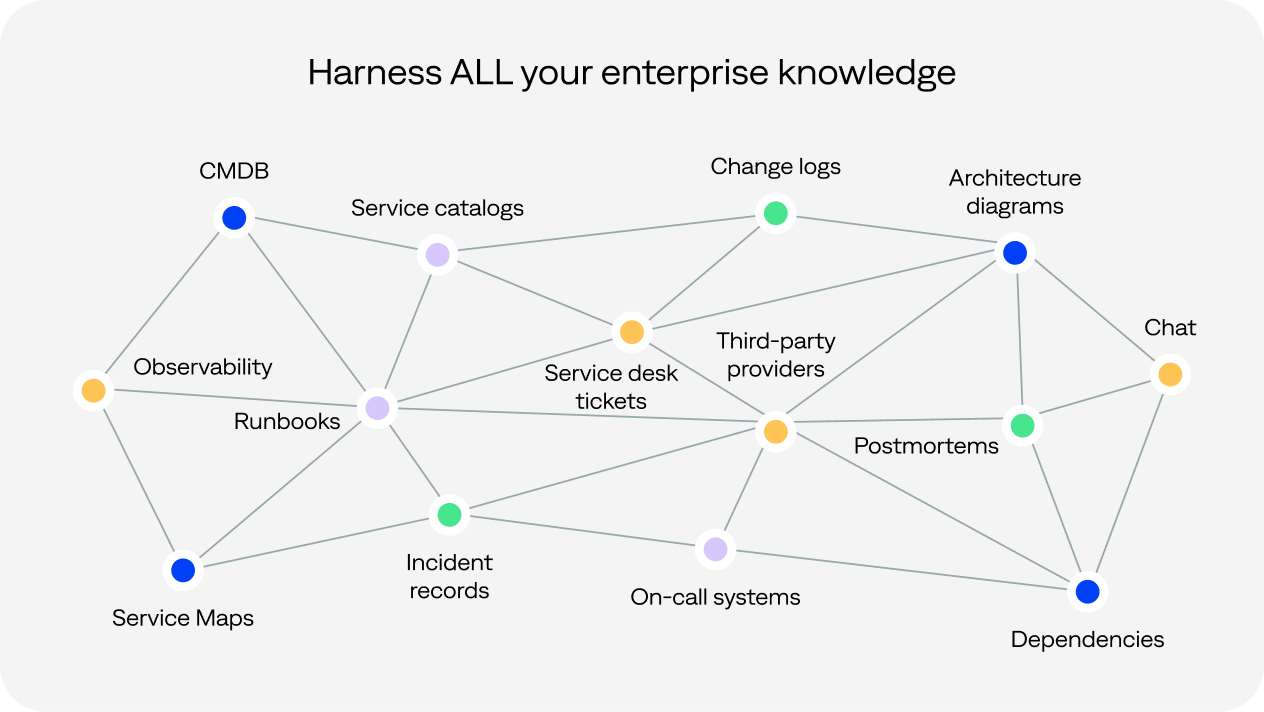
The IT Knowledge Graph mirrors how real-world teams operate. As new signals, incidents, and human feedback emerge, the IT Knowledge Graph adapts to changing conditions, bridging gaps between tools, teams, and knowledge. This unified intelligence gives AI agents and IT teams the confidence to predict, prevent, and agentically automate incident workflows, and evolve to meet changing business and technology requirements.
The IT Knowledge Graph is at the core of the BigPanda platform. It is a real-time intelligence engine that is purpose-built to enable an AI-first data strategy, forming the basis for agentic IT operations. Let’s explore how different data types are utilized to address strategic IT operations challenges, unlock value in phases, and reduce adoption friction.
There are three main entry points to agentic IT operations, each based on your organization’s specific requirements and goals.
Operational goal: Accelerate incident detection and response
Every incident starts as an alert, and it’s the L1 network operations center (NOC) teams’ job to monitor all alerts across the IT stack. However, in reality, L1s only see a fraction of the alerts firing in their enterprise. This is because they often rely on service and application owners to manually forward their alerts. This results in a patchy and delayed picture of what’s happening. And when alerts do flow in, teams are frequently overwhelmed by volume. NOCs often deal with a flood of alerts, many of which are false positives or low-priority notifications, and many lack the critical ‘know-how’ they need to take the next steps. Sorting through the noise to find critical alerts and digging for context takes time and delays response.
BigPanda AI Detection and Response changes the game by using real-time signals and automation to detect, diagnose, triage, and resolve issues quickly. It autonomously collects, correlates, and enriches alerts across silos—without waiting for human handoffs. Instead of seeing isolated symptoms, teams gain a complete, contextualized view of incidents as they unfold. This added visibility helps L1 teams detect issues earlier, understand their root cause faster, and route them intelligently. The result? Faster detection and triage, fewer escalations, and accelerated mean time to resolution (MTTR).

AI Detection and Response achieves this by using AI-driven correlation across observability, service desk activity, and external service provider dependencies. You can learn more about the capabilities that are unlocked by adding more data sources in the table below. By ingesting observability, CMDB, and ITSM data, your organization can improve first-contact resolution, eliminate manual and duplicate L1 workflows, and prevent disruptive escalations.
Phased data strategy for BigPanda AI Detection and Response

Operational goal: Reduce the volume and risk of change-related incidents
Change-related incidents can feel like an endless cycle for change managers, release managers, and ITSM leaders. High volumes of change requests, no clear way to systematically analyze risk, costly rollbacks, and constant firefighting after the fact strain resources and exhaust teams.
Changes are still the most significant contributor to IT outages. One global enterprise processes over 30,000 changes per month, supported by more than 10 Change Advisory Board (CAB) meetings per week, and still sees 15–20% of major incidents caused by changes. Even more telling: 60% of those incidents are linked to changes previously assessed as “low risk.”
The problem isn’t just the volume of changes. Manual processes and a lack of critical context make it difficult to assess risk and make informed decisions accurately.

BigPanda AI Incident Prevention offers a way to break this cycle. By simply ingesting ITSM data—such as ticket history, change records, and CMDB—into BigPanda, teams can automatically analyze the relationship between changes and incidents, and prevent incidents from happening.
ITSM data contains information, such as affected CIs, team owners, and past impact, allowing AI Incident Prevention to quickly identify patterns and flag high-risk changes before they go live. This unified, AI-driven approach means you don’t have to build complex data integrations across dozens of tools to see results. You can quickly start reducing incident volume, improving stability, and freeing up resources for strategic initiatives—turning change management from reactive damage control into proactive, risk-aware decision-making.
Phased data strategy for BigPanda AI Incident Prevention

Operational goal: Augment your IT experts with AI assistance
Incident commanders, L2 and L3 engineers, Site Reliability Engineers (SREs), and service owners face a triple threat to effective incident response. Poor collaboration between stakeholders, missed handoffs that delay resolution, and a lack of access to critical information buried across siloed systems and teams.

The BigPanda AI Incident Assistant is a real-time AI partner to help these teams overcome these challenges and investigate and resolve incidents faster. It surfaces hidden institutional knowledge across siloed teams, tools, and systems to quickly uncover what’s happening, why, and how to fix it. Teams can now reduce reliance on long bridge calls, eliminate unnecessary escalations, and generate lasting institutional knowledge from untapped sources like conversations, tickets, and chat threads.
Getting started is fast—enterprises only need access to ITSM, on-call data, and chat tools connections. By integrating directly with Slack and Microsoft Teams, AI Incident Assistant centralizes collaboration and ensures nothing gets lost in side conversations or forgotten after the fact. It also learns from past incidents, automatically surfacing relevant history, context, and recommended next steps. Within days (or as soon as your next major incident occurs), teams can improve collaboration, accelerate resolution, and transform major incident management from reactive scrambling to proactive, orchestrated action.
Phased data strategy for BigPanda AI Incident Assistant
The phased data strategy for the BigPanda AI Incident Assistant.
Agentic AI is the future of ITOps, and BigPanda powers that future

“By delivering scalable, enterprise-ready AI that integrates seamlessly into existing environments, BigPanda enables a fundamental shift in how organizations manage IT operations towards greater confidence, control, and agility.”

The BigPanda Agentic ITOps platform transforms how enterprises detect, respond to, and prevent incidents. Agentic ITOps represents a new paradigm, where technology works alongside humans to scale IT capacity to meet the speed, complexity, and demands of modern enterprise IT environments.
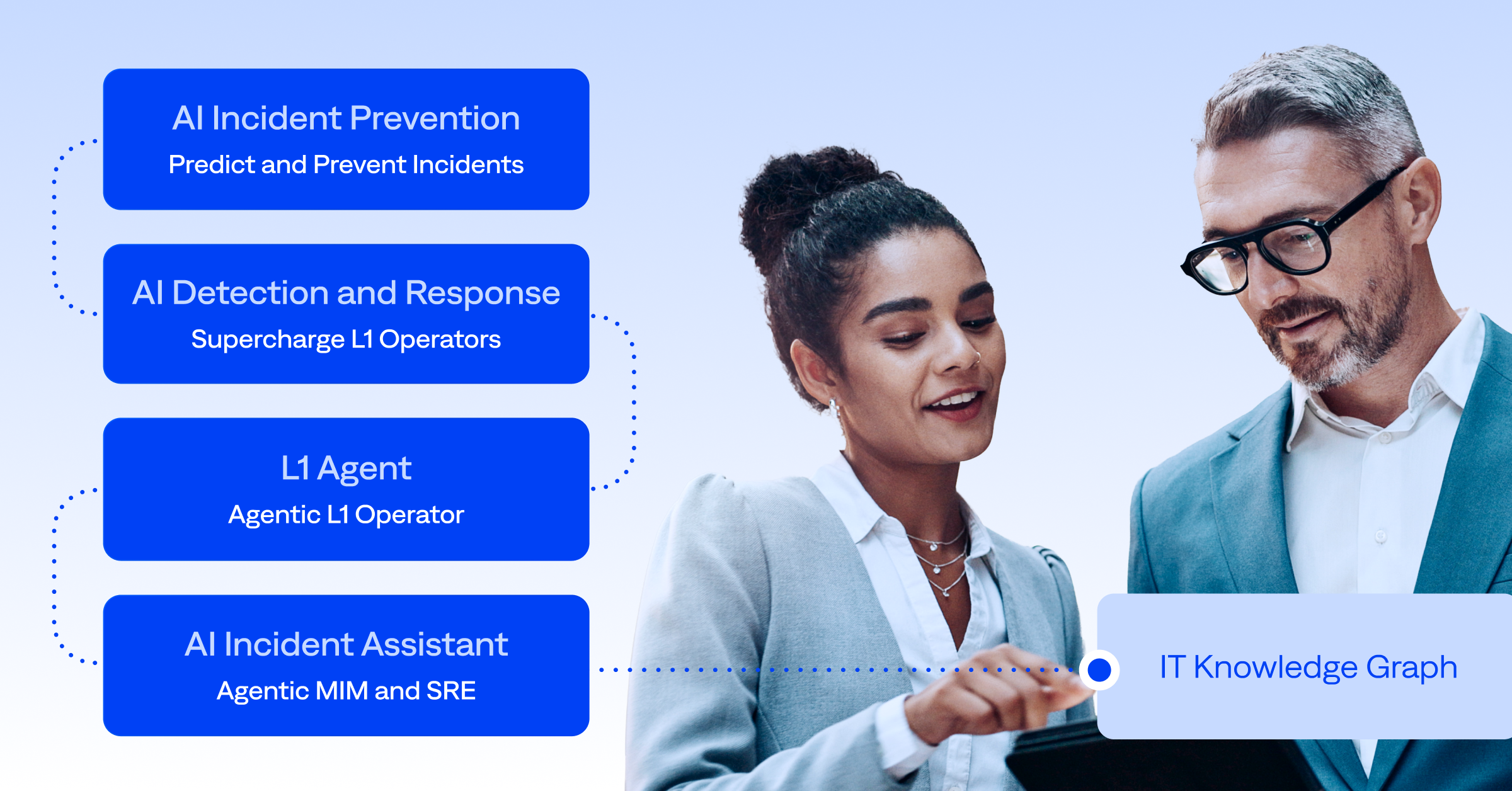
AI Detection and Response, AI Incident Prevention, and AI Incident Assistant from BigPanda allow enterprises to respond to and prevent IT incidents at machine speed, improving operational efficiency and delivering exceptional service reliability.
Your enterprise can start unlocking these capabilities today with a progressive, phased approach to an AI-first data strategy that unlocks value in phases and reduces adoption friction. Once you implement AI Detection and Response, you can continue to add data sources from various networks, applications, services, and business teams into the IT Knowledge Graph. This implementation unlocks the capabilities offered by AI Incident Prevention and AI Incident Assistant.
The more information the IT Knowledge Graph has access to, the more accurate and relevant the outcomes will be. Schedule a personalized demo to learn how your enterprise can lay the foundation for agentic AI and transform reactive IT operations into intelligent, autonomous systems.
“By delivering scalable, enterprise-ready AI that integrates seamlessly into existing environments, BigPanda enables a fundamental shift in how organizations manage IT operations towards greater confidence, control, and agility.”
DEMO
See the BigPanda agentic IT operations platform in action
Agentic AI transforms how enterprises detect, respond to, and prevent incidents.