









Are you facing challenges with incident routing, lengthy resolution times, or inconsistent team communication? If so, the IT Infrastructure Library (ITIL) can help. It’s a proven framework that improves IT reliability. It helps speed up issue resolution and enhances overall IT service delivery. ITIL processes can help you save time, resources, and headaches.
What is the ITIL process framework?
The U.K. government created the Information Technology Infrastructure Library in the 1980s. It is now in its fourth version, called ITIL 4 Foundation. ITIL is a collection of best practices for IT service management. It includes guidance on incident management, project management, and ITIL change management. It provides a comprehensive framework with clearly defined processes, roles, and service management practices. Professionals and organizations often pursue ITIL certification to validate their understanding and implementation of these best practices.
The incident management approach includes:
- Structure: Well-defined service design with stages like categorization, prioritization, resolution, and closure.
- Scope: Holistic, covering all IT service level management and departments with a consistent approach.
- Metrics: Broader considerations like impact on business objectives and business operations, cost of incidents, and knowledge base development
The ITIL framework is not a strict set of rules. It is flexible, allowing you to customize processes. You can adapt these processes to meet your customer and business needs. You can also change them as your IT environment evolves. A key component is the ITIL service lifecycle, which outlines the progression of IT services from initiation to completion.
What are the key ITIL processes for incident management?
For readers seeking a definition of ITIL incident management, it is a best practice. ITIL incident management aims to restore normal IT service quickly after an unexpected interruption. This helps reduce the negative impact on business operations.
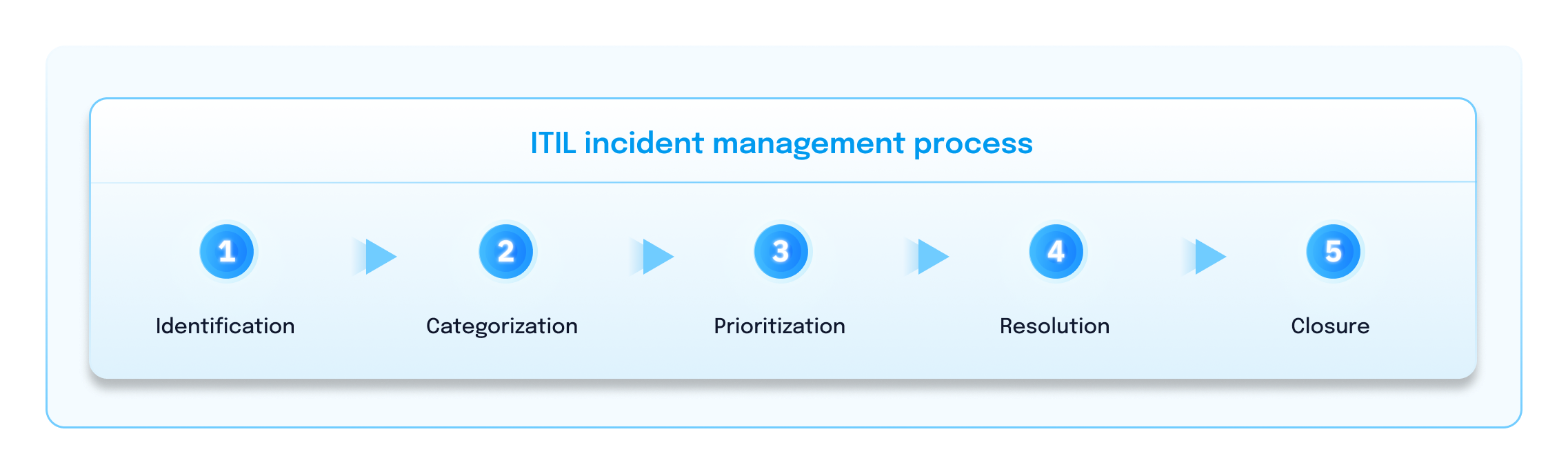
The ITIL processes for incident management typically include five steps: identification, categorization, prioritization, response, and closure. Knowing each stage helps improve incident analysis. It also supports ongoing service strategy management. This enhances the overall technical management of IT service delivery and IT event management.
Step 1: Identification
ITIL detects incidents through various channels, including user reports, system alerts, or monitoring tools. Once ITIL finds the incident, it logs the incident. It gives a unique tracking ID and records the initial details. Tools like automated detection systems can speed up this process.
Step 2: Categorization
ITIL categorizes incidents based on predefined criteria to ensure that the issue is handled correctly and tracked efficiently. Categories may change as more information becomes available.
Step 3: Prioritization
Priority matrices rank incidents based on importance and impact on the business. Incidents are typically assigned prioritization codes based on methodologies, including affected users, potential revenue loss, and impact on critical IT systems.
Step 4: Resolution
This step emphasizes containment strategies to prevent further damage. Given the importance of maintaining service availability, resolution involves implementing immediate fixes or temporary workarounds. ITIL escalates unresolved incidents for deeper analysis. It stores solutions and probable root causes in a knowledge base or configuration management database (CMDB) for future reference.
Step 5: Closure
Closure involves documentation, assessment, verification of resolution, and evaluation of the response actions. Ensure that any temporary workarounds are removed or made permanent. Verify initial categorization for accuracy and share comprehensive reports with stakeholders to enhance future incident response.
Challenges of ITIL process in incident management
While the ITIL incident management process streamlines IT problems and service continuity management, it also has several challenges.
High incident volume
When there are more incidents than IT professionals can handle, resolution delays are inevitable. Inefficient incident capacity management lowers operational efficiency, diminishes customer satisfaction, and makes it harder to maintain high service reliability levels.
Inefficient communication and collaboration among teams
Incident management requires seamless collaboration between stakeholders. When communication channels are unclear or separated, poor knowledge management can cause misaligned priorities. This leads to delayed responses and sometimes duplicate efforts, frustrating both IT teams and end-users.
Lack of standardized processes or tools
Inconsistent processes and tools create variability in reporting, tracking, and resolving incidents. Organizations struggle to maintain quality and speed in their incident resolution efforts without a standardized framework.
Difficulty prioritizing incidents based on business impact
Not all incidents are equal. Prioritizing and assessing incidents based on their business impact is crucial. Otherwise, the team risks wasting resources and delaying resolutions for critical issues.
Limited visibility into root cause and resolution progress
IT teams remain reactive when they cannot track how incidents are resolved or what causes them. This makes it difficult to prevent problems from recurring and achieve long-term stability.
Business strategies to streamline ITIL processes for incident management
Optimizing ITIL incident management involves streamlining processes, aligning with business goals, reducing resolution times, and improving overall service quality. Specific aspects include the following:
Enhance early detection
Use IT monitoring tools that give real-time insights into your IT infrastructure. Ensure you are using only what is necessary. Establish clear alerting and monitoring thresholds to define normal system behavior and support the timely identification of anomalies.
Deploy AIOps tools to aggregate and correlate alerts from multiple monitoring tools. Machine learning can identify significant incidents and reduce noise. Using both actions in deployment management supports quick responses and reduces user impact.
Streamline categorization and prioritization
Efficient triage and prioritization are vital components of incident project management. Set clear categorization criteria that consider the nature, impact, and urgency of incidents. Develop a prioritization matrix that addresses business impact, urgency, and service importance.
Harness AIOps to automate initial triage, categorization, and prioritization of incidents based on predefined rules. Align incident prioritization with SLAs to ensure resource allocation matches agreed-upon service levels.
Apply automation and remediation
Streamline resolution by developing automated workflows for routine tasks to reduce manual efforts and resolution times. Integrate incident management with ITSM tools and processes for seamless automation. Establish feedback loops within your system for continuous improvement. Review and refine automation based on user feedback and evolving requirements.
Enhance communication and knowledge sharing
Establish multiple, easy-to-use reporting and monitoring channels. Ensure timely and clear communication with stakeholders throughout the incident lifecycle. Build and keep a knowledge base. This should have solutions for common problems, FAQs, and troubleshooting guides. It will help solve recurring issues more quickly.
Ensure continuous optimization
Review and analyze incident trends and management processes on a regular basis to ensure effective incident management. Implement a feedback loop from users and IT staff to identify areas for improvement. Conduct post-incident reviews to analyze and learn from the handling of major incidents. Invest in regular AIOps training and ongoing support to ensure optimal performance. This helps your staff use ITIL principles and stay updated on AIOps best practices.
Align your ITSM tools with ITIL processes and practices
Align your ITSM tools with ITIL’s best practices to support efficient incident management, including tracking, management, and reporting. Integrate tools with other systems, such as CMDB, to enhance information accessibility.
The BigPanda platform makes integration seamless. The Sankey diagrams below illustrate how BigPanda AI capabilities facilitate improved incident tracking, management, and reporting.
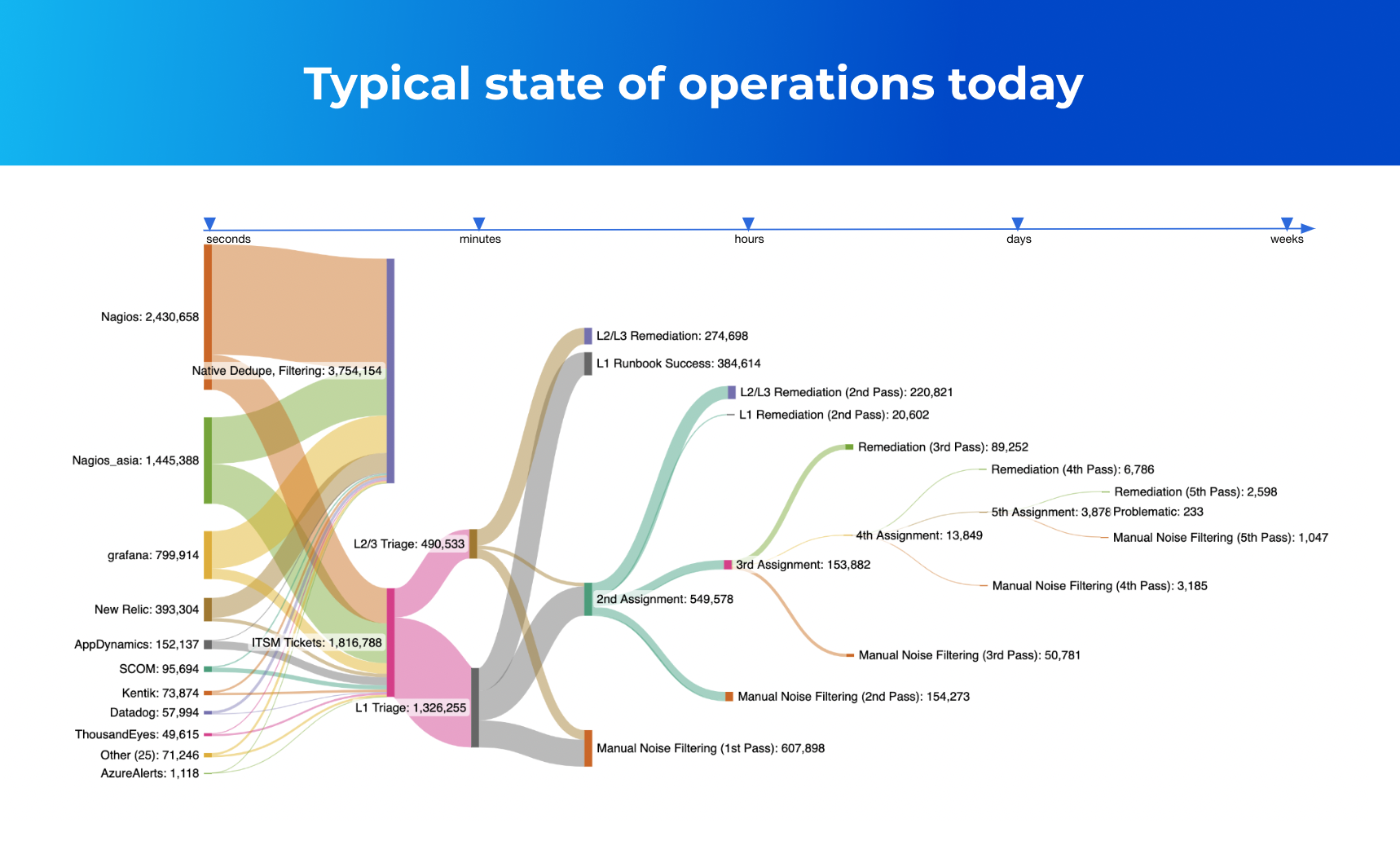
Figure 1: Sankey workflow showing the typical organizational landscape and event lifecycle.
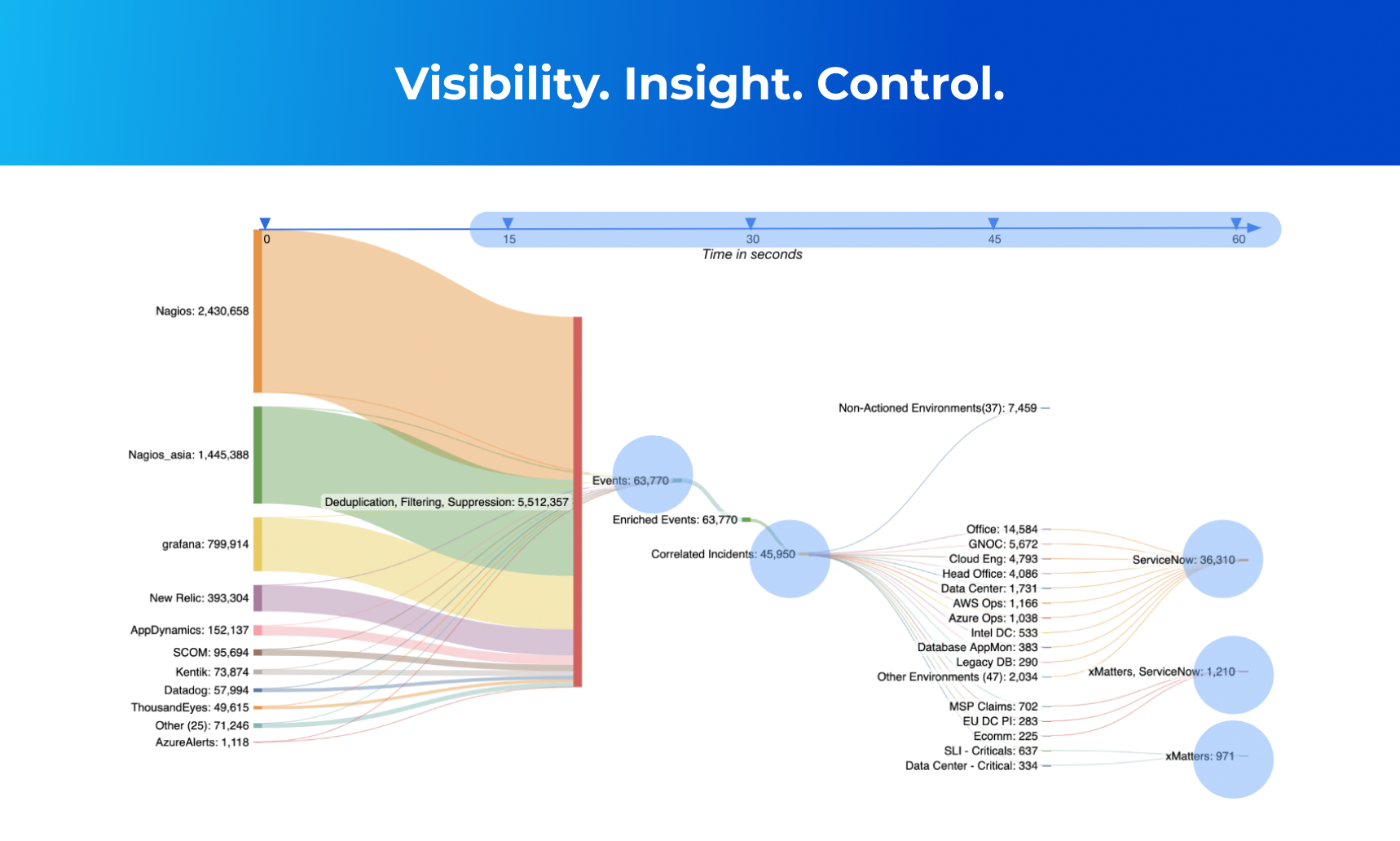
Figure 2: Sankey workflow showing a sample impact of using BigPanda AIOps to improve incident management.
How BigPanda enhances ITIL Incident Management
BigPanda AIOps can significantly improve each step of incident management, from detection to resolution and continuous improvement. We designed our AIOps platform to support hybrid infrastructures. BigPanda is a powerful ally in optimizing ITIL incident management processes with AI-driven insights and ITSM tool integration.
- Enhance incident classification and prioritization: Assist your teams in utilizing BigPanda Incident Intelligence. This tool will help them quickly sort and rank incidents. They can do this based on severity, business impact, and potential risk. Create incident tags based on formula calculations to automate and maintain the current prioritization.
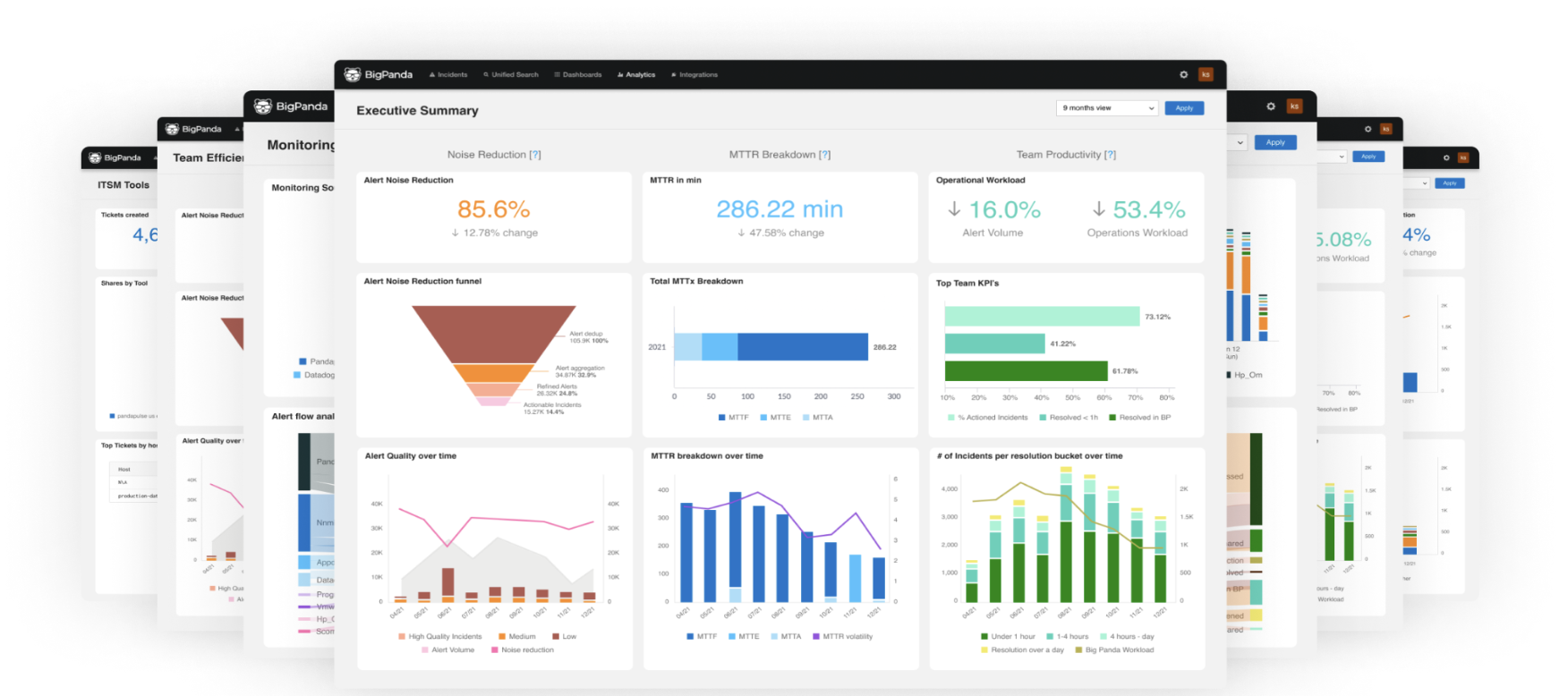
- Give stakeholders visibility: Unified Analytics dashboards (below) provide a centralized view of your IT operations, identifying areas for improvement. Simplify coordinating incident management with relevant KPIs, track performance, and identify patterns or recurring issues to drive continuous optimization.
- Leverage GenAI: GenAI supercharges your incident management processes. BigPanda’s AI capabilities classify and prioritize incidents, suggest contextual resolutions, predict recurring patterns, and analyze historical incident data to optimize workflows. GenAI can help create runbooks that adapt and automate routine incident responses. This frees up team resources to focus on important issues.
Discover true incident management excellence and continual service improvement. Harness BigPanda AIOps for swifter, proactive incident management to seamlessly manage the complexities of the modern IT landscape.
Next steps
- Get the latest research from EMA to learn How AIOps transforms IT Service Management.
- Learn how Gamma Communications uses BigPanda to reduce alert noise by 93%.
- Explore how AI-powered Incident Management can accelerate IT incident investigation.
- Interested in deepening your knowledge? Getting an ITIL certification can help IT workers and teams show their skills. It also helps them use ITIL-based tools more effectively.