





Introducing the next generation of the BigPanda AI Incident Assistant


AI can’t solve your business problems if it doesn’t understand your business
Effective incident response depends on having all of the context surrounding what’s happening. You have to understand your systems, services, architecture, and teams deeply enough to correctly interpret whatever alert just fired. Too often, that context doesn’t arrive packaged neatly in one place.
Gathering and interpreting context correctly under time pressure is one of the most difficult parts of the job. Especially when that vital information is scattered across monitoring tools, ticketing systems, architecture diagrams, runbooks, and the heads of whoever’s been on the team the longest.
AI can help gather, organize, and present that context, but sometimes, when it gathers information, it’s not clear how it got it or what it used. It’s like a black box that your teams are forced to either trust blindly or not trust at all.
Getting context wrong is worse than not having it at all.
When context is missing, the costs are real
We’ve all lived through some version of sending an on-call engineer to chase down the source of a payment service disruption. The real cause is a partner payment gateway outage that is listed on an unwatched external status page. Only after three escalations and 45 minutes does this become clear, despite a similar incident being resolved and well documented eight months ago.
By the time anyone finds the right context that could help resolve this similar problem, the company has lost $300,000 in abandoned carts for a fix that took four minutes.
These types of incidents are painful, and not only because the right context was just a click away in the wrong tool. Or locked away in a runbook that nobody remembered existed. They are painful because the blast radius is too large, and includes a time tax on the service desk, increased operational costs, missed SLAs, and lost revenue.
The BigPanda AI Incident Assistant launched two years ago
Fortunately, help with these types of incidents has arrived. In 2024, BigPanda introduced our AI Incident Assistant, which is built specifically to rapidly and agentically assemble the fragmented context behind an incident fast enough to matter, while it’s still live.
That mission hasn’t changed. What’s changed is how completely we deliver on it.
Introducing the new and improved BigPanda AI Incident Assistant
You already know Biggy as the AI agent that you chat with inside the AI Incident Assistant. The latest update of AI Incident Assistant replaces a single, generalist agent designed to run on a fixed set of hardcoded action plans. This update turns that same knowledge into composable building blocks, allowing customers to apply what the AI Incident Assistant learns to new cases and get smarter with every interaction.
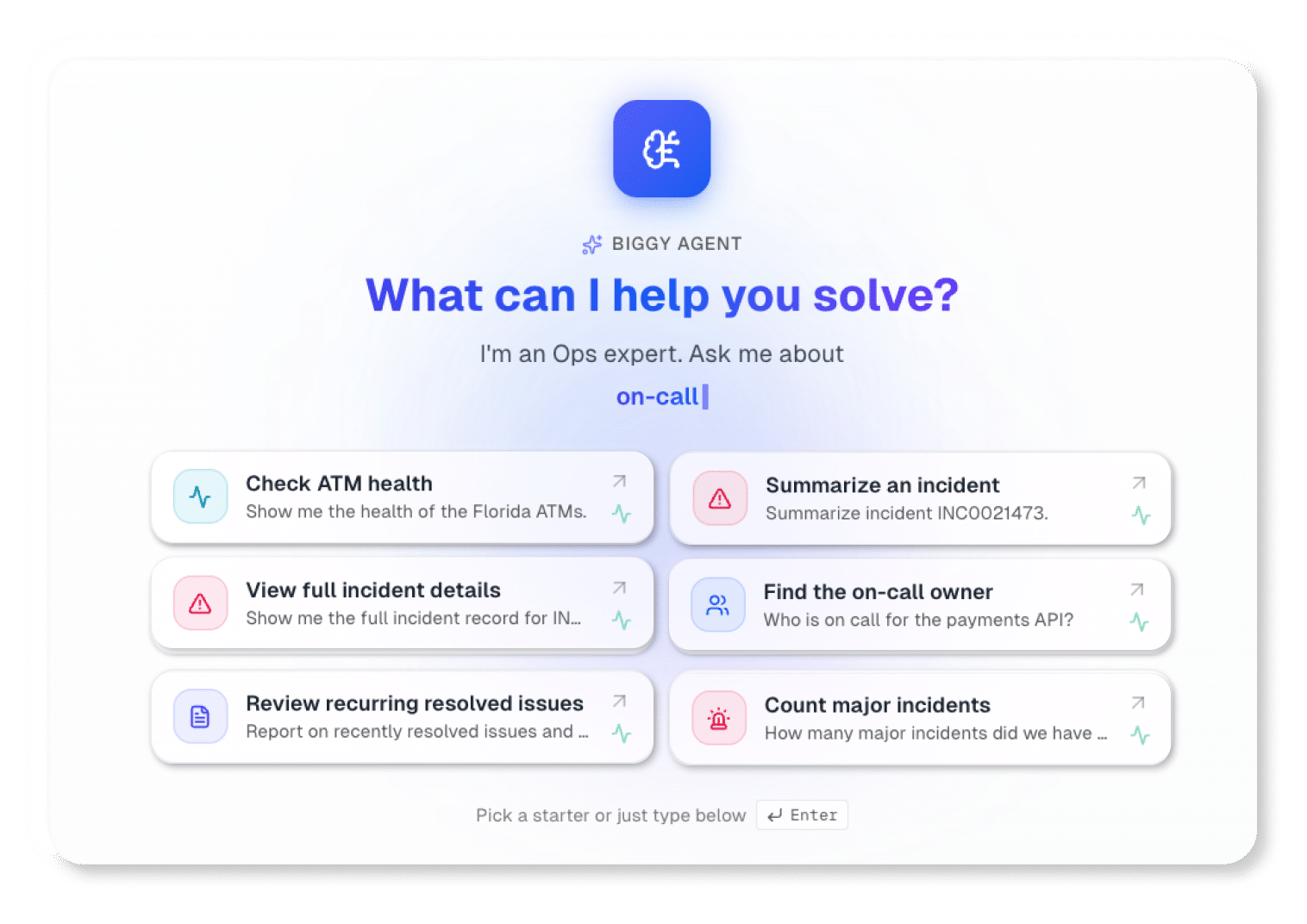
This update also delivers a smarter orchestrator that assembles capabilities on the fly for any request. When enabled, it provides persistent, adaptive memory to deliver faster, more consistent responses over time. It also enables greater customization, allowing customers to adjust behavior without custom product development.
If you’re already running custom Action Plans, they will automatically convert to the new model, so your existing work carries forward as you adopt the new features.
These changes reflect the belief that full context was never something one generalist assistant could gather alone, from scratch, on every single incident. It takes a team of specialists, each owning a different piece of the problem.
Six ways the new BigPanda AI Incident Assistant delivers enhanced value and capabilities
The increased capabilities of the new AI Incident Assistant result in lower operating costs, protected revenue through faster incident resolution, and freed up engineering time to focus on the work that actually moves the business forward. Here’s how.

Faster resolution with less toil.
Biggy streams responses in real time, so you can act on partial findings before the full investigation even finishes.

Customizable without new product development.
Skills and Agents use the context that the AI Incident Assistant captures to shape responses to match how your organization actually runs, instead of providing a generic default. Admins still have control over access and integrations.

A compounding investment.
When Memory is enabled, every conversation feeds a knowledge asset that becomes more comprehensive over time, providing historical and human context that persists and compounds rather than resetting with each conversation.

Safe by design.
Mutating actions (i.e., paging on-call or creating a ticket) are governed by configurable approval policies. This means additional context and more autonomy don’t mean less oversight.

Guided onboarding.
First-visit walkthroughs help users and admins configure Skills, Agents, and access controls from day one.

More than 18 integrations in one engine.
Datadog, Splunk, ServiceNow, Jira, New Relic, and more are all running on the same underlying engine, though the experience is tailored to where you’re working: web chat, Slack, or Microsoft Teams.
The BigPanda AI Incident Assistant solves the context problem, piece by piece
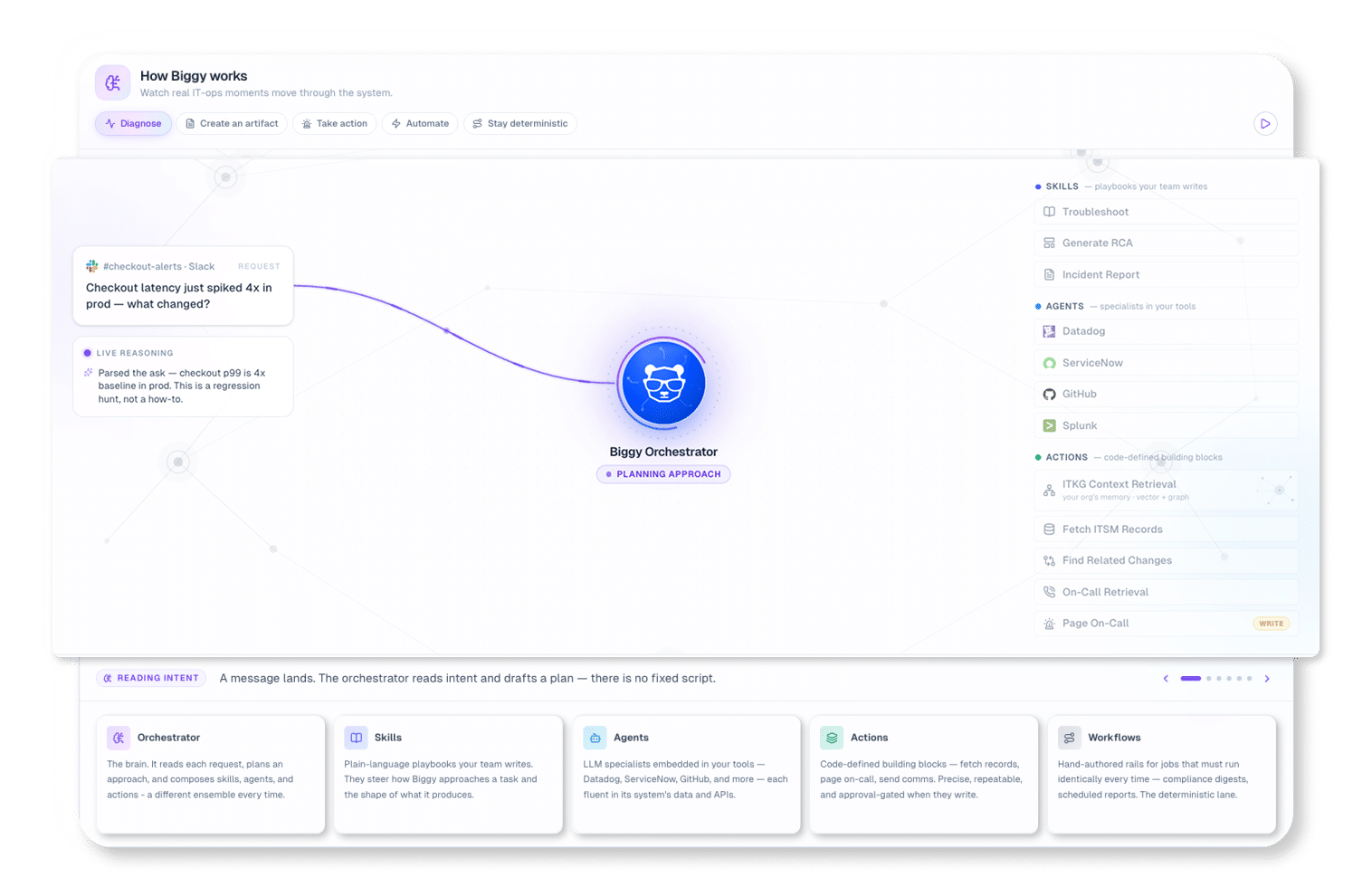
At the center of all this is a single architectural shift. The knowledge that used to live inside a single fixed, hardcoded assistant is now built from composable Capabilities and Skills. These are reusable building blocks instead of a monolith. Everything else exists to put those building blocks to work. Orchestrator reads every request and assembles the right capabilities for it, Adaptive Memory retains what’s learned, and Agents and Workflows turn skills into consistent, repeatable actions.
The Orchestrator and Capabilities give your teams context they can see, not just context that’s used
Every incident response starts with source context to identify the entity that triggered the alert and the condition behind it. But even this isn’t enough, because you also need topological context to understand how that entity connects to everything else.
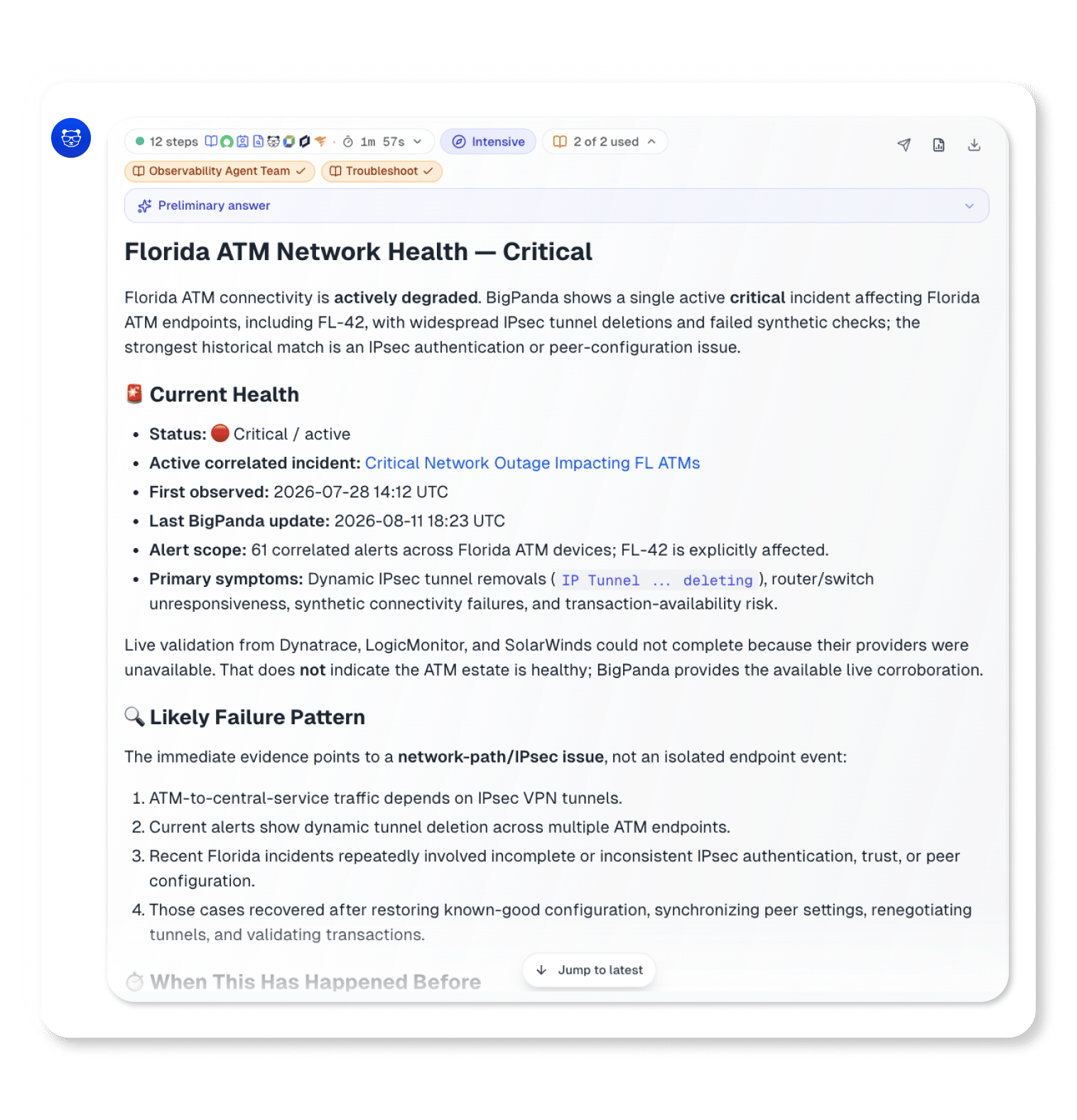
The Orchestrator provides this context. It’s also the investigation engine behind both the AI Incident Assistant and the “Ask Biggy” brain that reads a request and decides which Capability to use. For complex investigations, Biggy AI agents investigate multiple hypotheses simultaneously across your IT ecosystem, which we call a Swarm Investigation. This pulls together context in seconds, across web chat, Slack, and Microsoft Teams, identifying anomalies, impacted services, and root cause from real-time and historical data.
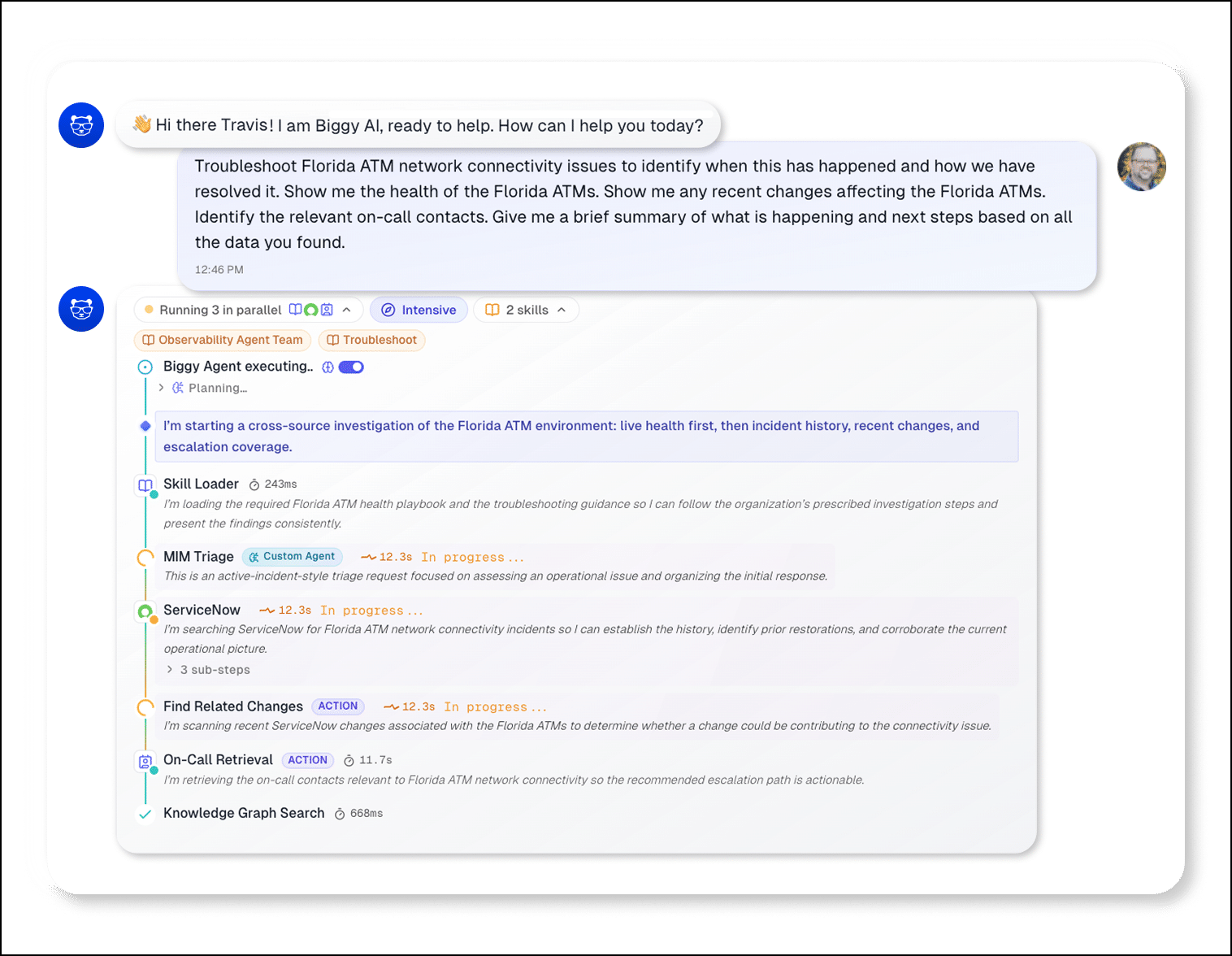
And unlike the old single-agent design’s opaque, nested calls, Biggy now narrates what it’s checking and why as it works. It gives you a live account of its reasoning instead of a spinner, so you can trust the context because you can see it.
Adaptive Memory: context that doesn’t reset
Adaptive Memory operationalizes the context that used to live only in people’s heads, or in tickets nobody had time to read.
When enabled, it gives your organization a private, organization-specific memory graph that learns automatically and carries its learning forward. It provides Facts, showing things like where runbooks live and who owns what (the human context). It provides Experience: what the AI Incident Assistant has seen before, task by task (the historical context). And How-Tos: the accumulated situational judgment of the team.
This is the institutional memory that compounds. Every investigation and resolution feeds back into it, so the system already knows what caused this incident before, rather than starting from scratch on the next one.
Skills and Agents: your team’s knowledge, encoded and tunable
Remediation context is the hardest to formalize. It’s what’s in a runbook, and what’s in an experienced responder’s head. Rarely both at once.
Skills are how a team documents knowledge as a shareable playbook, editable by teammates you grant access to. This playbook is described in natural language, no code required, and versioned, so a bad change can be rolled back.
Agents take it further for specialized cases. Now you have customizable AI helpers with their own persona, tools, and instructions. Each can be configured and access-controlled by your admins, and then tuned to your environment, your terminology, and your escalation policies. It’s like hiring someone with subject-matter expertise. They still need some training on your environment, but not much, since they already show up prepared.
Together, this is what lets you customize without custom product development. Although Admins still configure who has access and how integrations are set up, your team can now build and adjust Skills and Agents directly, in plain language, instead of filing a ticket and waiting.
Workflows: for the rare cases where the sequence can’t vary
Most of the time, you want AI Incident Assistant reasoning through a problem, not following a script. But some processes must run in exactly the same sequence every time, such as a scheduled compliance audit. For those situations, a Workflow lets you lock in that fixed sequence. However, the details the Orchestrator fills in from live context can still vary incident to incident.
This is the same automation muscle running on autopilot. Workflows are executed consistently across all shifts and time zones, without anyone kicking them off manually.
Get started with the upgraded BigPanda AI Incident Assistant
The latest version of our AI Incident Assistant is live today. Some capabilities, including Adaptive Memory, require enablement and configuration within your organization, so reach out to your account team to get everything turned on.
There’s no new SKU and no separate purchase required. If you’re already a customer, log in to see the new experience, or reach out to your BigPanda account team with questions about Skills, Agents, or any of these new updates.
And if you’re new to BigPanda, you can request a demo below to see the AI Incident Assistant in action for yourself.