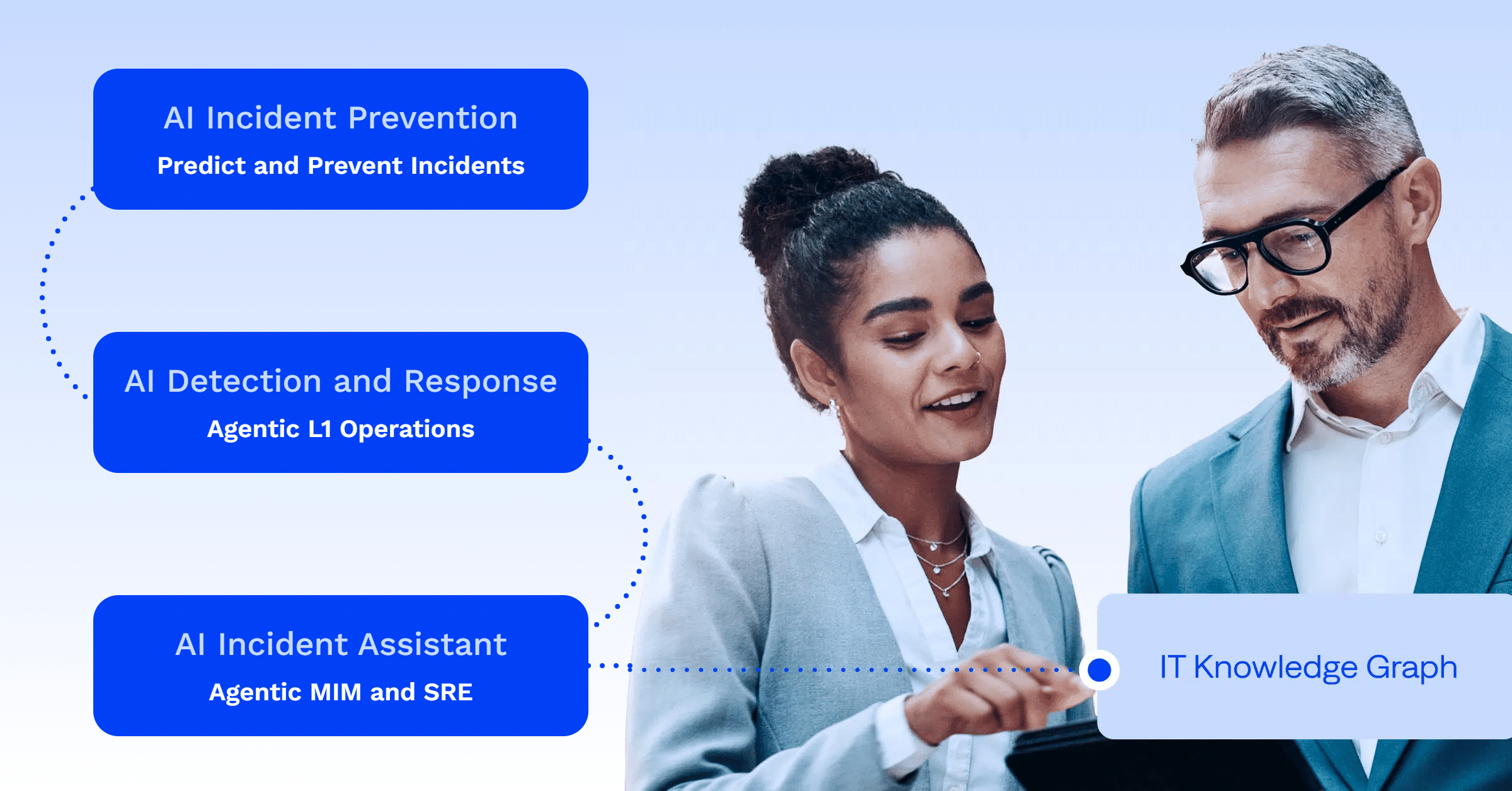










ServiceOps is a technology-enabled approach that unifies IT operations and IT service management (ITSM) teams to improve incident management.
In a recent survey of more than 400 global IT leaders by Enterprise Management Associates (EMA), 96% of respondents reported positive results from implementing the approach. Adoption rates are high: 75% have either an active effort or a formal initiative to streamline collaboration between ITSM and ITOps teams.
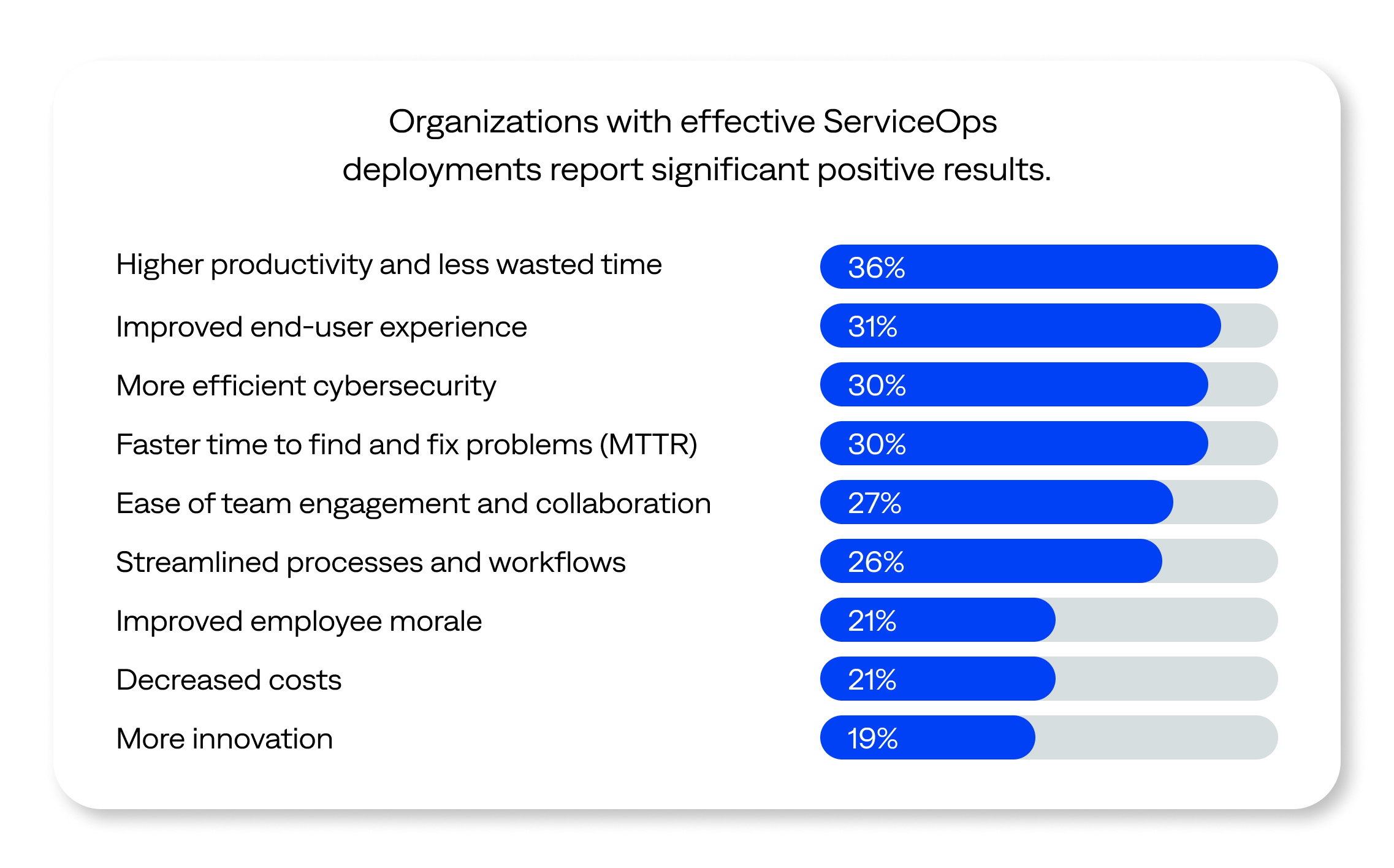
ServiceOps addresses high-priority IT objectives, from improving productivity and user experience to reducing costs. Nearly a third of respondents report deploying ServiceOps allows them to find and fix problems more quickly, measurably decreasing mean time to detection (MTTD) and resolution (MTTR). Enabling teams to do more with the same staff also improves morale.
Achieving these results requires people, processes, and technology. To function effectively, ServiceOps needs a platform to break down operational and data silos and facilitate cross-functional collaboration. Almost 50% of the EMA survey respondents identified “a platform for enterprise-wide visibility and action” as the most critical technology to unify service and operations.
Enable ServiceOps with full incident context
Fragmented data, siloed tools, workflows, and manual processes continue challenging ITOps and ITSM teams. And despite investing millions each year in observability and ITSM platforms, these teams still face alert fatigue, reactive incident response, and persistent outages. EMA identified several changes that teams must implement to ensure ServiceOps effectiveness, including:
- Workflows to bridge DevOps, ITOps, and ITSM teams
- More real-time context, including discovery/dependency mapping, IT asset management, and CMDB
- End-end visibility into application performance and IT infrastructure
It takes a platform that provides a contextual view of data and processes across cross-functional teams to deliver the desired outcomes of ServiceOps. Full-context operations directly addresses these challenges by providing all responders with a unified view of alert and incident data across the IT infrastructure.
A full-context platform presents all the information ITOps and ITSM teams need to manage an incident — from detection through resolution — quickly and in one place. This allows teams to anticipate issues as they develop and proactively detect, identify, and resolve incidents before they become outages.
Unify ITOps and ITSM teams to support ServiceOps
A collaborative approach to ITOps and ITSM is vital to an effective ServiceOps strategy. Likewise, efficiency requires ITSM and ITOps teams to share workflow processes, data, and objectives.
According to EMA, the three most essential elements of unifying service and operations are:
- Workflow automation (49%)
- A platform for enterprise-wide visibility and action (45%)
- AI/ML/analytics, AIOps (38%)
Full-context operations harnesses advanced AIOp capabilities to instantly correlate monitoring, topology, CMDB, change, and historical data across sources and dimensions. ITOps and ITSM teams get a unified picture of alerts and incidents, eliminating the need to juggle multiple monitoring systems.
With the full context of incidents, these teams can quickly understand what happened, why, and how to address it. Rapid access to complete incident data enables teams to resolve more incidents faster, eliminate data silos, collaborate around remediation efforts, and automate manual processes.
AI and ServiceOps
EMA’s research reinforces that AI, ML, and generative AI have transformative potential for ServiceOps. However, only 34% of respondents report having a mature AI practice, with another 33% early in their journey.
As organizations integrate AI into their ServiceOps practice, making those investments actionable and credible depends on comprehensive, contextual data. AI is only as good as the data that trains it. Without contextual data, these tools can generate unreliable or inaccurate results.
Full-context operations uses AIOps to ingest, correlate, and normalize complex data from across the IT infrastructure and enrich that data with context. This creates unified, actionable alerts and provides a comprehensive view of the IT environment. This full-context view empowers AI, ML, and generative AI tools to make accurate recommendations that improve decision-making.
Maximize the impact of ServiceOps
ServiceOps outcomes map directly to IT’s collective top priorities. According to EMA’s research, when deployed correctly, ServiceOps can deliver:
- Higher productivity and less wasted time
- Improved MTTR
- Easier collaboration
- Streamlined workflows and processes
Full-context operations positively impact these outcomes by providing the data, insights, and processes to make incident management faster, more consistent, and more sustainable. By adopting ServiceOps and full-context operations, ITOps and ITSM teams can collaborate efficiently, respond faster, assign resources appropriately, and maintain service availability.
Key takeaways
- ServiceOps unifies ITOps and ITSM teams around shared workflows, data, and goals. By eliminating silos, teams become more proactive, collaborate more effectively during incident response. Resolving issues faster.
- Siloed data is the biggest obstacle to effective ServiceOps, leading to slower incident resolution and inefficiency. Real-time access to each other’s context enables ITOps and ITSM teams to collaborate efficiently and reduce delays. EMA research found that 69% of organizations waste at least 25% of total MTTR just waiting for information from other teams.
- Nearly 50% of IT leaders say a platform for enterprise-wide visibility and action is the most critical technology for ServiceOps, as it enables faster incident resolution, improved collaboration, and proactive risk management. Unified incident data becomes the foundation, not just a nice-to-have.
- Full-context operations are what close the ServiceOps gap. By correlating monitoring, topology, CMDB, change, and historical data into a single unified view, every responder gets the complete picture of an incident from the start rather than piecing it together manually.
- AIOps is one of the top three technologies that IT leaders identify as essential to enabling ServiceOps, because it provides cross-team visibility into workflows and automated correlation of incidents and data, benefits that neither ITSM nor observability tools can deliver on their own.
- The BigPanda agentic ITOps platform delivers full-context operations natively. It gives ITOps and ITSM teams a shared, real-time view of every incident without requiring a foundational overhaul of existing tools or infrastructure.
Learn more
Explore how you can use ServiceOps to deliver exceptional service quality in ServiceOps 2024: Automation and (gen)AI-powered IT service and operations. The report details:
- Key outcomes and benefits of ServiceOps
- How to implement ServiceOps in your enterprise
- Practical applications of automation, GenAI, and AI in ServiceOps
Our webinar, Real-world strategies for incident management, highlights how real-world automation and generative AI solutions can transform incident management.