






1
IT incident management (ITSM) V.S. IT problem management: Two disciplines, one goal
Picture a familiar scene: a critical application goes down during peak business hours, and your on-call engineers scramble to restore service. Two weeks later, the same application fails again, frustrating your teams with the same symptoms, the same scramble, and the same customer frustration. If this pattern feels familiar, your organization may be strong at IT incident management, but underinvested in IT problem management.
The two disciplines are frequently confused, and the confusion is costly. With unplanned downtime costing organizations an average of $14,056 per minute, or up to $1.5 million per hour for large enterprises, companies can’t afford to keep resolving the same incidents over and over. Every repeat incident is a cost you’ve paid twice: once to resolve it, and again when the unaddressed root cause resurfaces.
IT incident management is the practice of restoring normal service operations as quickly as possible when something breaks. IT problem management is the practice of identifying and eliminating the underlying causes of incidents so they don’t happen again. Modern enterprises need both, and agentic IT operations make it possible to run both disciplines at machine speed.
Enterprises are moving beyond reactive, manual incident management to proactive, automated operations. Agentic IT operations bring autonomous, intelligent agents into the incident management lifecycle to detect, triage, and resolve incidents faster and with less human toil. Where traditional IT teams struggled to keep pace with alert floods and hybrid-cloud complexity, agentic ITOps empowers teams to shift from reactive firefighting to proactive resilience. Let’s dive in and learn how agentic ITOps transform IT incident and problem management.
2
What is IT incident management?
Incident management operates as a component of the IT service management (ITSM) framework, which focuses on addressing and resolving IT-related incidents.
An IT incident is any unplanned interruption or degradation of IT services. ITOps teams handle various incidents, including software or hardware failures, email issues, security breaches, user errors, and, in the worst case, outages. Incidents are not to be confused with IT events or problems, let’s take a look at the definition of each.
- Incidents are any non-scheduled IT service disruption or degradation.
- Events are any observable occurrences in an IT system, whether normal operations or errors.
- Problems are the underlying root cause of one or multiple incidents, often hinting at a deeper issue in the IT infrastructure.
According to ITIL guidelines, problem management focuses on preventing or reducing incidents, while incident management addresses real-time issue resolution.
The BigPanda agentic ITOps platform bridges this distinction by continuously correlating events, identifying recurring problems, and automating the handoff between reactive incident response and proactive problem prevention — all through its IT Knowledge Graph and AI-powered detection capabilities.
3
What is IT problem management?
IT problem management is the practice of identifying, analyzing, and eliminating the root cause of incidents to prevent recurrence and reduce the impact of incidents that can’t be prevented outright.
In ITIL terms, a problem is the underlying cause of one or more incidents. The cause is often unknown when the problem record is created, which is why investigation is the primary job of problem management. If a reporting application crashes every Monday morning, each crash is an incident. The capacity bottleneck, memory leak, or misconfigured job that causes those crashes is the problem.
Problem management can be reactive or proactive:
- Reactive problem management investigates root cause after incidents occur, typically through root-cause analysis (RCA) and postmortems, then drives permanent fixes or documented workarounds (known errors).
- Proactive problem management analyzes incident trends, telemetry, change data, and historical patterns to identify and eliminate risks before they ever trigger recurring ncidents.
Where incident management is measured in minutes, problem management is measured in outcomes over time, such as repeat incident rate, incident volume reduction, and long-term service stability. Industry benchmarks suggest a healthy repeat incident rate sits below 5%, while a rate above 10% is a strong signal that problem management needs formal attention.
4
The key differences between IT incident management and IT problem management
IT incident management and IT problem management are inextricably linked. ITIL guidance calls for teams to manage both, but to do so separately. Here’s how they compare:
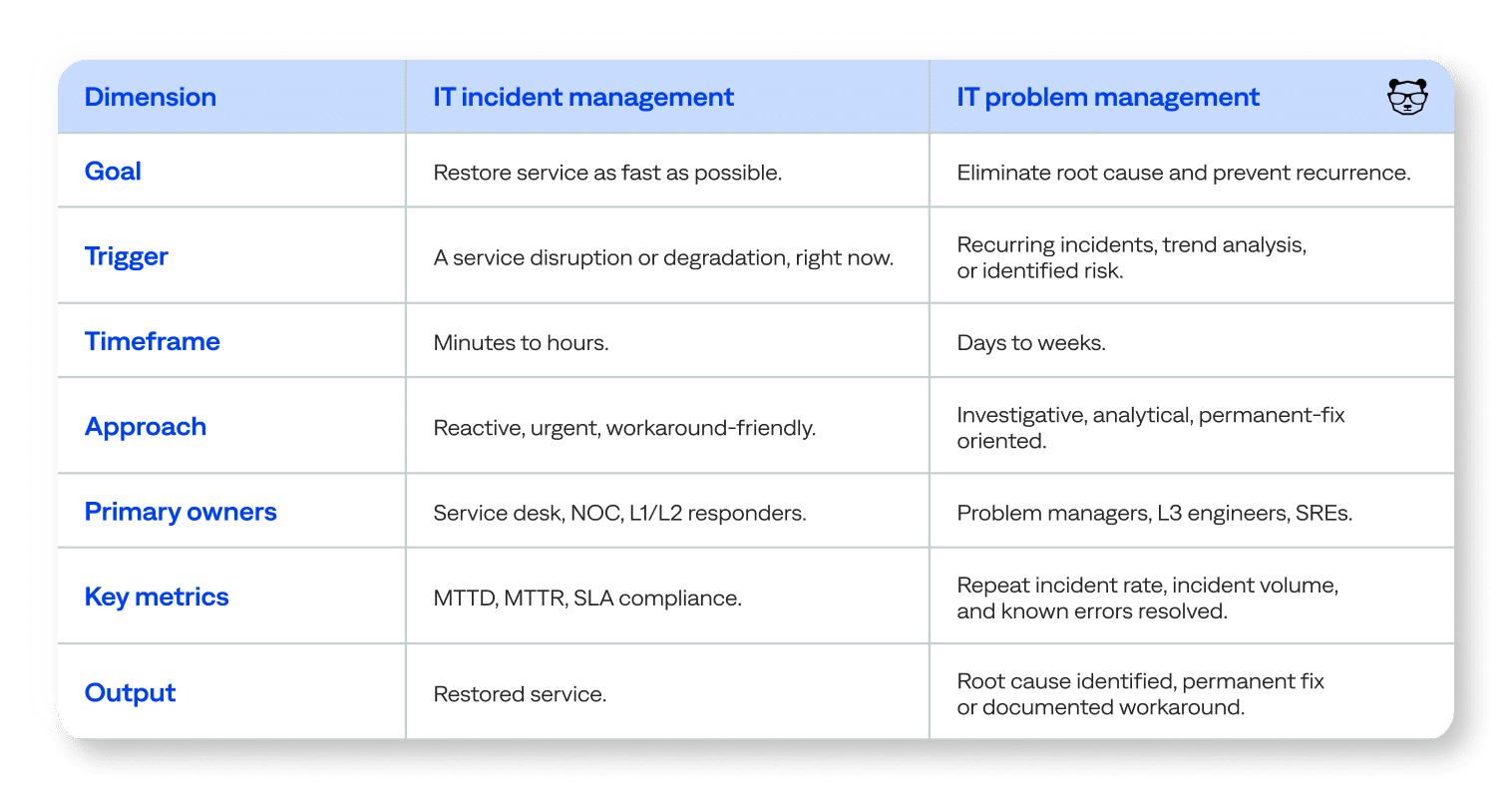
The distinction matters because the two practices can work against each other when poorly coordinated. Incident responders under SLA pressure close tickets on mitigation and move on without a deliberate handoff. The underlying problem never gets a record, an owner, or a fix. The result is an operations team that’s perpetually busy but never gets more stable, and continues treating symptoms repeatedly instead of curing the disease.
5
How IT incident management and IT problem management work together in ITIL
In a mature ITSM practice, the two disciplines form a continuous loop:
- Incidents feed problems. Postmortems, recurring incident patterns, and RCA findings generate problem records. The service desk restores service with a fix or workaround, then hands the pattern to problem management.
- Problems inform incidents. The known error database (KEDB) gives responders proven workarounds, so when a known problem triggers a new incident, resolution is fast and consistent.
- Both feed continuous improvement. Closed problems reduce future incident volume; incident data validates whether permanent fixes actually worked.
That’s the theory. In practice, the loop breaks down under real-world conditions. As most IT teams juggle more than 20 observability and monitoring tools, alert floods bury the patterns that would reveal problems, and organizational knowledge lives in chat threads and bridge calls, and overloaded engineers rarely have time for deep RCA when the next incident is already paging them. This is exactly where agentic ITOps changes the equation.
6
How agentic ITOps enhances IT incident management
Agentic IT operations bring autonomous, intelligent AI agents into the incident lifecycle to detect, triage, and resolve incidents faster and with dramatically less human toil. Rather than waiting for humans to notice, investigate, and act, AI agents continuously operate across your environment, autonomously handling routine tasks and collaborating with humans on complex decisions.
Detect, triage, and respond at machine speed
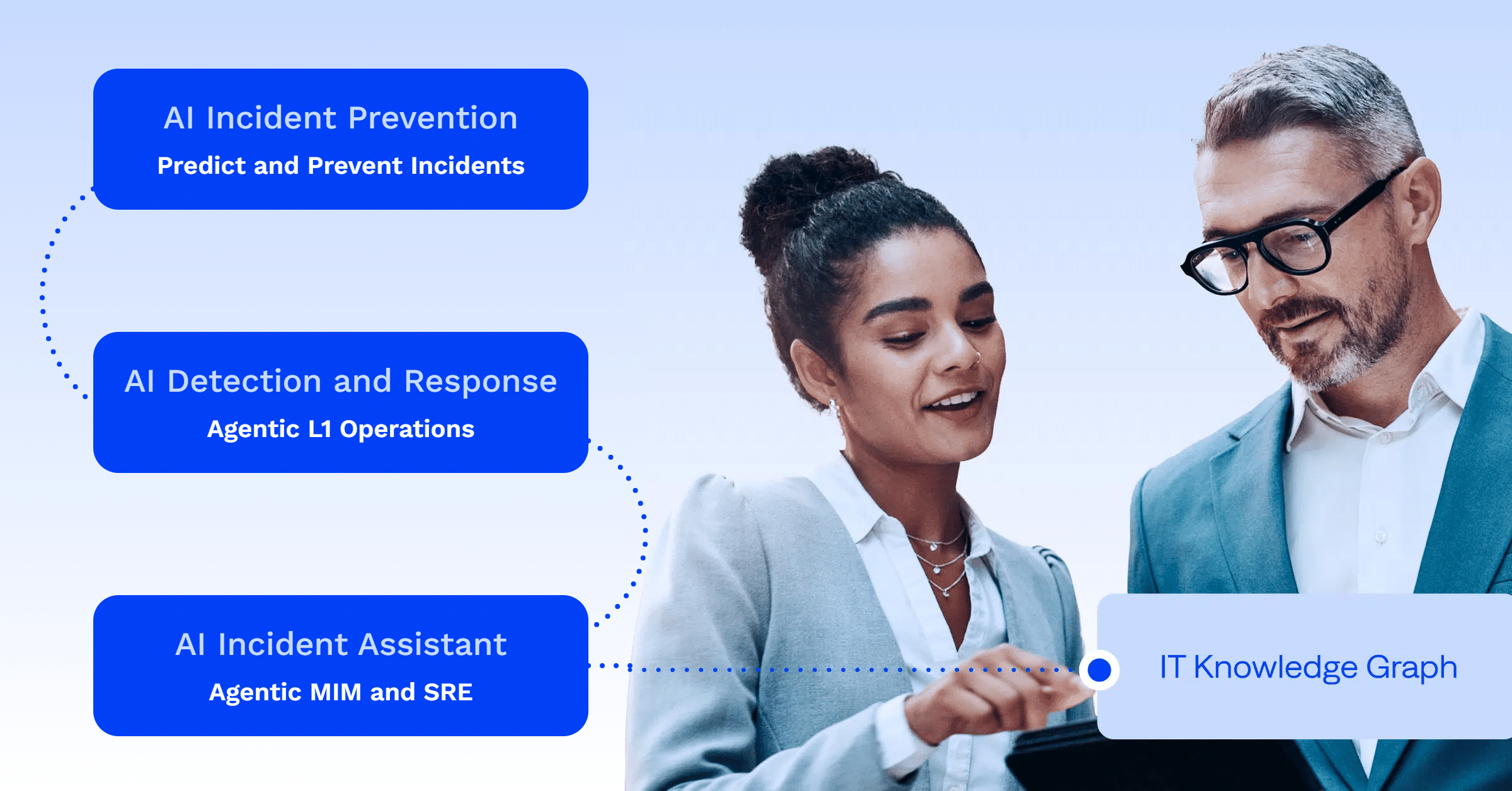
BigPanda AI Detection and Response continuously monitors signals across your entire tool ecosystem, correlates related alerts into unified incidents, and suppresses the noise that buries critical signals. Instead of an operator spotting a red dashboard — or worse, a customer reporting the outage — incidents surface the moment anomalous patterns emerge, shrinking detection time from minutes to seconds. From there, AI-native agents autonomously investigate alerts, prioritize and route incidents to the right teams, execute runbooks, and suppress duplicate events, escalating to human engineers only when genuinely needed. L1 teams stop drowning in repetitive queue work, and escalation-driven bridge calls drop sharply.
Give responders instant context
For the complex incidents that do reach L2, L3, and SRE teams, the BigPanda AI Incident Assistant synthesizes correlated alerts, topology data, change history, and past resolution patterns into clear summaries and recommended actions. Engineers spend less time gathering context and more time resolving, driving MTTR down on every incident.
7
How agentic ITOps enhances IT problem management
Problem management has traditionally been the discipline that enterprises know they should invest in, but rarely do. Agentic ITOps removes that trade-off by automating the investigative heavy lifting.
Surface problems hiding in incident data
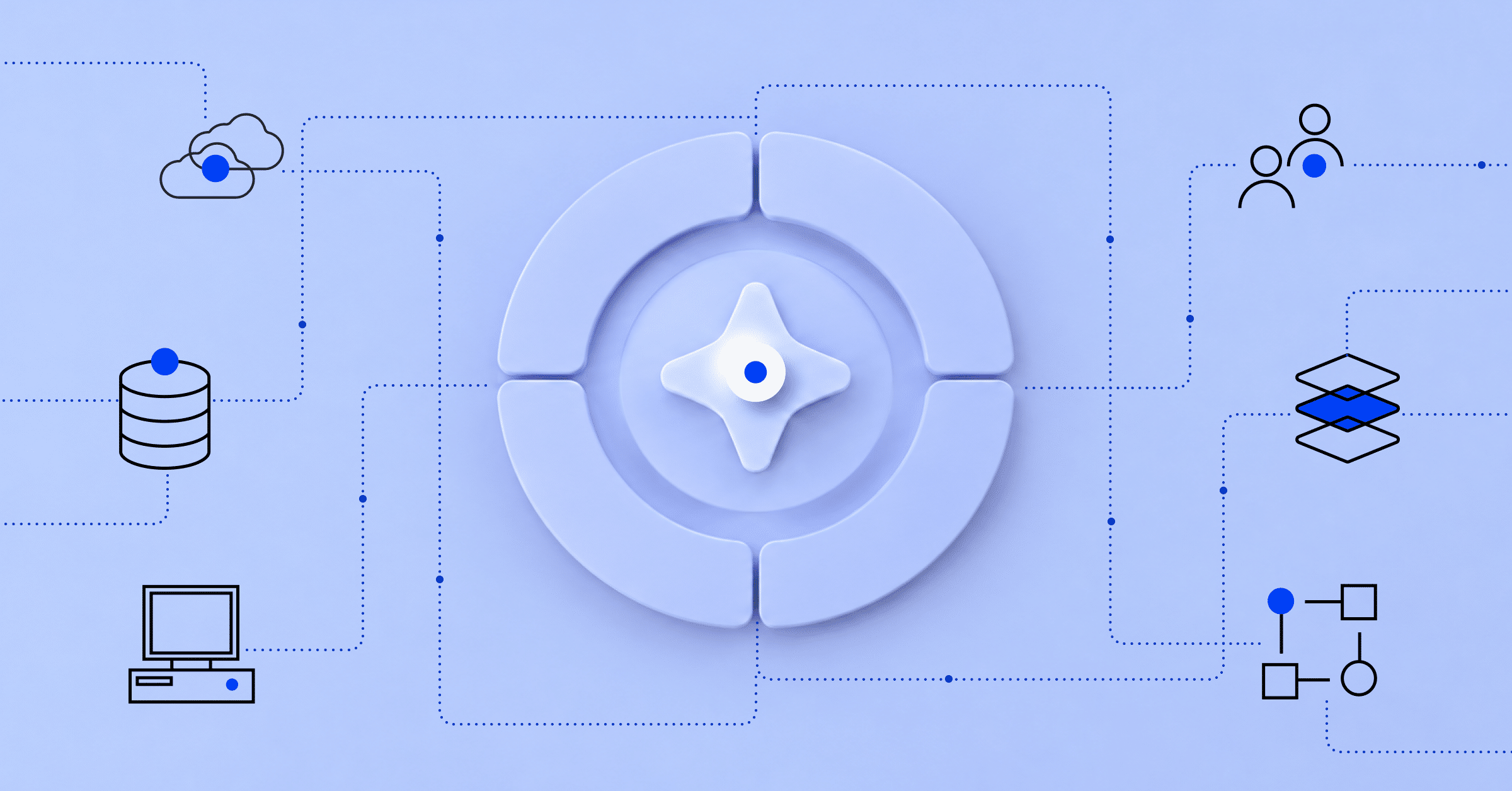
The BigPanda IT Knowledge Graph continuously maps relationships between services, infrastructure, changes, and historical incidents. By correlating events across time and topology, the IT Knowledge Graph automatically identifies recurring patterns that indicate underlying problems, even when individual incidents were resolved by different responders who never compared notes.
Automate root-cause analysis
Manual RCA is slow, inconsistent, and dependent on whoever attends the postmortem. Agentic ITOps automates root-cause identification by analyzing correlated alerts, change data, and topology in real time, then preserving those findings so every future investigation starts from institutional knowledge rather than a blank page. Each incident closure becomes a learning event that sharpens future detection, categorization, and recommendations.
Prevent incidents before they occur
This is proactive problem management at its most powerful. BigPanda AI Incident Prevention applies predictive analytics and change risk intelligence to identify risky IT changes, which are a leading cause of outages, before they become incidents. Integrated with your ITSM change workflows, AI Incident Prevention automatically flags dangerous changes so teams can intervene ahead of impact rather than scrambling to recover afterward.
Measure what matters
BigPanda Unified Analytics gives problem managers the visibility they’ve historically lacked: repeat incident rates, top recurring incident categories, MTTR trends, and SLA compliance, all in one place. Teams can measure and prove the value of problem management to the business.
8
Transform IT incident and IT problem management with Agentic ITOps from BigPanda
Incident management and problem management were never meant to compete for your team’s attention, but in a world of manual processes, alert floods, and hybrid-cloud complexity, that’s exactly what happens. The urgent wins, the important waits, and the same incidents keep recurring.
The BigPanda agentic IT operations platform breaks that cycle. By unifying real-time event intelligence, the IT Knowledge Graph, autonomous AI agents, and predictive prevention in one platform, BigPanda enables enterprises to:
- Detect, investigate, and resolve incidents faster with AI-driven correlation, autonomous L1 operations, and the AI Incident Assistant.
- Turn incident data into problem intelligence by automatically identifying recurring patterns and probable root cause.
- Prevent incidents entirely with predictive change risk intelligence that flags high-risk conditions before they become outages.
- Continuously improve with Unified Analytics that proves whether fixes worked and where to invest next.
It’s time to move from reactive chaos to proactive resilience. To learn more about the value agentic ITOps brings to IT incident management, you can check out our latest ebook linked below or schedule a demo to see BigPanda in action today.
9
Five key takeaways from this blog
- Incident management restores service; problem management eliminates causes. Incidents demand speed and workarounds. Problems demand investigation and permanent fixes. Confusing the two leads to teams that stay busy without ever becoming more stable.
- Repeat incidents are the signal that you’re missing problem management. A repeat incident rate above 10% indicates your organization is paying for the same failure over and over. Every recurrence is a resolution cost you’ve paid twice.
- The two disciplines only work as a loop. Incidents should feed problem records; resolved problems should reduce incident volume and arm responders with known workarounds. Manual processes and siloed tools are what break this loop.
- Agentic ITOps accelerates incident management at every step. AI Detection and Response reduces detection time, the L1 Agent autonomously triages and routes incidents, and the AI Incident Assistant provides responders with instant context to help drive down MTTR across the board.
- Agentic ITOps finally makes proactive problem management practical. The IT Knowledge Graph surfaces recurring patterns automatically, AI-powered RCA preserves institutional knowledge, and AI Incident Prevention flags high-risk changes before they cause outages, shifting teams from reactive firefighting to proactive resilience.