





Introducing the BigPanda L1 Agent: An autonomous L1 operator for your enterprise


Enterprises cannot hire their way out of IT complexity and scale
Every enterprise IT leader facing the spiraling complexity of modern IT environments has a version of the same conversation. How can we manage the increasing complexity of more services, more dependencies, and more layers of observability and monitoring? Their answer would add headcount to the NOC, sign another Global System Integrator contract, and buy your organization another year.
The problem is that this math eventually stops adding up. New operators, whether internal hires or outsourced staff, come in without knowledge of your enterprise’s systems, history, or incident management procedures and processes. Issues escalate more than they should. The L2s and L3s on the receiving end of those escalations waste precious time reconstructing the context that should have come with the ticket. That burns expensive senior engineering time on work that never needed to reach them in the first place, extending MTTR. And when major incidents can cost enterprises up to $1.5 million per-hour, that’s time no company can afford to waste.
Simply adding more L1s doesn’t fix this cycle. Costs grow as IT infrastructure becomes more complex. Organizations find themselves trapped, spending more each year on headcount and GSI contracts, watching SLA compliance erode, and relying on human judgment for work that should have long since been automated
Introducing the BigPanda L1 Agent
The BigPanda L1 Agent is an AI-native, autonomous IT operator that handles runbook investigation, prioritization, incident suppression, routing, and resolution, acting independently without waiting for human intervention.
Built on the BigPanda agentic ITOps platform, the L1 Agent takes on the work that eats up L1 team’s time and executes it at a speed and scale that human operators can’t match. Rather than waiting for someone to log in, review the queue, and click apply, the L1 Agent investigates, decides, and acts autonomously.

How the BigPanda L1 Agent works
Rules-based automation has been failing IT organizations for the same reason for two decades. Rules require perfect data and perfectly predictable conditions, and neither of those exist in a real enterprise environment. Most operations are too complex, dynamic, and context-dependent for if-then logic to handle reliably. Rules cover roughly 20% of operational work, while the other 80% has historically required human judgment.
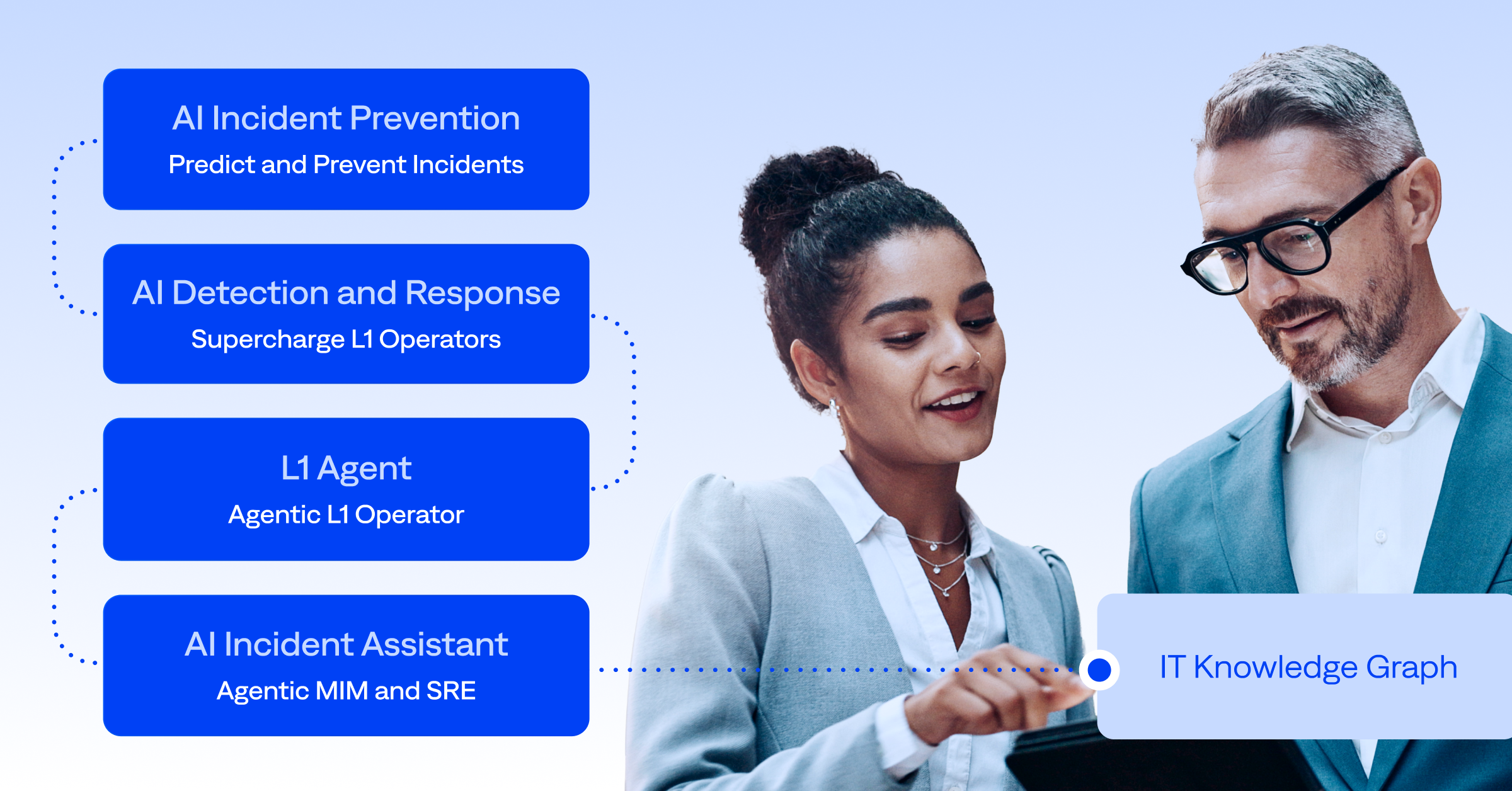
The L1 Agent does not follow or require a script. It applies AI reasoning across real-time incident data and operational knowledge to take context-aware action in any situation, including ones no rule could anticipate. It reasons through an incident the way an experienced operator would by drawing on what is happening now, what has happened before, who owns what, and how the environment is wired together. The BigPanda IT Knowledge Graph enables this, providing the Agent with a unified, continuously updated view of your operational environment.
Take incident routing as a concrete example. When an incident fires, here’s what happens:
- The L1 Agent automatically picks up the incident.
- It runs AI analysis, pulling in historical incident records, recent change context, external observability signals, and service desk data to build a full picture of what is happening.
- Using that context, it determines which team the incident belongs to and routes it directly.
- It steps aside so the right team can act, with full context already attached.
The whole sequence happens in seconds, without unnecessary escalations or misassignments. And because the agent learns from every outcome, it gets more accurate the longer it runs in your environment.
A different kind of operating model
The L1 Agent changes how L1 operations get measured. The question shifts from how efficiently your team handles incidents to how much of your incident workload the agent automates end to end, without human intervention. Leaders can stop planning around headcount and start planning around automation coverage. That’s a different conversation with finance, a different approach to capacity planning, and ultimately a fundamentally different operating model.
AI-assisted operations can make your L1 team faster, but a human still has to act on every recommendation that comes through. The bottleneck isn’t information; it’s the human action required for every single incident in the queue. The L1 Agent addresses that directly. It handles the work, which means scale no longer requires proportional headcount growth. Your L1s can focus on higher-value work, including overseeing what the agent is doing, handling the exceptions it escalates, and developing the expertise that moves them toward L2 and beyond.
How Gamma Communications reduced incidents with L1 Agent
Gamma Communications was one of BigPanda’s earliest L1 Agent design partners. Over the past several months, their team has been working with BigPanda to automate first-line triage and routing, reducing manual effort for their NOC operators and enabling their engineers to focus on higher-value work.
“The BigPanda L1 Agent aligns directly with our strategy to scale operations without scaling cost. We’re focused on eliminating repetitive manual effort and enabling our teams to operate at higher value,” said Dan Bartram, Head of Platform Engineering at Gamma.
“By embedding automation at L1, we anticipate a step-change in efficiency. Incidents will be triaged, enriched, and, in many cases, automatically resolved before human intervention is needed. This not only reduces MTTR and operational overhead but also frees our engineers to focus on complex problem-solving and innovation.”
Get started with the BigPanda L1 Agent
The BigPanda L1 Agent is available now, starting with intelligent ticket routing and assignment. Additional capabilities, including automated suppression, prioritization, and resolution, are in active development and will be rolled out in the coming months. To see what autonomous L1 operations look like in practice, talk to your BigPanda account team or request a demo.