







Enterprise IT operations leaders are realizing that legacy incident management processes cannot keep pace with today’s sprawling, hybrid-cloud enterprise environments. Enterprise IT doesn’t look anything like it did even five years ago. Hybrid cloud architectures, distributed microservices, and increasingly rapid CI/CD cycles have increased the speed and complexity of IT operations by orders of magnitude, leaving ITOps teams struggling to keep up.
When things go wrong, the consequences are more expensive than ever, with major outages costing large enterprises an average of $1.5 million per hour. As IT outage costs rise, it’s critical to resolve incidents as quickly as possible to minimize impact on your organization. Better yet, enterprises need to transition to an incident management model that harnesses advances in technology to prevent incidents before they occur.
Agentic ITOps are the fastest path to breaking this cycle of reactive firefighting and moving to proactive, automated control. Agentic ITOps use AI agents that can understand real-time context across your entire IT ecosystem, coordinate people and communications, and take autonomous action at machine speed.
Learn more about copilots in our previous post, “AI-powered incident management assistants: A guide.”
With the recent introduction of agentic AI-powered assistants, organizations are beginning to test how to implement these advanced tools successfully. According to recent ServiceOps research from EMA, enterprises with mature AIOps programs report benefits such as proactive incident response, reduced outage frequency, and more actionable alerts.
What are agentic AI ITOps agents?
An agentic AI-powered IT operations agent is an autonomous software system that combines large language models with real-time access to context across your IT environment, including monitoring tools, ticketing systems, runbooks, and APIs. These agents can independently perceive, reason, plan, and act across operational tasks, often without requiring human intervention. Unlike a chatbot or recommendation engine, it closes the loop end-to-end by ingesting signals from across your observability stack, correlating data to identify root causes, determining a remediation path, and executing actions directly in connected systems. It operates through a continuous cycle of perception, reasoning, and action to detect anomalies, trace their root cause, facilitate repair, and verify recovery. The “agentic” quality is what distinguishes it: rather than responding to prompts, it pursues goals, self-corrects when steps fail, and adapts its approach as conditions change, behaving less like a tool you query and more like an autonomous operator working alongside your team.
Enterprises that adopt an agentic ITOps assistant can dramatically improve Mean Time to Resolve (MTTR) and operational efficiency. Let’s take a closer look at the top six use cases of agentic AI agents.
#1 Streamline major IT incident coordination
Teams need to accomplish many administrative tasks in the first moments of an incident. These tasks could include creating an incident channel, inviting the right cross-functional team members, and sending incident summaries with tickets and alerts.
An AI-powered incident assistant is an always-on partner that helps IT teams streamline collaboration, investigate more effectively, automate resolution, and prevent future incidents.
These assistants can use agentic AI to organize key incident details from a range of data sources and address manual setup tasks. The assistant can also create and maintain a real-time incident summary to ensure that everyone, including new team members, always has the most up-to-date context. With that work handled, teams can focus on more pressing matters, such as finding the incident’s root cause, implementing a fix, and optimizing processes to prevent future incidents. This results in improved team productivity and quick delivery of an action plan, keeping stakeholders happy and informed.
#2 Automate major incident management communications
In addition to tactical process improvements, an IT operations assistant can improve collaboration and team relationships. By serving as a hub for infrastructure knowledge across siloed teams and fragmented tools, AI can automatically document knowledge sharing and provide collective insights to effectively meet goals.
AI provides your L2 and L3 operators direct access to L1 knowledge. Making this expertise available to all IT team members can help improve productivity and decision-making, speed up incident timelines, and solve general problems.
AI agents automatically summarize and sync real-time incident updates across bridge calls, chat channels, and ITSM tickets. All stakeholders stay aligned on status, impact, and actions without manual updates.
#3 Troubleshoot active incidents with agentic AI
Agentic IT operations assistants can help troubleshoot active incidents. AI agents can autonomously investigate multiple hypotheses in parallel across your IT ecosystem, surfacing anomalies, impacted services, and root cause from real-time and historical data. Using relevant data, agentic AI can provide operators with prioritization guidance, impact assessments, and resolution steps to reduce incident timelines and improve decision-making. Data from similar incidents can also help establish metrics and measure impact, including faster mean time to resolution (MTTR).
#4 Document post-incident details
You can use an IT operations assistant to automatically generate executive summaries, after-action reviews, postmortems, and more, easing the burden of post-incident analysis and saving incident responders valuable time.
Incidents can last anywhere from hours to days. NOC and incident management teams often sit on massive bridge calls, troubleshooting with dozens of colleagues for hours. Documenting a post-mortem can take multiple individuals days, or even weeks, to produce. The last thing an incident manager wants to do is try to summarize the key outcomes of days of work. AI agents can save time, provide thorough incident information, and support team morale. Most importantly, AI can learn how to improve incident triage.
#5 Identify knowledge gaps
AI agents pull data from many IT sources, both human and machine-generated. An agentic IT operations assistant sits at the center of your infrastructure, giving it a unique opportunity to identify system gaps, deficiencies in operator or incident manager knowledge, and opportunities to optimize processes. For example, AI can identify gaps in observability, isolate low-performing alerts, improve alert tagging, identify redundant or unused tools, and provide insights on recurring issues.
#6 Access SME knowledge with plain-language chat
People often use copilots to answer questions they don’t want to ask someone else. Instead of relying on individual subject-matter experts, the IT operations assistant summarizes information across the IT organization. Team members can ask the IT operations assistant questions directly in chat or, ideally, within their ITSM portal, such as ServiceNow Now Assist, to investigate incidents, surface context, and get suggested actions.
Delivering value with an agentic AI-powered IT operations assistant
Implementing an AI assistant for ITOps can help your organization improve productivity and decision-making, reduce incident timelines, and optimize workflows. The more significant benefit to your larger organization is reduced costs and happier stakeholders and customers.
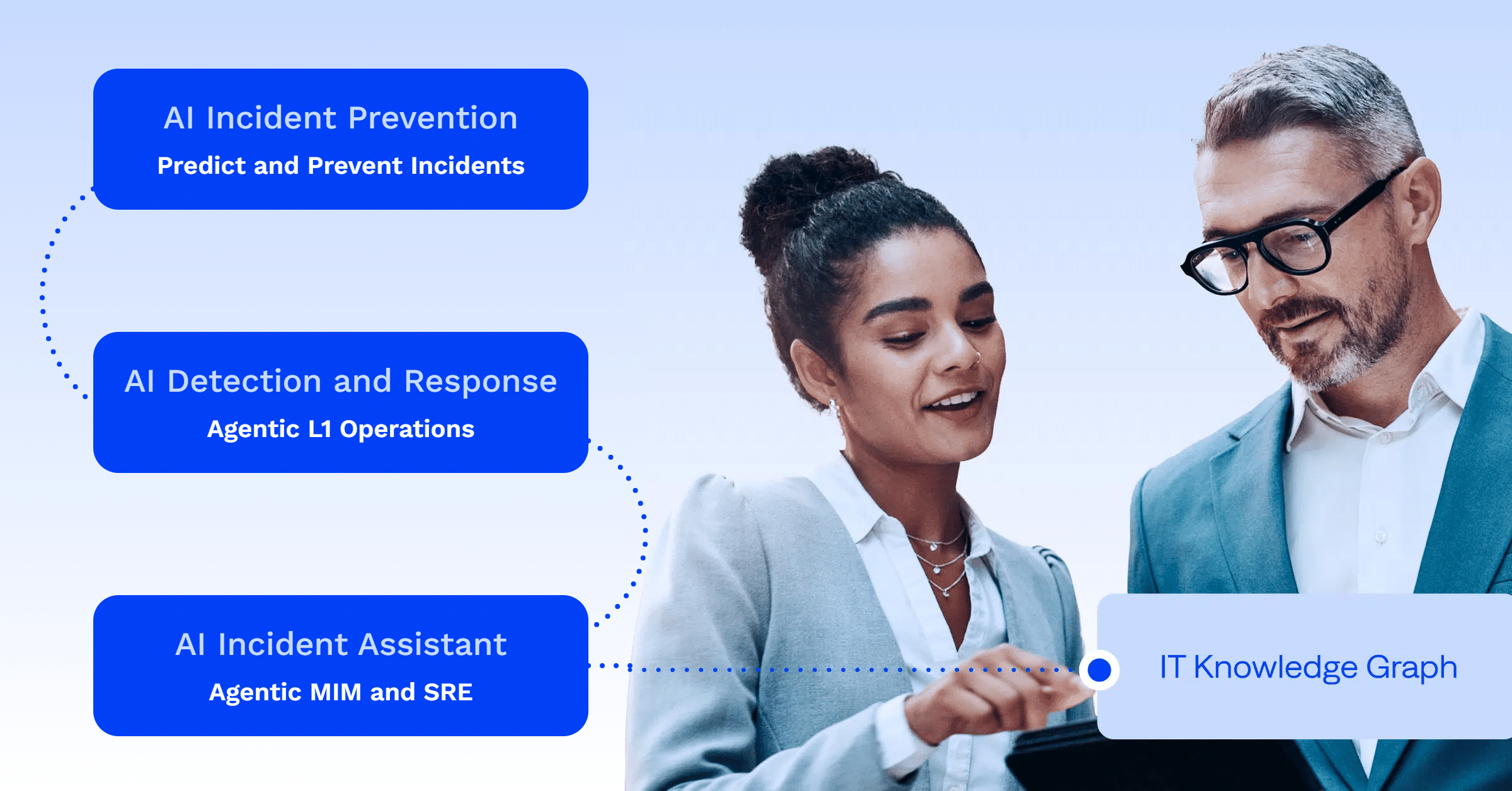
In addition to the suite of automation capabilities, the BigPanda AI Incident Assistant is an always-on partner that helps IT teams streamline collaboration, investigate smarter, and automate resolution without the chaos. It is designed to improve the customer experience by preventing outages and service disruptions, improving service reliability before customers are impacted.
To learn more about AI Incident Assistant, schedule a demo.
Key takeaways from this blog:
- Legacy incident management can’t keep pace with modern IT complexity. Hybrid cloud, microservices, and accelerating CI/CD have made outages more frequent and more expensive, averaging $1.5M per hour for large enterprises. A reactive, manual approach is no longer viable.
- Agentic AI shifts IT operations from reactive firefighting to proactive control. AI agents can understand real-time context across an entire IT ecosystem, coordinate people and communications, and take autonomous actions at machine speed, far faster than any manual process allows.
- AI can handle the administrative and communication burden so human expertst can focus on resolution. From spinning up incident channels and syncing stakeholders to auto-generating postmortems, AI assistants can automate the coordination tasks that drain operator time, freeing teams to concentrate on root cause and remediation.
- Agentic AI can increaase expertise across the entire IT organization. By surfacing L1 knowledge to L2 and L3 operators and giving every team member access to SME-level context via plain-language chat, AI can help make every responder an expert. This accelerates decision-making and reduces reliance on more experienced resources.
- The long-term value is prevention, not just faster resolution. AI agents can continuously identify knowledge gaps, redundant tools, low-quality alerts, and recurring issues. These agents turn post-incident data into systemic improvements that reduce outage frequency over time and protect the customer experience.