






From AIOps to agentic ITOps: Why AI for IT operations has entered a new era

Enterprises cannot hire their way out of IT complexity and scale. A new approach is needed.
Enterprise IT has reached an inflection point. Your teams are responsible for hybrid cloud infrastructure, microservices, third-party dependencies, and shipping AI-generated code at unprecedented velocity. IT environments are becoming more complex faster than traditional tools and processes can keep pace. Alert volumes keep climbing. Institutional knowledge keeps walking out the door. And the pressure to do more with flat or shrinking budgets isn’t letting up.
For nearly a decade, AIOps was the industry’s answer to this problem. And to be clear, AIOps delivered real value such as reduced alert noise, enhanced correlation, and faster triage. However, traditional AIOps platforms, constrained by structured data and rule-based systems, failed to deliver on the promise of proactive, autonomous operations.
It’s impossible for enterprises to hire their way out of this reality. New operators, whether internal hires or outsourced staff, lack knowledge of your enterprise’s systems, history, context, and incident management procedures. Issues escalate more frequently than they should, and the L3s and SREs on the receiving end of those escalations waste precious time reconstructing the context that should have come with the ticket. This wastes expensive senior engineering time on work that never needed to reach them in the first place, extending MTTR. And when major incidents can cost enterprises up to $1.5 million per hour, that’s time no company can afford to waste.
Agentic IT operations close the gap. By pairing advances in agentic AI with the vast reserves of unstructured operational data that legacy platforms couldn’t touch, agentic ITOps transforms AI from a tool that helps humans work faster into an autonomous digital operator that prevents, detects, triages, and resolves incidents at machine speed. Agentic ITOps isn’t a replacement for AIOps; it’s the evolution that finally delivers on the promised capabilities of AIOps.
Here’s why this shift is happening now, what separates agentic ITOps from AIOps, and how IT leaders are already putting it to work.
What is AIOps?
AIOps, or artificial intelligence for IT operations, applies AI and machine learning to streamline and optimize IT processes. Since Gartner coined the term in 2017, AIOps platforms (which Gartner now refers to as event intelligence solutions, or EISs) have become a fixture of enterprise ITOps.
The primary outcomes of traditional AIOps are:

Noise reduction:
Compressing overwhelming alert noise into a manageable set of actionable incidents.

Alert and event correlation:
Aggregating and analyzing data to identify relationships between events to reduce alert fatigue and pinpoint critical issues.

Accelerated root cause analysis:
Surfacing probable causes so responders can investigate faster.

Improved incident workflows:
Enriching incidents with context and routing them to the right teams
These outcomes matter. Organizations that centralized their operations with AIOps saw measurable improvements in detection and response. Alvin Smith, Vice President of Global Infrastructure and Operations at IHG Hotels & Resorts, stated that “centralizing our operations with BigPanda allowed us to have a much earlier MTTD (mean time to detection), which gave us a head start to resolve operational incidents.”
The limitations of traditional AIOps
Traditional AIOps relies on structured data housed in a configuration management database (CMDB) and processed through rule-based systems. That dependency creates two persistent problems.
The CMDB can’t keep up with modern enterprise ITOps. Maintaining an accurate CMDB while your tech stack evolves daily is a losing race. “A CMDB was sold as an inventory and up-to-date map of the entire universe of your services and components, and it almost always falls short of that,” explains Jason Walker, Chief Innovation Officer at BigPanda.
A CMDB can’t provide full context or complete visibility into your operations. Even a perfectly maintained CMDB omits most of your organization’s institutional knowledge. Vital operational context in the form of team expertise, unstructured tickets, chat logs, call transcripts, and runbook knowledge remains buried and unusable. If an incident hits at 2 am, your responders are left without the actionable context they need to detect, triage, and respond quickly and effectively.
Rigid, rule-based systems compound these issues. In an era where AI-assisted development is accelerating change across every enterprise, systems that depend on static rules and structured inventories fall further behind each quarter. In short, while traditional AIOps makes humans faster and better informed, it doesn’t fundamentally change who does the work, or how much of it there is. These are the problems that agentic ITOps solves at scale.
What is agentic ITOps?
Agentic ITOps uses advanced agentic AI to transform manual, reactive ITOps processes into intelligent, autonomous systems that can proactively prevent, detect, diagnose, and respond to IT incidents with minimal human intervention.
Two architectural breakthroughs distinguish agentic ITOps from traditional AIOps:
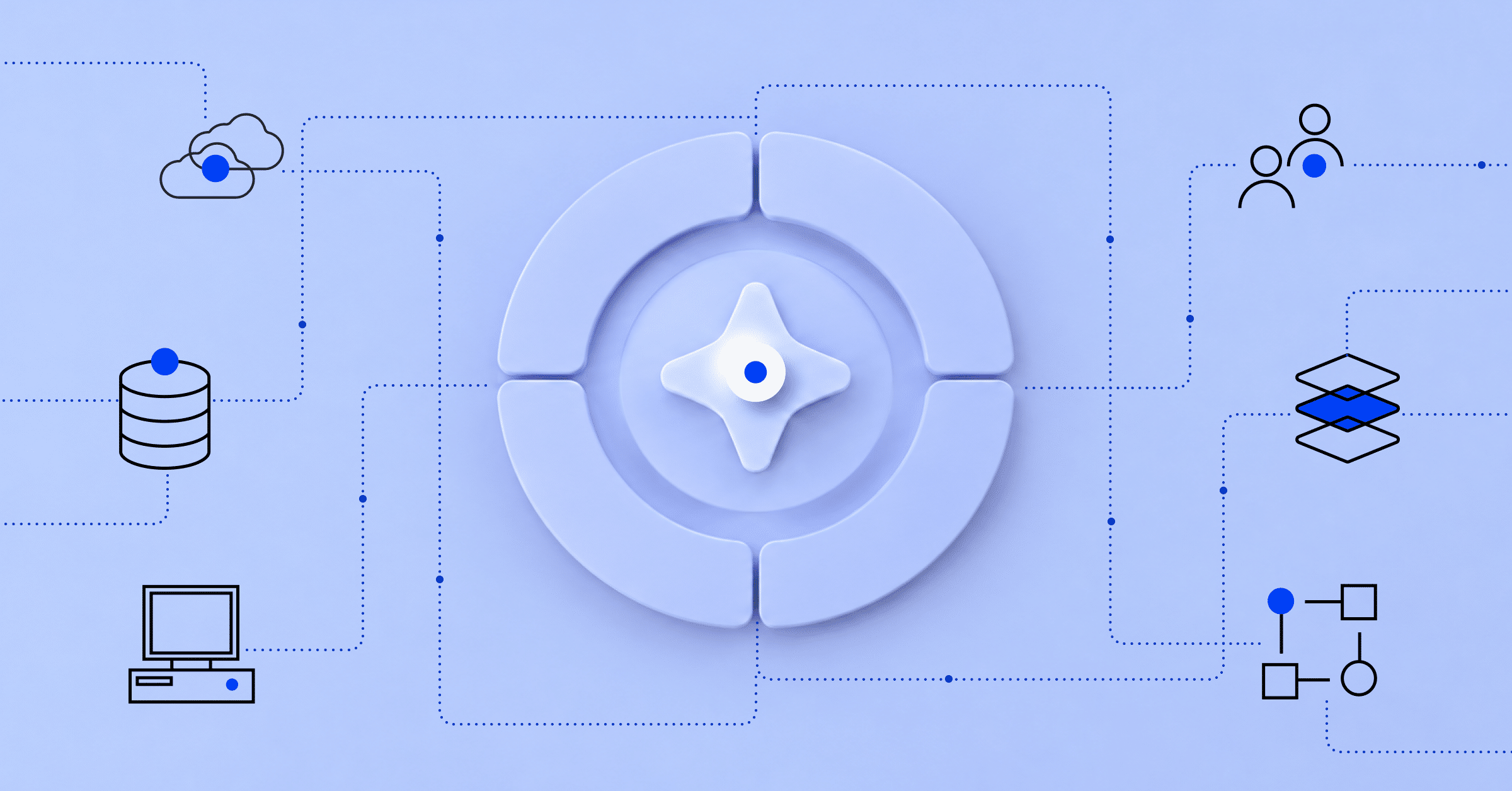
Agentic ITOps eliminates the dependency on structured data and rules. Agentic AI can ingest, index, and reason over unstructured data. With agentic AI, chat histories, ticket narratives, call transcripts, ITSM logs, documentation, and even external signals like power outages and social media reports all become sources of intelligence to equip your responders with vital context. This provides unprecedented understanding and visibility.
Agentic ITOps can take independent action without human intervention. Agentic ITOps uses autonomous systems, also known as AI agents, that can make decisions and perform tasks without constant human intervention. These agents can adapt to changing environments, learn from experience, and collaborate with humans to prevent, detect, and respond to incidents at machine speed. They can automatically detect potential issues, rapidly diagnose them, assess impact, prioritize accordingly, trigger automated fixes or suggest next steps, and even prevent IT incidents before they impact services.
Critically, agentic ITOps doesn’t remove humans from the loop. It augments your responders and spares them from needless, repetitive work so they can focus on solving critical issues and driving innovation.
Comparing AIOps to agentic ITOps
The clearest way to understand the shift from traditional AIOps to agentic ITOps is to compare the two approaches side by side.
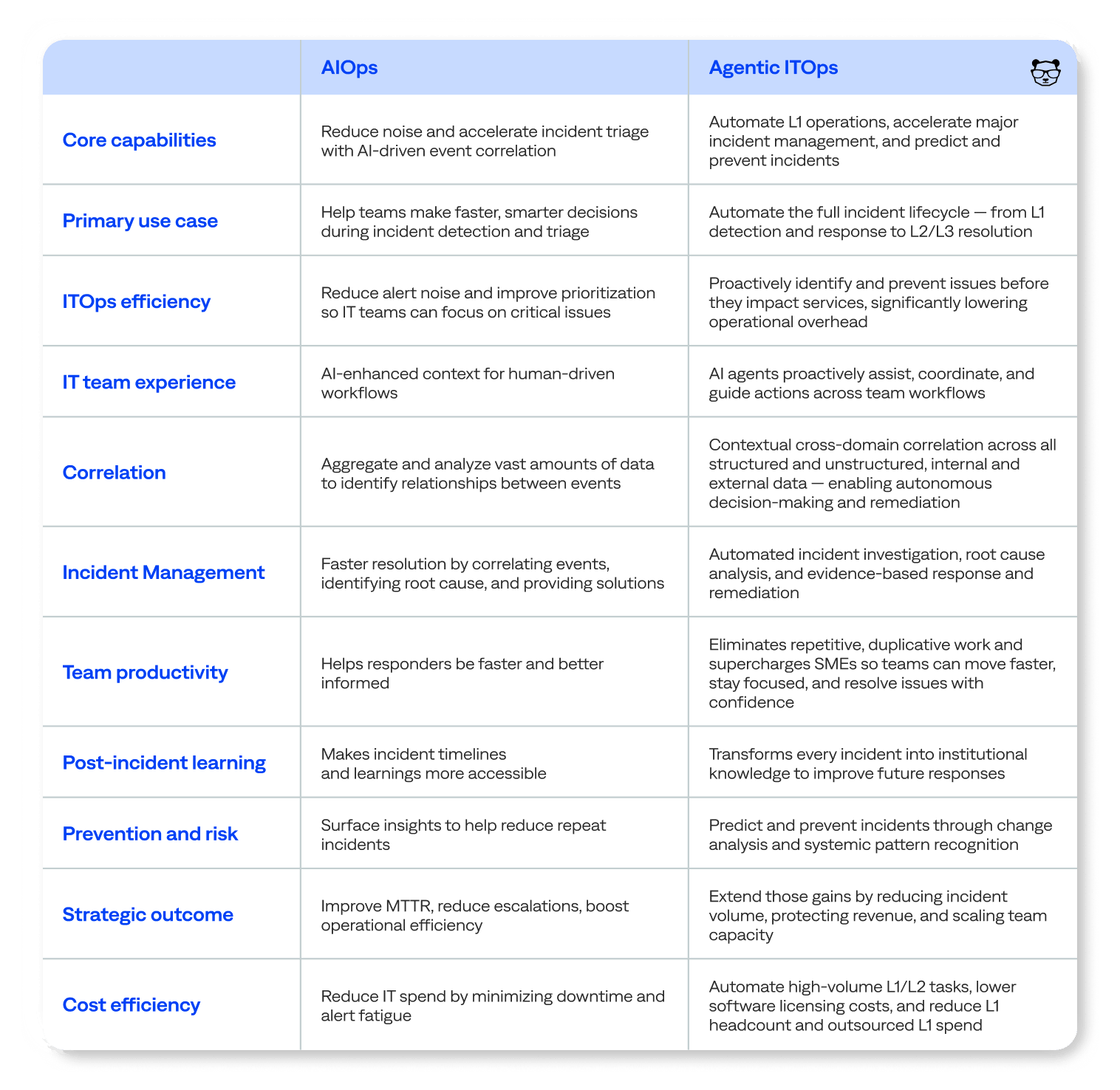
The pattern is consistent across every row: AIOps helps humans do the work faster; agentic ITOps does much of the work itself, and frees up humans for the work only they can perform.
Agentic ITOps adoption is increasing rapidly
The capabilities that agentic AI brings to ITOps make the long-sought-after goal of proactive issue detection a reality. AI can continuously scan the environment and surface anomalies before they become incidents, and the IT leaders we’ve spoken to have described achieving proactive operations as an urgent priority.
The teams that are furthest along have stopped thinking of AI as a feature within an existing workflow and started building workflows around it. Agentic ITOps platforms don’t fit into the old NOC model; they’re the foundation of a new one.
Three forces are converging to make agentic ITOps an urgent priority for enterprise IT leaders.
Complexity is compounding faster than headcount
Modern enterprise environments span hybrid infrastructure, hundreds of SaaS dependencies, and services that change daily. Meanwhile, AI-assisted development means more code is shipping, faster, from more sources than ever before. The volume of changes and the incident risk they entail are scaling exponentially, while ITOps headcount remains flat. Manually keeping pace is no longer a viable strategy. Autonomous prevention, detection, triage, and response is the only approach that scales with the environment itself.

The economics are impossible to ignore
There is an estimated $250 billion in manual ITOps workflows that are ripe for intelligent automation. Every repetitive L1 task your team performs, such as acknowledging alerts, gathering context, opening tickets, paging responders, and running standard diagnostics, are tasks that agentic ITOps can automate. That translates directly into reduced L1 headcount requirements, lower outsourced L1 and MSP spend, fewer unnecessary escalations into expensive engineering time, and reduced IT software licensing costs. For CIOs looking to adopt Agentic AI, ITOps and ITSM are among the lowest-hanging fruit for disruption.
Technology has caught up to promised capabilities
The vision of proactive, self-healing IT operations isn’t new; it’s what AIOps was always supposed to deliver. What’s new is that agentic AI can now reason over messy, unstructured, incomplete data, adapt to changing environments without rule rewrites, and take autonomous, evidence-based action. The gap between the AIOps promise and the deployed reality has closed.
What agentic ITOps looks like in practice
Adopting agentic ITOps isn’t an abstract transformation. It shows up as four concrete capability shifts:
Massively improved incident detection. AI agents can deliver real-time visibility into external dependencies, end-user issues, and real-world events that traditional monitoring never sees. Issues get detected earlier, often before customers notice.
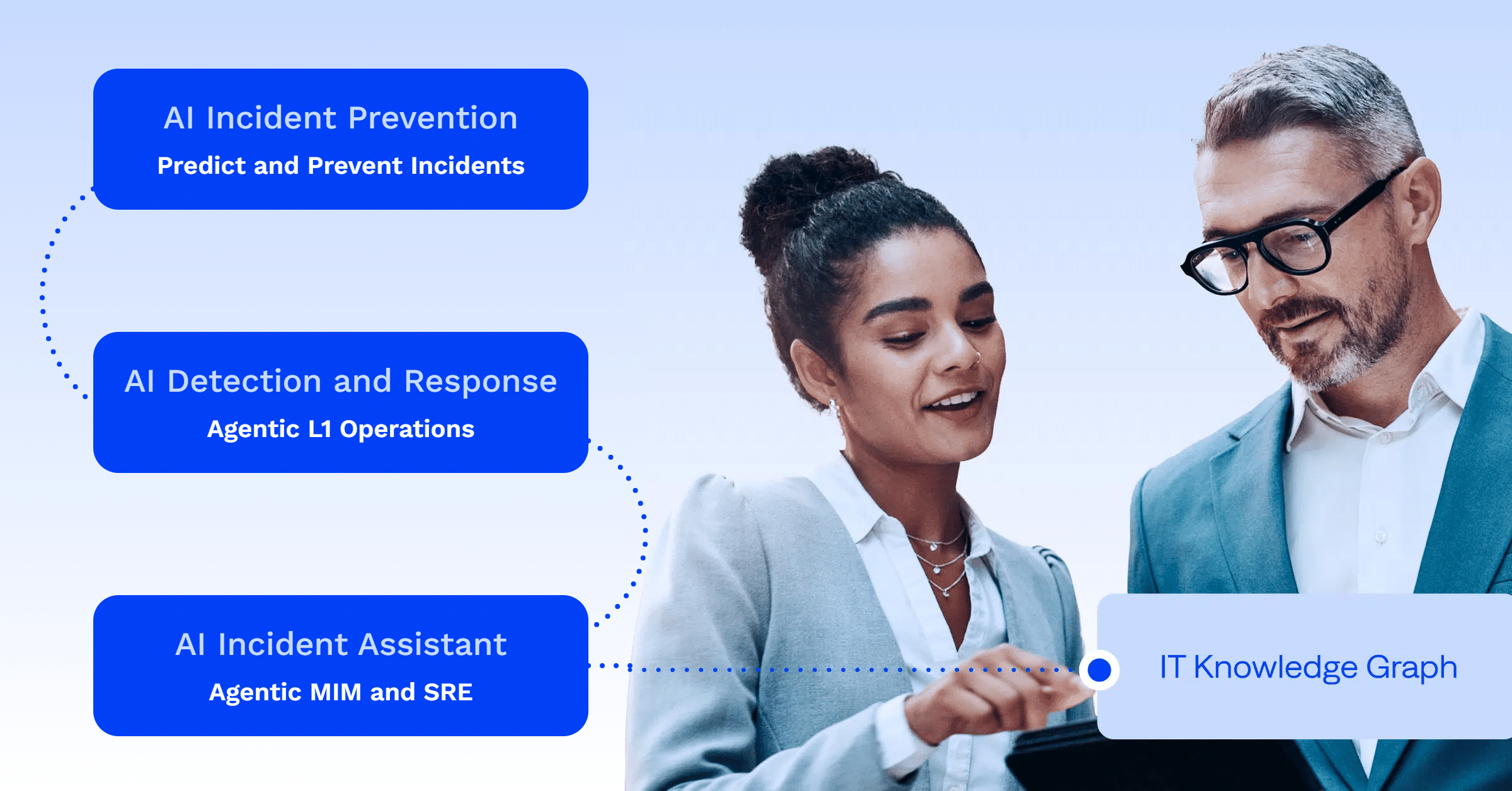
Automated L1 operations. Agentic ITOps autonomously detect, triage, and respond to incidents across complex and distributed environments, providing AI-driven insights and guided actions for responders. The routine work that consumes L1 teams today happens at machine speed, around the clock.
Augmented incident management teams. An AI assistant works alongside your L2, L3, and SRE teams to automate workflows, accelerate resolution, and boost service reliability. Responders arrive at every incident with the investigation already done, the context already assembled, and the next steps already suggested.
Automated IT change management. With change analysis and risk mitigation built in, agentic ITOps provides clear guardrails that help teams predict and prevent change-related failures. Teams shift from reactive firefighting to proactive reliability.
With these capabilities, incidents are detected sooner, triaged instantly, and resolved faster, and every incident becomes institutional knowledge that improves the next response.
How to prepare your organization for agentic ITOps
The good news for IT leaders is that you don’t need a multi-year data cleanup project to get started. Agentic AI is designed to work with messy, incomplete, fragmented data, and your existing tickets, chat logs, monitoring alerts, and documentation are the raw material.
To help you get started, BigPanda released our new ebook, Laying the data foundation for agentic ITOps: A strategic guide for enterprise IT leaders. This guide will help enterprise IT leaders prepare their organization for agentic ITOps and lay the groundwork for advanced features including AI Incident Prevention, AI Detection and Response, and AI Incident Assistant.
Get your copy today to learn how your organization can lay the data foundation for agentic AI-powered ITOps that improve mean time to resolution (MTTR), reduce L1 spend, prevent escalations, and improve SLAs and uptime.
5 key takeaways from this blog
- Agentic ITOps is the evolution of AIOps, not a replacement for it. It delivers on the original AIOps promise of proactive, AI-powered IT operations by adding autonomous decision-making and action to the noise reduction and correlation that AIOps pioneered.
- Agentic ITOps doesn’t need structured data and rules. Traditional AIOps depends on accurate CMDBs and rigid rule sets. Agentic ITOps ingests unstructured data such as tickets, chat logs, transcripts, and external signals, and converts your buried institutional knowledge and context into operational intelligence.
- AI agents act, not just analyze. Agentic ITOps automatically detects potential issues, diagnoses them, assesses impact, prioritizes, triggers automated fixes or suggests next steps, and predicts and prevents incidents to cover the full incident lifecycle.
- The business case is measured in both risk and dollars. With an estimated $250 billion in manual ITOps workflows ripe for automation, agentic ITOps reduces incident volume, protects revenue, lowers L1 and outsourced spend, prevents escalations, and improves SLAs and uptime.
- Humans stay in the loop and can focus on higher-value work. Agentic ITOps augments responders rather than replacing them, eliminating repetitive toil so SMEs can focus on critical issues, innovation, and the judgment calls only humans can make.