






The most expensive hour in IT: Why major incident management is Agentic ITOps’ moment of truth


Picture the bridge call at 2 am. A Sev1 has taken down a critical service, and the paging storm has pulled forty people out of bed, even though only six of them will ever touch the fix. The first hour disappears into roll call and trying to figure out which changes shipped last night, which alerts are related, and who actually owns the failing service. The engineers closest to the problem keep getting interrupted to brief executives, and everyone on the call already knows the post-mortem will sit unwritten for weeks.
Every enterprise IT leader has lived some version of this scene, many this quarter. The stakes of major IT incident management are well documented. Major outages cost large enterprises an average of $1.5 million per hour, something we call “the most expensive hour in IT.”
Agentic AI is redefining what’s possible during a major incident, and for enterprises starting their Agentic ITOps journey, major incident management has emerged as the smartest first step. In this post, we’ll examine where the traditional major incident process breaks down, what AI agents change about it, and how IT leaders can avoid becoming part of the 40%+ of agentic AI projects Gartner expects to be canceled by the end of 2027.
What is major incident management?
Major incident management (MIM) is the process enterprises use to respond to their highest-severity incidents. Sev1s and Sev2s disrupt critical business services, threaten SLAs, and put revenue and customer trust at risk. Where routine incidents flow through standard L1 workflows, a major incident triggers an emergency protocol. Your teams have to declare the incident, assemble responders, stand up a bridge or war room, coordinate the investigation, keep stakeholders informed, and document everything once service is restored.
Organizations invest $250 billion of enterprise spending every year in manual, human-driven IT operations because the stakes demand it. And all that money buys an operating model that complexity has already outgrown, because it was built for a simpler era of IT. Today’s environments run on distributed architectures, sprawling third-party dependencies, and a relentlessly accelerating pace of change. A response model that depends on humans sharing what they know over a conference line simply can’t keep pace.
Where the traditional major incident management process breaks down
Traditional major incident management relies on the assumption that if you get enough smart people into a room, they’ll always find the answer to the problem. In modern environments, that assumption fails in four predictable ways.

Combine these factors and an uncomfortable truth emerges: the people are doing everything right, and the process itself has become the bottleneck.
How Agentic ITOps changes the war room
Here’s the distinction every IT leader evaluating AI should understand: assistive AI waits to be asked. Agentic AI pursues the outcome.
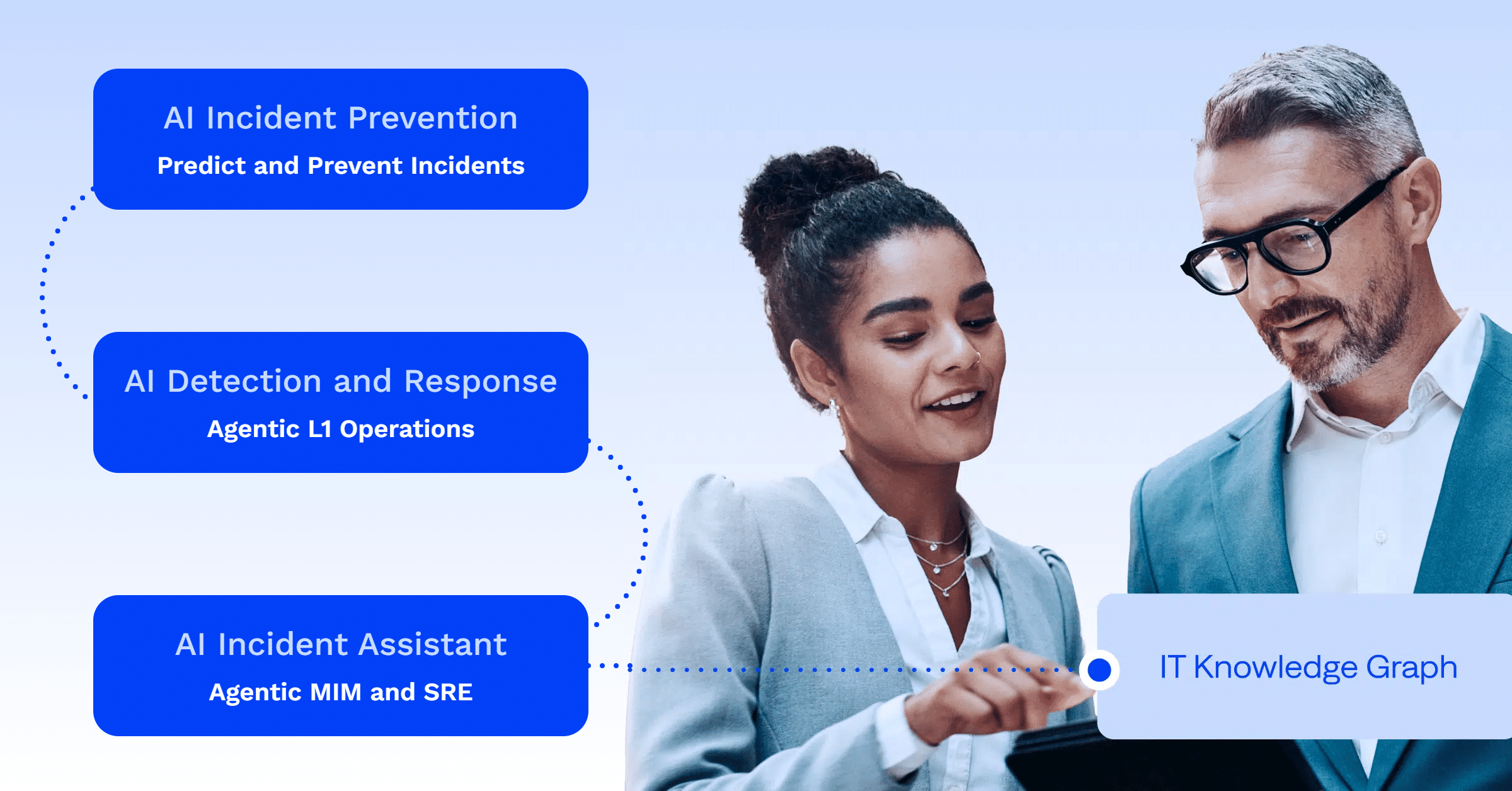
Agentic IT operations deploy autonomous AI agents that can perceive, reason, plan, and act to investigate incidents, coordinate people, and improve with every incident they touch. Think of it as the next step in a progression, where monitoring surfaced the symptoms, AIOps separated signal from noise, and Agentic ITOps takes action on what it finds.
Applied to major incident management, that shift touches every stage of response:

Responders start with answers, not questions.
At the time of declaration, the BigPanda AI Incident Assistant has already gathered what changed, which services are affected, how far the impact could spread, and how similar incidents were resolved in the past. The archaeology phase disappears.

The bridge gets smaller and sharper.
Instead of paging by rotation alone, agents determine which experts the incident actually requires, drawing on service ownership and a record of who has solved similar problems before. Fewer people get woken up, and the ones brought in are the right ones.

Investigation runs in parallel, at machine speed.
AI agents can pursue multiple hypotheses simultaneously, such as reviewing recent changes, converting raw telemetry into plain language, and retrieving comparable incidents along with their fixes. Responders can ask questions in natural language, rather than pivoting between a dozen consoles, and the latest generation of the AI Incident Assistant brings that investigative muscle directly into the war room.

Communication runs itself.
Status updates flow to leadership and business stakeholders on an automated cadence, driven by workflows that match the communication, escalation, and approval protocols you already follow. Your engineers keep troubleshooting while your stakeholders stay current.

Resolution feeds prevention.
Post-mortems and executive summaries are produced the moment an incident closes, and every incident strengthens the knowledge foundation behind the next response. Over time, recurrence drops, and response sharpens. This compounding effect helps SRE teams succeed at enterprise scale.
One of our customers, a Fortune 500 global hospitality enterprise, spent two hours troubleshooting a major incident the traditional way. When they let the AI Incident Assistant’s agents take over the investigation, they had their root cause fifteen minutes later.
Agentic AI in ITOps is the future, but success isn’t guaranteed
Gartner predicts that by 2029, 70% of enterprises will deploy agentic AI to operate their IT infrastructure, up from less than 5% in 2025.
The direction is settled, but the outcomes of individual programs aren’t. Gartner also predicts that over 40% of agentic AI projects will be canceled by the end of 2027, citing escalating costs, unclear business value, and inadequate risk controls. S&P Global found that 42% of companies walked away from most of their AI initiatives in 2025, up from 17% a year earlier. And MIT research showed that 95% of enterprise generative AI pilots fail to deliver their intended operational impact.
The pattern that’s emerging is that these programs rarely fail because the AI wasn’t capable. They fail because their was no clear owner of the program and its outcomes. From integration, governance, reliability engineering, business-aligned metrics, to holding leadership accoundatble, the unglamorous work that turns a promising pilot into a production operating model is the work most pilots never get.
Major incident management sharpens both edges of this reality. The potential returns are larger here than almost anywhere in IT, and the margin for error is smaller: one poorly governed autonomous action during a Sev1 can set an AI program back by a year. That’s why, at BigPanda, we encourage leaders to treat Agentic ITOps not as a tool rollout but as a series of deliberate leadership decisions.
Why major incident management is the right starting point for Agentic ITOps
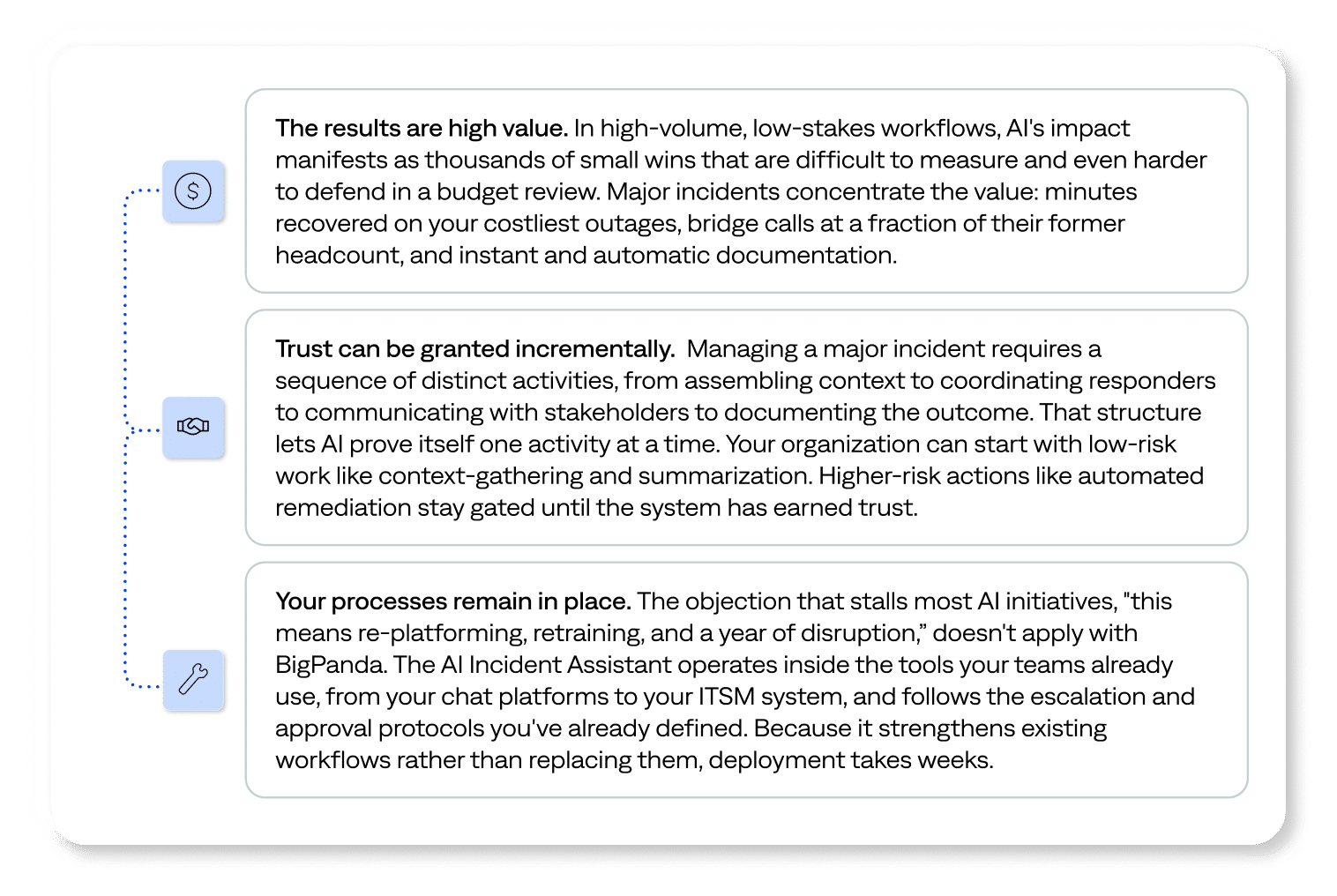
While starting your Agentic ITOps journey in the highest-stakes room in IT might sound risky, in practice, three characteristics make it the strongest opening move.
Four decisions separate successful Agentic ITOps deployments from failed pilots
So what should an IT leader actually decide before launching agentic AI in the war room? Based on our work with the world’s largest IT organizations, success comes down to four questions, answered deliberately in the first 90 days:
- Scope: Which parts of the major incident lifecycle will AI own, assist with, or simply observe?
- Autonomy: Under what conditions can AI act without human approval, and how does it earn more latitude?
- Metrics: Which two or three numbers will prove the program’s value in a business review?
- Change Agent: Which leader is accountable for turning the pilot into an operating model?
These decisions are critical for ensuring your Agentic ITOps deployment is successful and impactful. We’ve put all of these key learnings into The Four Decisions: A 90-Day Leadership Playbook for Agentic ITOps. Inside, you’ll find a breakdown of where AI should reason first in the incident lifecycle, an autonomy ladder with promotion criteria and automatic circuit breakers, the key metrics that belong in your business review, and a phase-by-phase 90-day plan with clear exit criteria.
The most expensive hour in IT has repeated itself long enough. The enterprises that finally change it will be the ones that start today, with a focused scope, a graduated trust model, and a plan.
Key takeaways from this blog:
- The traditional major incident process has become the bottleneck. Major outages cost large enterprises an average of $1.5M per hour, yet response still relies on crowded bridge calls, manual context gathering, hand-built status updates, and post-mortems that arrive weeks late — a model designed for far simpler environments.
- Agentic AI transforms every stage of major incident response. Answers ready at declaration, precision paging that shrinks the bridge, parallel machine-speed investigation, self-running stakeholder communications, and documentation that feeds the next response.
- Adoption is accelerating, but success isn’t automatic. Gartner expects 70% of enterprises to run agentic AI in IT infrastructure operations by 2029, while also predicting that over 40% of agentic AI projects will be canceled by the end of 2027. The programs that fail rarely fail on technology.
- Major incident management is the smartest first use case. Its value is concentrated enough to measure, its structure lets AI earn trust one activity at a time, and it strengthens existing workflows rather than replacing them.
- Success hinges on four leadership decisions. Scope, autonomy, metrics, and an accountable change agent determine whether your program transforms operations or joins the ranks of cancellation statistics.