






What is IT topology mapping?
IT topology mapping is the process of discovering and visually representing how components in an IT environment connect to, depend on, and communicate with one another across hardware, software, services, and networks. Network topology mapping and infrastructure topology mapping are narrower disciplines, each covering a single layer within it.
The full-stack view gives operations teams a live working model of dependencies, so they can see what broke, what it affects, and where to look for the root cause. Without that model, incident responders trace dependencies by hand while the incident is still running.
Physical vs. logical topology mapping
IT topology mapping covers two main dimensions. Physical topology captures the hardware layer: servers, cables, switches, and data center layout. Logical topology captures service relationships, application dependencies, and traffic flows.
Both dimensions matter for incident response. A physical view tells you which rack is down; a logical view tells you which customer-facing services that rack was serving.
Types of IT topology mapping
Each type targets a different layer of the environment. Together they cover the full stack.
| Type | What it covers | Primary use |
|---|---|---|
| Network topology mapping | Routers, switches, firewalls, VLANs, physical links, logical network paths | Network troubleshooting, traffic analysis, connectivity monitoring |
| Infrastructure topology mapping | Servers, storage, virtualization, cloud resources, data center interconnects | Capacity planning, hardware incident triage, cloud migration impact |
| Application topology mapping | Services, microservices, APIs, databases, dependencies between application components | Root cause analysis, service impact assessment, change risk scoring |
Infrastructure topology mapping and application topology mapping are especially relevant for enterprise teams managing hybrid cloud estates, where a single service may span on-premises hardware, cloud VMs, and third-party APIs.
How IT topology mapping works
The process runs in four steps, and the fourth feeds back into the first.
Step 1: Discovery
Automated agents, APIs, SNMP polling, and flow data scan the environment to identify configuration items and endpoints. Manual scanning is possible but quickly becomes inaccurate in any environment that changes frequently.
Step 2: Relationship mapping
The tool builds dependency links between discovered components based on traffic patterns, configuration data, and service calls. This is where the map gains its operational value: knowing that Service A depends on Database B, which runs on Host C.
Step 3: Visualization
The map renders as an interactive graph or diagram, with nodes representing components and edges representing the connections between them. Teams can query, filter, and explore the map to understand scope and impact.
Step 4: Continuous update
As deployments, scaling events, and configuration changes happen, the map refreshes. This is the step where automated and manual approaches diverge most sharply: a manual map is outdated within hours in a CI/CD environment.
Topology mapping vs. CMDBs and dependency mapping
These three concepts are related but serve different purposes. Confusing them leads to the wrong tool for the job.
| Concept | What it captures | Primary limitation |
|---|---|---|
| CMDB (configuration management database) | Structured database of configuration items and their attributes | Manually maintained; goes stale quickly in dynamic environments |
| Dependency mapping | Application-service relationships and component dependencies at the application layer | Narrower scope than full topology; typically misses network and infrastructure layers |
| IT topology mapping | Dynamic, relationship-first model of the full environment including network, infrastructure, and application layers | Requires continuous update to stay accurate; can be incomplete if discovery isn’t automated |
A CMDB stores records. A topology map models relationships. Service dependency mapping does the same at the application layer. The IT Knowledge Graph treats all three as complementary inputs to a single intelligence layer rather than competing systems of record.
Why static topology maps fail modern IT environments
A static map built for quarterly change cycles can’t keep up with a hybrid cloud environment that changes daily. The DevOps Research and Assessment (DORA) team at Google Cloud found that 23% of teams surveyed deploy daily and 45% deploy weekly, and at enterprise scale the totals mount fast: one global financial institution executed roughly 50,000 IT changes in a single year.
Three problems compound from there:
- Manual update cycles mean the map reflects the past, not the present.
- Siloed tools produce fragmented views that contradict each other.
- AI systems fed stale topology data produce incorrect correlations and miss real root causes.
When an incident fires and the map is wrong, responders reconstruct dependencies by hand. At Cambia Health Solutions, the NOC chased hundreds of seemingly disconnected alerts without knowing which ones belonged to the same incident, and identifying a critical alert could take up to 30 minutes against a committed 15-minute SLA. Not knowing what depends on what is a topology problem. Once those alerts were correlated into single incidents, Cambia’s NOC began identifying critical alerts in 30 seconds.
Real-time topology mapping and AIOps
Whether topology is real-time or static decides whether a map can drive automation or can only be read. An AIOps platform correlating alerts against a week-old map will group the wrong symptoms and route responders to a component that has since been replaced.
Key use cases for IT topology mapping
- Alert correlation: groups alerts that share an upstream dependency into a single incident, cutting noise before it reaches the queue
- Root cause analysis: traces symptoms through the dependency graph to the origin component
- Change risk assessment: identifies dependent services before a change ships, preventing avoidable outages
- Blast radius estimation: shows the full impact scope during an active outage so the right teams engage immediately
- Capacity and migration planning: models the effect of moving or scaling a component before execution
How the IT Knowledge Graph handles real-time topology mapping
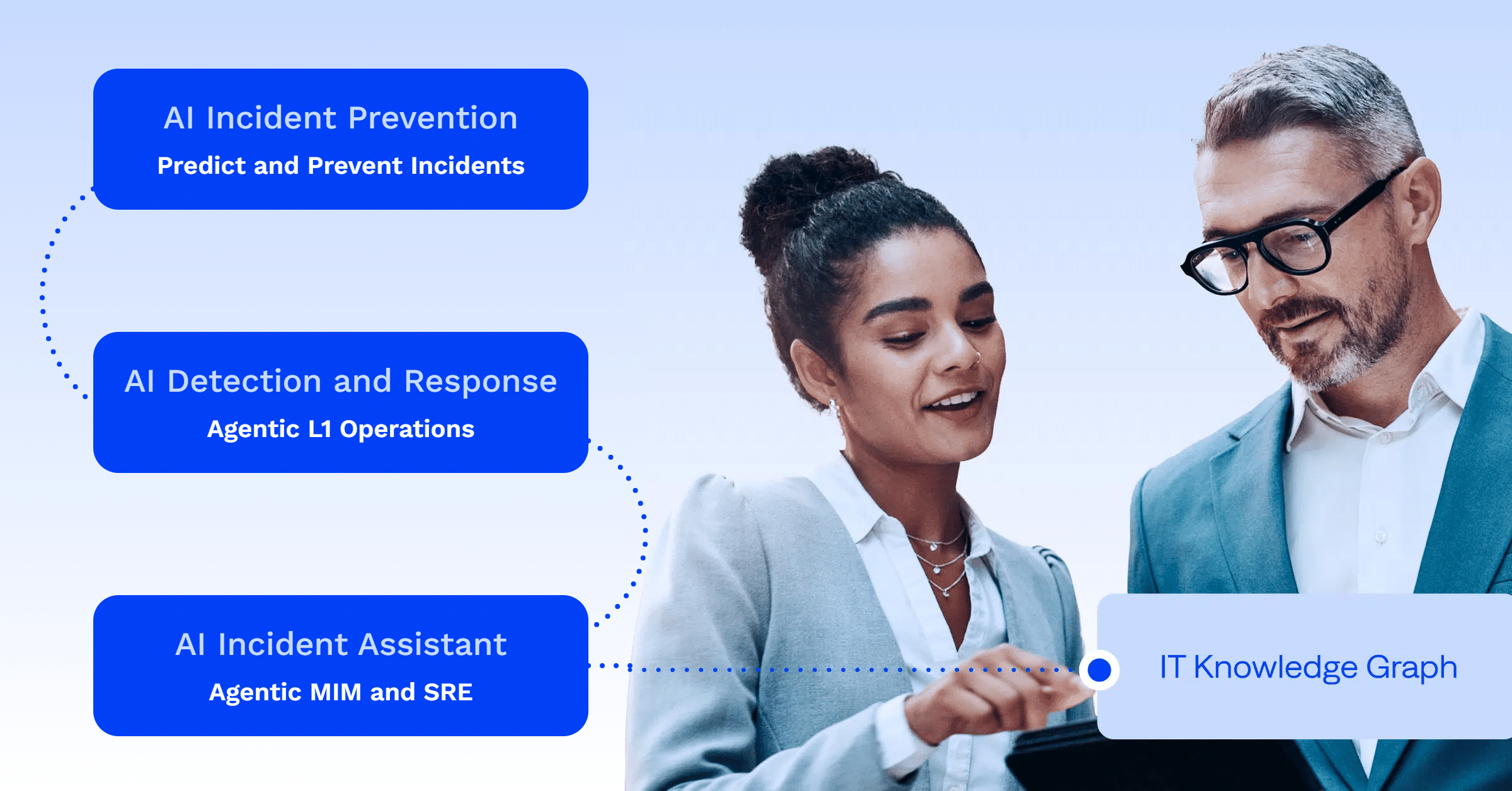
The IT Knowledge Graph captures topology, change, observability, and ITSM data in a unified, continuously updated layer. It ingests topology signals from fragmented source systems into a full-stack model and makes that model available to AI agents in real time. Unlike static CMDB-based approaches, it works with the fragmented, inconsistent data real enterprise environments produce, and improves that data through daily use.
That live topology feeds AI Detection and Response for cross-domain alert correlation, part of how the platform reduces alert volume by over 95%.
Frequently asked questions about IT topology mapping
How is IT topology mapping different from network topology mapping?
Network topology mapping focuses on the network layer: routers, switches, firewalls, and connection paths. IT topology mapping covers the full stack, including hardware, software, services, cloud resources, and the dependencies between them. Network topology mapping is one component of IT topology mapping, not a synonym for it.
What is the difference between topology mapping and a CMDB?
A CMDB is a structured database of configuration items maintained as a system of record. IT topology mapping is a dynamic, relationship-first model that captures how those items connect in real time. A CMDB tells you what exists; a topology map tells you what depends on what. CMDBs go stale faster because they require manual updates.
What is application topology mapping?
Application topology mapping visualizes dependencies between application components: services, microservices, APIs, databases, and the calls between them. It lets teams assess the impact of a failure or planned change at the service layer, not just at the network or hardware layer.
What is real-time topology mapping and why does it matter?
Real-time topology mapping continuously updates dependency data as the environment changes rather than capturing a snapshot that grows stale. In hybrid cloud and CI/CD environments, infrastructure changes constantly. A live topology model improves the speed and accuracy of alert correlation, root cause analysis, and change risk assessment.
What IT topology tools or software are available?
IT topology tools range from agent-based network discovery tools to APM platforms with service dependency mapping to AIOps platforms that include topology as part of broader incident management. The IT Knowledge Graph unifies topology, change, and observability data from your existing tools to power correlation and automated triage across the full stack. The right tool depends on whether you need network-layer visibility, application-layer dependency mapping, or a unified view across both.
Check out more related content

PLATFORM
BigPanda Agentic ITOps
See how BigPanda uses agentic AI in IT operations.