






E-BOOK
From reactive chaos to automated control:
Transform ITSM with an agentic AI-powered incident assistant
Reduce the volume and duration of incidents with agentic ITOps.
1
The challenges of modern incident management
2
Transform IT incident management from reactive and manual to proactive and automated with agentic AI
3
Supercharge your experts with the BigPanda AI Incident Assistant
Key Learnings:
- Major IT service outages are increasing in cost, frequency, and duration. This unplanned downtime costs large enterprises an average of nearly $25,000 per minute, or $1.5 million per hour.
- Enterprise ITOps requires a more agile and intelligent approach that leverages advances in AI and automation to remain scalable, effective, and sustainable.
- Agentic AI-powered automation reduces incident duration and volume, enabling faster, smarter, and lower-risk resolutions through evidence-based insights. L2 and L3 teams can focus on strategic, high-value work, empowering IT to meet customer and business demands, adhere to SLAs, and support innovation.
- The BigPanda AI Incident Assistant automates incident management tasks such as providing real-time summaries that update as the incident progresses and generating after-action reports, saving an average of 35 minutes per interaction.
The challenges of modern incident management

“The tasks of IT incident management are still burdensome, complex, and manual. Processes like collecting and correlating data are hard, especially if you do them manually.”

Enterprises rely on hybrid cloud infrastructures that span on-premises, private, and public clouds, as well as agile CI/CD methodologies, to accelerate software delivery and innovation. These advancements promote business agility, but they also create significant challenges for the teams tasked with ensuring service reliability, improving operational efficiency, and preventing incidents from escalating into outages.
Enterprise Management Associates (EMA) found that major IT service outages are increasing in cost, frequency, and duration. This unplanned downtime costs large enterprises an average of nearly $25,000 per minute, or $1.5 million per hour. As IT outage costs rise, it’s critical to resolve incidents as quickly as possible to minimize impact on your organization.
To resolve incidents and maintain reliable services, enterprises typically rely on IT Service Management (ITSM) frameworks. These frameworks provide structured processes for event management, incident management, change management, problem management, and other disciplines to ensure service continuity. ITSM helps centralized IT teams standardize operations, minimize disruptions, and ensure consistent delivery across the organization.
ITSM relies on accurate and comprehensive data about an organization’s IT environment to be effective. However, this has become increasingly challenging as enterprise IT departments struggle to keep up with the dramatic increases in complexity, fragmentation, and chaos in their IT environments.
These factors result in fragmented collaboration, inaccessible data and knowledge, and poor situational awareness, which in turn drive spiraling operational, infrastructure, and personnel costs.
“The tasks of IT incident management are still burdensome, complex, and manual. Processes like collecting and correlating data are hard, especially if you do them manually.”

Fragmented collaboration and poor documentation
According to a survey by EMA, 43% of respondents identified prioritization and routing as the phase of incident management that most needs improvement, while 52% named team engagement and collaboration as the areas that need the most improvement. Incident management teams are forced to collaborate across multiple support and escalation tiers, which are often aligned with siloed areas of the network, applications, and services. This messy, manual process is inefficient and slows down investigation, increasing operational costs.
Inaccessible institutional knowledge
Fragmented, noisy, and incomplete data complicate incident response and prevent teams from gaining a clear understanding of the full context surrounding IT incidents. Critical procedural and protocol knowledge for incident response is buried and siloed in undocumented chats or call transcripts, making it difficult to identify and apply remediation actions based on past incidents. This issue makes it extremely difficult for teams to get the actionable insights they need to resolve incidents effectively.


Manual workflows that lack situational awareness
During major incidents, routine tasks such as health checks, status updates, or escalations for other incidents often fall through the cracks. Subject matter experts (SMEs) are inundated with routine questions or escalations that distract them from higher-value, strategic work. Without clear ownership, incidents fester and teams react to escalating incidents in silos.
A fragmented, reactive approach to incident management negatively impacts service reliability, hinders business growth, erodes customer trust, and hurts the bottom line. Legacy tools and processes designed for monolithic systems and static infrastructures cannot adapt to meet these challenges. Enterprise ITOps requires a more agile and intelligent approach that leverages advances in AI and automation to remain scalable, effective, and sustainable.
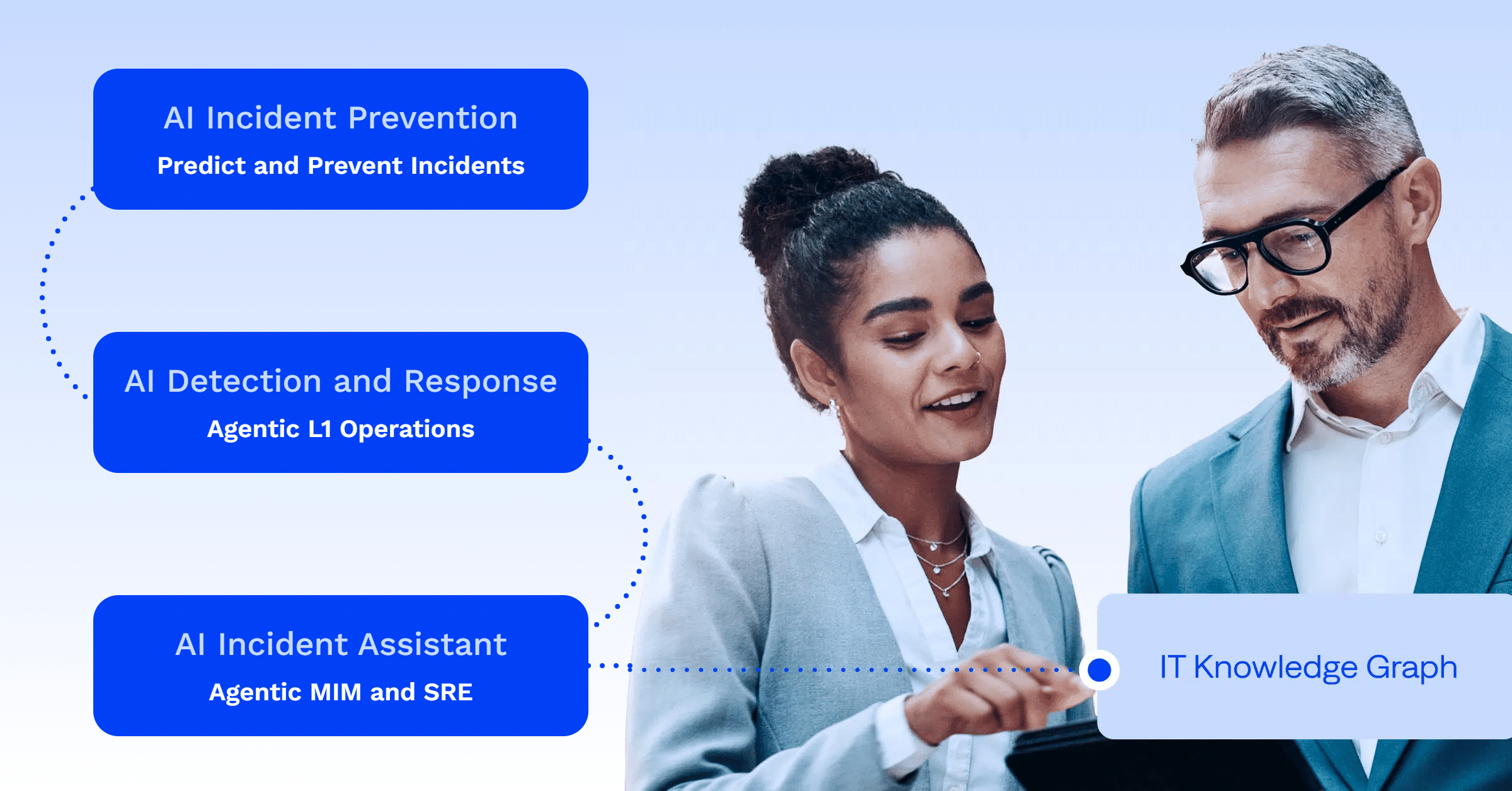
Agentic ITOps offers a path forward by transforming manual and reactive ITSM processes into intelligent, autonomous systems. These systems can adapt to changing environments, learn from experience, and collaborate with humans to respond to incidents at machine speed. With intelligent, automated workflows, enterprises stand to gain faster mean time to resolution (MTTR), lower operational overhead, and increased team productivity.
Let’s explore how enterprises can empower incident management teams with AI assistance by integrating agentic AI into their incident management strategy.
Transform IT incident management from reactive and manual to proactive and automated with agentic AI
When it comes to incident management, fragmented tools, teams, data, and processes are major bottlenecks that hinder collaboration, slow down response, and put your business at risk of costly outages. In fact, 27% of IT leaders report that 50% or more of mean-time-to-resolve (MTTR) is wasted just waiting for information. At BigPanda, we recognize that agentic AI can completely change this paradigm.
Agentic ITOps represents a significant advancement in traditional artificial intelligence for IT Operations (AIOps) capabilities by incorporating autonomous decision-making and action. Advances in agentic AI can transform ITOps and ITSM, bringing significant improvements in efficiency and capability. By harnessing these advancements, enterprises can reduce revenue loss and SLA penalties, while also improving customer experiences and confidence through reliable, innovative services.
Agentic AI is artificial intelligence that creates autonomous systems capable of making decisions and performing tasks without constant human intervention. These systems, also known as AI agents, can adapt to changing environments, learn from experience, and collaborate with humans to detect, respond to, and prevent incidents at machine speed. Critically, agentic AI doesn’t require highly structured inputs to function, and can leverage all your messy, scattered data. This system enables a radically different strategy that transforms static data into adaptive intelligence.
Agentic ITOps platforms consolidate all the necessary incident data, from detection through remediation, into a single, contextual view. This unified view enables responders to quickly understand what is happening, its root cause, and the right course of action. Organizations that successfully automate incident management tasks can save significant time during and after incidents.

The BigPanda AI Incident Assistant surfaces actionable insights where your teams already work, within Slack and Microsoft Teams.

The BigPanda AI Incident Assistant surfaces actionable insights where your teams already work, within Slack and Microsoft Teams.
By incorporating an agentic AI-powered incident assistant into their incident management processes, enterprises can:
Automate incident collaboration
Automate manual incident management workflows and help escalation teams quickly gain situational awareness. The BigPanda AI Incident Assistant also incorporates highly configurable, intelligent automations and workflows built around your enterprise’s exact incident protocols, eliminating manual coordination work and cutting resolution time in half. AI Incident Assistant brings teams together seamlessly in Slack or Teams with a managed incident channel that handles on-call paging, incident status updates, and transcribes bridge calls and chat. Instantly understand priorities and keep all stakeholders informed in real-time with automatic summaries of key insights and sync real-time updates across bridge calls, chat channels, and ITSM tickets.

Surface insights with AI-powered investigation
Agentic AI minimizes manual overhead in investigations, dramatically shortening the mean time to knowledge. Analyze real-time internal and external observability data, historical incidents, and informal knowledge to deliver actionable insights at every stage of the incident lifecycle. A swarm of AI incident investigation agents autonomously reason and investigate across observability tools, gathering real-time context to identify anomalies, impacted hosts and services, and potential root cause. These agents test hypotheses, leverage context across your entire IT ecosystem, and use human-in-the-loop validation to significantly streamline investigation. Some AI Incident Assistant customers report 200% time savings in generating root cause analysis (RCA).
Automate with intelligence
AI-powered automation reduces incident duration and volume, enabling faster, smarter, and lower-risk resolutions through evidence-based insights. L2 and L3 teams can focus on strategic, high-value work, empowering IT to meet customer and business demands, adhere to SLAs, and support innovation.
AI Incident Assistant dramatically accelerates incident response and decreases the burden placed on your teams. With immediate access to accurate, actionable insights, each Incident Management team member can quickly understand what happened, why, and what to do. Responders can make better-informed decisions and quickly prioritize and assign incident remediation.
Supercharge your experts with the BigPanda AI Incident Assistant

“With the help of BigPanda, we reduced incidents by 69% and significantly improved IT operational efficiency.”

For example, a technical support team that uses the BigPanda AI Incident Assistant to automate incident management tasks, such as providing real-time summaries that update as the incident progresses and generating after-action reports, saving an average of 35 minutes per interaction. AI Incident Assistant agentically assembles relevant team members based on historically resolved incidents and provides those SMEs with the necessary information about what happened and how to resolve it.
These capabilities result in fewer and shorter bridge calls. Reduced call volume, duration, and number of attendees translates into considerable labor cost savings and decreased business disruptions. For BigPanda customers, the average reduction in bridge call costs ranged from 35% to 74%, resulting in annual cost savings of $1.8 million to $3.2 million.

AI Incident Assistant acts as a real-time AI partner for incident commanders, L2 engineers, site reliability engineers, and service owners to investigate and resolve incidents faster with agentic AI. It surfaces hidden institutional knowledge across siloed teams, tools, and systems to quickly uncover what’s happening, why, and how to resolve it.
“With the help of BigPanda, we reduced incidents by 69% and significantly improved IT operational efficiency.”
AI Incident Assistant includes several groundbreaking capabilities, including:
Agentic assembly
Intelligently assemble and rapidly engage the most qualified and correct SME in major incident management processes. Agentic SME assembly brings teams together seamlessly in Slack or Teams with a managed incident channel that handles on-call paging, incident status updates, and transcribes bridge calls and chat.
Agentic communications
Instantly understand priorities and keep all stakeholders informed in real time. Continuously updated incident summaries in collaboration channels and a centralized dashboard show the status, impact, and actions taken.
Multichannel synchronization
Drive alignment and clear communication across teams on incident data and the latest incident status. Automatically summarize key insights and sync real-time updates across bridge calls, chat channels, and ITSM tickets (coming soon).
Post-incident reporting
Relieve the burden of post-incident analysis and report creation and save incident responders valuable time. AI Incident Assistant automatically generates executive summaries, after-action reviews (AAR), post-mortems, and more.
Real-time troubleshooting
Automatically gather and continuously update relevant insights about an incident as it unfolds. BigPanda deploys a team of AI agents across observability tools to gather context and identify anomalies, impacted hosts and services, and potential root cause in real time. Teams get an instant, unified view of what’s happening and why, without waiting on others or manually piecing together data.
Agentic troubleshooting
AI agents swarm observability tools to automatically surface the most relevant dashboards and signals as an incident’s context evolves. AI-generated analysis simplifies complex data into clear insights in real time, reducing cognitive load and dramatically accelerating the investigation process.
Suggested resolution
Accelerate resolution with smart, AI-driven suggestions. AI Incident Assistant recommends remediation steps based on past incidents, knowledge base articles, SOPs, and even real-time chat conversations that are not typically documented or operationalized, so your team can act faster with confidence.
Agentic workflow studio
Streamline operations with AI-powered workflows. The intuitive, no-code workflow builder creates scheduled or triggered, real-time automations based on routine actions using natural language and a drag-and-drop interface.

AI Incident Assistant allows enterprises to respond to incidents at machine speed, dramatically improving operational efficiency and delivering exceptional service reliability. In fact, our customers report saving 20-30 minutes per incident on manual tasks. Schedule a personalized demo to learn how your enterprise can transform reactive incident management into intelligent, autonomous systems that meet the speed, complexity, and demands of modern IT environments.
DEMO
See the BigPanda AI Incident Assistant in action
Harness agentic AI to resolve incidents at machine speed.


