






What is on-call management?
On-call management is the operational discipline of ensuring the right responder reaches the right incident fast. It covers on-call scheduling, rotation design, escalation policies, runbook access, alert routing, and the metrics that measure program health, including MTTA (mean time to acknowledge), MTTR (mean time to resolution), and escalation rate. Also referred to as on-call incident response or on-call operations.
Why on-call management matters
The teams that keep the digital world running are also the ones getting paged at 2 a.m. for a false positive. Alert noise is a structural problem, and the people absorbing it are the engineers enterprises can least afford to lose.
The business consequences follow directly. Burnout drives attrition among the highest-context engineers. Alert fatigue masks real incidents inside noise. Slow escalation paths inflate MTTR. For large enterprises, unplanned downtime costs an average of $23,750 per minute, according to EMA research. That math makes on-call program quality a financial issue, not just an operational one.
End users, not monitoring tools, still originate 65% of IT tickets, and a weak on-call program is part of that cost.
How on-call management works
A functioning on-call program has two interlocking layers: the scheduling infrastructure that determines who is reachable, and the policy and routing layer that determines what happens when an alert fires.
Schedules and rotations
The schedule defines who is on call, during which hours, and in what order. Teams typically choose from a few rotation patterns. Weekly handoffs are common for smaller teams. Follow-the-sun rotations distribute coverage across time zones so no single region carries all the overnight hours. Tiered primary and secondary rotations ensure a backup is always reachable when the first responder doesn’t acknowledge.
The quiet failure mode here is schedule drift. Teams change, and rotations that aren’t actively maintained end up pointing alerts at engineers who have moved roles or left the company entirely.
Escalation policies and notification routing
Escalation policies define what happens when acknowledgment doesn’t arrive. Time-based escalation fires after a defined window, typically passing the alert up to a secondary on-call or a manager. Role-based escalation routes by service ownership or expertise. Multi-tier paths handle P0 and P1 incidents differently from lower-severity alerts.
Notification routing connects the alert source to the right person through the right channel, whether that’s SMS, email, Slack, or a voice call. Misconfigured escalation management workflows are a common source of delayed response.
On-call management vs. incident management
On-call management governs who responds and how they’re reached. Incident management governs what happens after they pick up. The two disciplines are deeply interdependent, but conflating them creates real operational gaps.
| Dimension | On-call management | Incident management |
|---|---|---|
| Primary focus | Who responds and how they’re reached | What happens after the responder picks up |
| Scope | Scheduling, rotations, escalation policies, alert routing | Classification, prioritization, coordination, post-incident review |
| Outcome measure | MTTA, escalation rate, pages per engineer | MTTR, incident frequency, postmortem quality |
| When it activates | The moment an alert fires | Once the right responder is engaged |
On-call is the operational mechanism. Incident management is the broader framework. A strong on-call program gets the right responder to the right incident fast. Incident management determines what they do when they get there.
On-call management in Agentic ITOps
The traditional on-call model is rules-based and reactive. Someone configures an escalation path, writes a runbook, and hopes the pager reaches the right person with enough context to act. That model doesn’t scale to hybrid cloud, microservices, and alert volumes that can reach tens of millions of events per year.
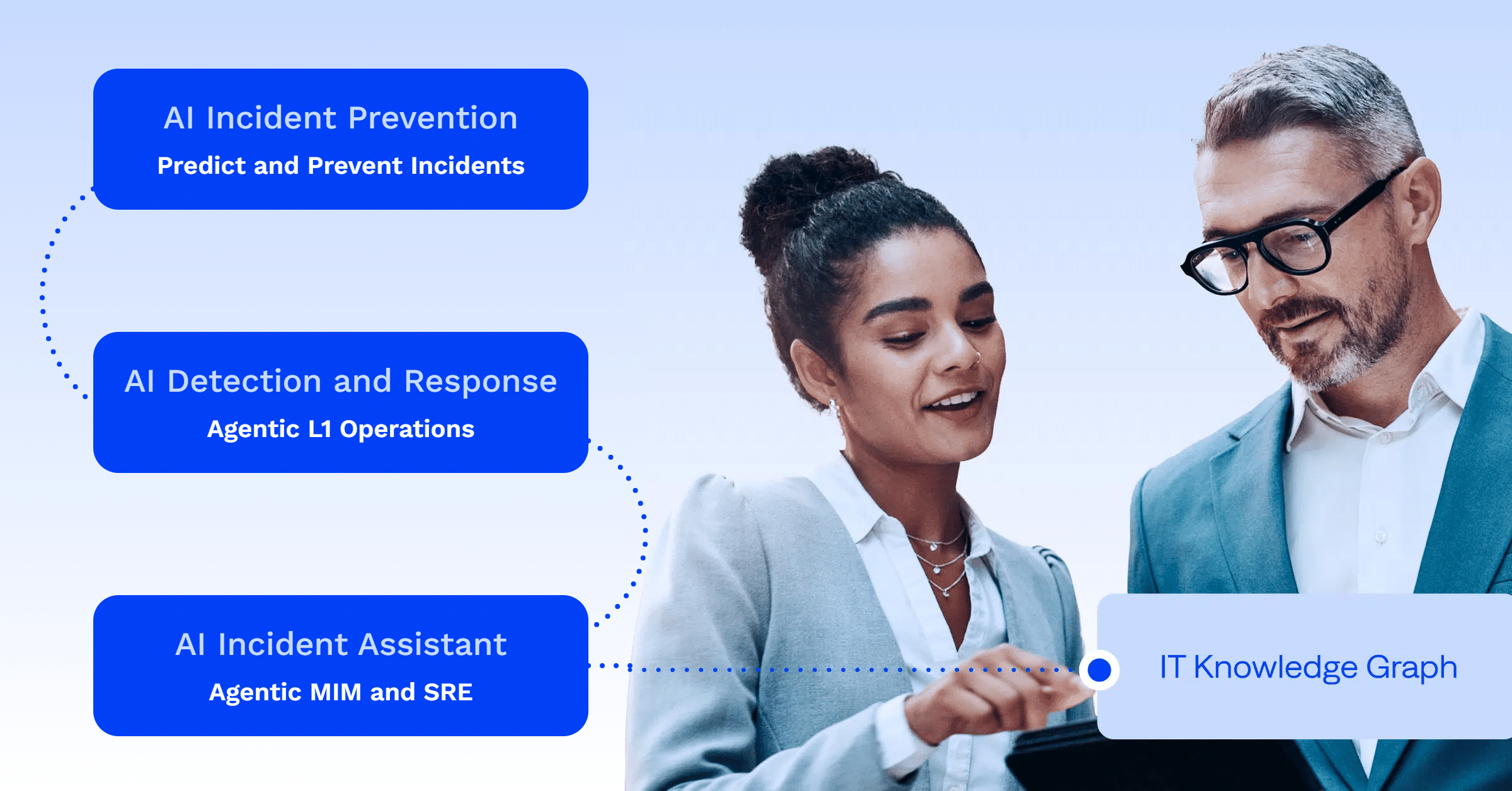
Agentic ITOps changes the on-call equation directly. Instead of waiting for a human pager to fire, AI agents detect, diagnose, and can resolve routine incidents before any responder is contacted. The BigPanda platform covers the full incident lifecycle: AI Incident Prevention stops change-related incidents before they start, AI Detection and Response correlates signals and surfaces context at speed, the L1 Agent handles autonomous L1 operations without adding headcount, and the AI Incident Assistant manages escalated and major incident response.
IT Knowledge Graph: context before the pager fires
The IT Knowledge Graph captures siloed, fragmented data and the tribal knowledge that normally lives in one engineer’s head. It turns that scattered information into a living intelligence layer AI can reason with, not just a static record to search.
When an incident fires, on-call engineers get a unified summary with root cause, related changes, and suggested next steps already attached. The Knowledge Graph works with messy, incomplete data from day one, so there’s no CMDB cleanup project required before getting value.
AI Incident Assistant: automating the on-call workflow
The AI Incident Assistant takes the manual coordination work out of escalated response. It pulls on-call schedules automatically, pages the right subject matter experts, and assembles responders in Slack or Microsoft Teams with actionable context already waiting for them.
Status updates go out automatically. Key findings log to ServiceNow tickets without someone copy-pasting across tools. Post-incident reports generate without a team spending an hour after resolution reconstructing a timeline. One customer eliminated half the SREs previously required on bridge calls by replacing manual coordination with the AI Incident Assistant’s workflow.
On-call management results with BigPanda
The California DMV reduced incident response from four-to-eight hours down to under 15 minutes after adopting the BigPanda platform for AI-driven event correlation and incident management. Bungie achieved 99% alert compression, meaning responders only see the incidents that actually require attention. Cambia Health Solutions automated 83% of alerts and brought critical alert identification down to 30 seconds at L0/L1.
Across 23 customers assessed in The Business Value of the BigPanda Platform report, the platform delivers an average ROI of 430% with payback in under a year.
Frequently asked questions about on-call management
What is the difference between on-call management and on-call scheduling?
On-call scheduling is one component of on-call management. Scheduling defines who is on call and when. On-call management covers the full program: escalation policies, notification routing, runbook access, performance metrics like MTTA and MTTR, and the processes that determine how well responders are equipped when incidents arrive.
How does AI improve on-call incident response?
AI on-call management changes the response model by acting before the pager fires. AI agents correlate alerts, suppress noise, identify root cause, and can resolve routine incidents automatically at L1, so on-call engineers receive fewer pages and the ones they do receive come with context already attached. The result is lower MTTR, less alert fatigue, and on-call incident response that scales without adding headcount.
What metrics should IT teams use to measure on-call program health?
The core metrics are MTTA (mean time to acknowledge), MTTR (mean time to resolution), and escalation rate. Alert-to-incident ratio tracks how much noise the program filters before it reaches responders. Escalation rate reveals whether routing is working or whether incidents are climbing tiers they should not.
How does Agentic ITOps change on-call management?
On-call tools manage schedules and route pages. The BigPanda platform works alongside them and changes what reaches the pager: the IT Knowledge Graph provides real-time context before a responder ever opens a ticket, the L1 Agent resolves incidents autonomously at L1, and the AI Incident Assistant automates coordination for escalated response. The platform works with existing observability and ITSM tools rather than replacing them. Learn more about Agentic ITOps.
See also
- MTTA (mean time to acknowledge)
- Escalation management
- IT incident management
- Bridge call
- Agentic ITOps
Check out more related content

PLATFORM
Reduce on-call alert noise and accelerate incident response
Get your team off the alert treadmill with intelligent incident correlation and automation.