







What is L1 automation?
L1 automation is the use of AI-driven workflows and autonomous agents to handle Level 1 IT operations tasks without manual intervention. Those tasks include alert detection, incident triage, enrichment, runbook execution, routing, and initial response. It’s an ITOps and AIOps term, distinct from industrial or operational technology (OT) automation. Also referred to as L1 IT automation, L1 incident automation, and L1 support automation.
Understanding IT operations tiers: L0, L1, L2, and L3
IT operations are divided into four tiers based on task complexity and who or what handles the work. L1 carries the highest ticket and alert volume of any tier, which is why automation delivers the greatest efficiency gain there.
| Tier | Typical tasks | Who or what handles it |
|---|---|---|
| L0 | Automated monitoring, alerting, self-service portals | Fully automated systems, no human touch |
| L1 | High-volume alert triage, incident routing, initial response, runbook execution | First-line operators or autonomous L1 IT automation agents |
| L2 | Investigation and resolution of escalated issues | Specialist engineers |
| L3 | Complex, novel, or business-critical incidents | Subject matter experts and senior engineers |
Applying automation at the L1 layer means the work that used to require a room full of operators gets handled before an engineer opens a dashboard. L1 IT automation doesn’t replace judgment; it removes the volume problem that buries judgment in noise.
The L1 problem: why manual operations don’t scale
Alert volume
A large organization’s monitoring tools can generate tens of thousands of alerts a day. No team triages that by hand, so many raise alert thresholds just to mute the noise, which masks real problems rather than solving them.
Tribal knowledge
Experienced L1 operators carry years of context: which alerts matter, which services are connected, which runbook applies. When they leave, that knowledge goes with them.
Economics of outsourcing
BigPanda CEO Assaf Resnick notes that enterprises are questioning why they pay outsourcers $20 million to $40 million a year for junior L1 work that agentic AI can handle faster and at a fraction of the cost (2026 Agentic ITOps Predictions webinar). BigPanda estimates that enterprises spend roughly $250 billion a year running IT operations by hand. That spend is increasingly difficult to justify when the technology to automate it exists.
How L1 automation works
L1 incident automation follows a repeatable sequence from signal to resolution:
- Alert ingestion: The system ingests alerts from monitoring tools across the environment in real time, whether from cloud, on-premises, or hybrid infrastructure.
- Noise reduction and deduplication: The system groups duplicate and correlated alerts, then suppresses false positives and auto-resolved alerts before they reach a human queue.
- Enrichment: The system attaches context to each incident, including affected services, topology, ownership data, historical precedent, and business impact. An operator receiving that incident already knows what matters.
- Triage and classification: AI reasoning determines severity, urgency, and the correct resolution path based on real-time data and historical outcomes, not static rules.
- Automated resolution or runbook execution: For known issue types, the system executes the appropriate runbook or resolution action without waiting for human initiation.
- Escalation with full context: When genuine human judgment is needed, the system routes the incident to L2 or L3 with all enrichment and resolution history already attached, so specialists spend their time solving, not searching.
L1 automation software vs. rules-based automation
| Dimension | Rules-based automation | AI-driven L1 automation software |
|---|---|---|
| New issue types | Rules fail on unknowns; any new pattern requires manual rule-writing | AI reasons from context and historical patterns to handle novel situations |
| Maintenance burden | Rules require constant manual updates as environments change | AI learns from outcomes and improves without rule rewrites |
| Scalability | Performance degrades as environment complexity grows | Improves with more data; compounds over time |
| Context awareness | Binary conditions with no topology or business impact reasoning | Uses service topology, ownership, historical incidents, and business impact |
| Knowledge retention | Rules don’t capture or preserve tribal knowledge | Operationalizes institutional knowledge so it survives staff changes |
Most enterprises start with rules-based scripts and outgrow them as their environments expand. The maintenance burden alone becomes unsustainable, and rules break precisely when they’re needed most. AI-driven L1 automation software handles the messy, real-world complexity that rules can’t anticipate.
Key capabilities of L1 automation
L1 helpdesk automation and NOC automation draw on the same underlying capabilities, even though the inputs differ: service desk tickets in one case, monitoring alerts in the other. The capabilities below are what to look for in either context.
Automated alert correlation and suppression
Groups related alerts across monitoring tools and domains, not just within a single source, so operators see incidents rather than raw event floods.
AI-powered enrichment
Attaches topology, ownership, historical, and business-impact context to every incident automatically, including low-severity ones no human would ever enrich by hand.
Autonomous runbook execution
Selects and runs the right runbook for known issue patterns without human initiation, which is a major source of MTTR reduction on repeat incidents.
Intelligent routing
Assigns incidents to the right team based on service ownership and workload, not a round-robin queue.
Escalation with context
Hands L2 and L3 a complete investigation record rather than a bare alert, so specialists start from the investigation instead of repeating it.
Knowledge capture and reuse
Encodes resolution paths so the system improves over time rather than depending on whoever is on shift.
Integration with existing ITSM and monitoring tools
Operates within existing ServiceNow, Jira, and monitoring stacks without requiring workflow replacement.
L1 automation in practice
The Business Value of the BigPanda Platform report, covering 23 enterprise customers assessed between November 2024 and July 2025, shows an average ROI of 430% with payback in under a year. Those are measured outcomes from production deployments, not projections.
Cambia Health Solutions automated 83% of alerts, with critical alerts identified in 30 seconds at L0/L1. Bungie achieved 99% alert compression. Across the 23-customer dataset, ticket volume reductions ranged from 10% to 87% (median 43%), and customers reclaimed between 4,000 and 380,000 hours of manual work annually. A separate survey of more than 20 enterprise customers put L1 toil savings specifically at up to $13.3 million and over 200,000 hours a year.
Those reclaimed hours represent real engineers shifted from repetitive triage to work that requires their expertise. To see how these outcomes are delivered, explore L1 Agent.
Why context makes L1 automation work
The context an incident requires is different every time. What is broken, who owns it, what the downstream impact is, and whether it has happened before: that information is spread across silos and mostly unstructured. It lives in people’s heads, in scattered runbooks, and in tools that don’t talk to each other.
The IT Knowledge Graph is a real-time intelligence layer that captures fragmented data and tribal knowledge and turns it into something AI agents can actually use. It unifies observability, ITSM, change, and organizational context so the L1 automation layer reasons with full situational awareness rather than pattern-matching against a lookup table.
A system that only matches patterns fails the moment it sees something new. A system that reasons with context handles novelty, adapts to a specific environment, and gets more accurate with every incident it processes.
Does L1 automation replace IT operations teams?
No. L1 automation handles repetitive, high-volume triage work so engineers can focus on complex problems and judgment calls that require human expertise. It augments the team; it doesn’t eliminate the need for one.
Resnick predicts that the junior L1 layer as traditionally staffed, including outsourced arrangements built on rotating operators with little environmental context, will be largely automated within three to five years (2026 Agentic ITOps Predictions webinar). That frees senior engineers from toil rather than eliminating the operations function. Operations teams don’t disappear. They stop firefighting.
How L1 Agent works
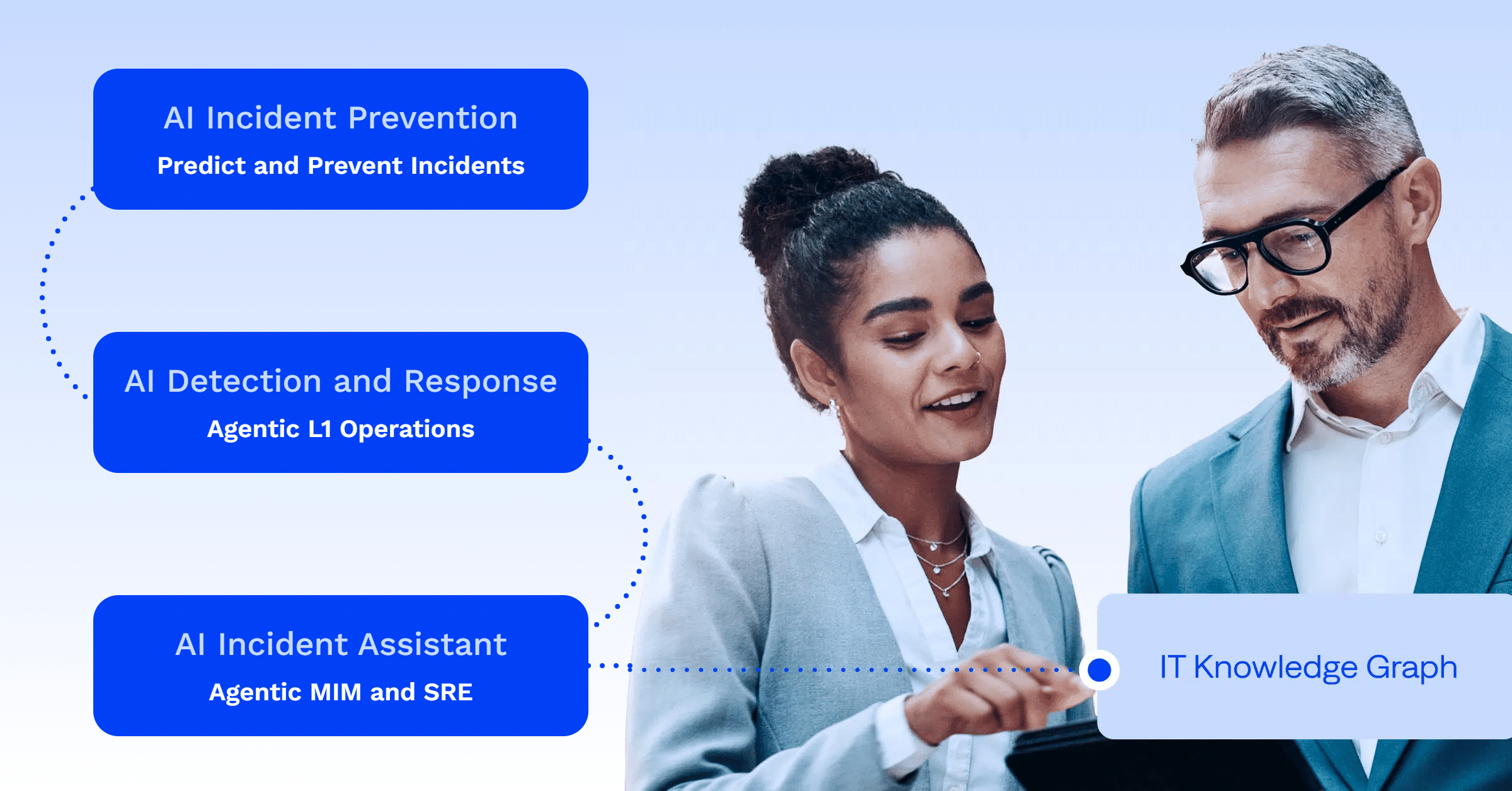
L1 Agent is an AI-native operator purpose-built for L1 workflows. It sits alongside AI Detection and Response, the required foundation that supplies the cross-domain correlation and agentic triage context L1 Agent draws on to act.
Distinguishing features
Every incident routes to the right team, and false positives, noise, and auto-resolved alerts never reach the human queue. L1 Agent resolves more at L1 by applying AI reasoning across real-time data, historical outcomes, and operational knowledge. When human judgment is required, L2 and L3 receive the full enrichment and resolution history, not a bare alert.
L1 Agent is built on the IT Knowledge Graph and learns from the environment continuously, with no manual rules required. The platform is included in the Gartner® Market Guide for Event Intelligence Solutions, 2025, and the Gartner® Market Guide for AI Site Reliability Engineering Tooling.
Frequently asked questions about L1 automation
What is the difference between L1 automation and AIOps?
AIOps is the broader application of AI and machine learning to IT operations across detection, correlation, analysis, and response. L1 automation is a specific use case within AIOps focused on the first tier of incident response. Agentic ITOps extends this by letting AI agents act within guardrails across the full incident lifecycle.
What tasks can L1 automation handle?
L1 automation handles alert correlation, noise suppression, incident enrichment, runbook execution, routing, and initial response for known issue types. More advanced L1 automation tools also handle automated ticket creation, false-positive suppression, and context-rich escalation when autonomous resolution isn’t appropriate.
How does L1 automation integrate with existing ITSM tools?
Modern L1 automation tools work within existing ServiceNow, Jira, and monitoring stacks without replacing workflows already in place. The IT Knowledge Graph connects to ServiceNow or Jira in minutes, then expands one source at a time.
How long does it take to see results from L1 automation?
A proof-of-value assessment typically takes about four weeks, and some teams see results sooner: Gamma Communications substantially reduced alert volume within two weeks. Starting with one or two high-visibility use cases, rather than trying to automate everything at once, tends to produce the fastest measurable outcomes.
Is L1 automation the same as L1 helpdesk automation?
L1 helpdesk automation refers to service desk ticket automation: intake, routing, password resets, and common request fulfillment. L1 IT automation and L1 incident automation refer to the NOC and infrastructure layer, covering alert triage, incident correlation, and runbook execution. The best L1 support automation platforms address both contexts.
Check out more related content


PLATFORM
BigPanda Agentic ITOps
See how BigPanda uses agentic AI in IT operations.