






What is agentic IT operations?
Agentic IT operations (agentic ITOps) refer to the use of agentic AI to transform manual, reactive IT workflows into intelligent, autonomous systems that can proactively detect, diagnose, respond to, and prevent IT incidents with minimal human intervention. Unlike traditional ITOps, which require rules-based automation and structured data inputs, agentic ITOps can autonomously reason through ambiguous, messy, and incomplete data, execute multi-step workflows, and adapt to new information, escalating to humans only when necessary.
Why agentic ITOps matters
Enterprise IT environments are too complex for human-driven operations to keep up. Alert volumes are overwhelming, incidents escalate faster than teams can respond, and manual review processes create bottlenecks that slow detection, triage, and resolution.
Despite a 20% year-over-year increase in observability and ITSM spending, incident detection remains poor. End users, rather than system telemetry, still report 35% of all incidents. L1 teams face an overwhelming volume of repetitive, low-value work, driving escalations to L2 and L3 resources that strain budgets and slow resolution.
Agentic ITOps changes this by operating at machine speed and scale. It can ingest signals from dozens of monitoring, observability, and ITSM tools simultaneously, correlate them across systems, and take or recommend action—without waiting for a human to connect the dots. For IT and operations teams, that means fewer escalations, lower MTTR, and a meaningful reduction in the toil that consumes L1 capacity.
How agentic ITOps works
Agentic ITOps platforms combine large language models (LLMs) or other AI models with the ability to take actions—such as calling tools, querying systems, and executing workflows. In practice, this means:
- Alert ingestion, deduplication, and correlation. Agentic AI continuously ingests signals from monitoring, observability, and ITSM tools. It deduplicates noisy alert streams and correlates events across systems to surface actionable, high-fidelity incidents—rather than flooding teams with raw alerts.
- Incident detection, triage, and routing. Once an incident is detected, agentic ITOps automatically triages it: identifying probable root cause, assessing service impact, assigning priority, and routing it to the right team—without manual review.
- Incident remediation and response. Agentic AI surfaces actionable insights for responders, including AI-generated incident summaries, change risk scores, root cause analysis, similar incident history, and clear mitigation steps. Where confidence is high, it can execute remediation steps autonomously.
- Incident prevention. By analyzing change tickets, historical incident patterns, and affected systems, agentic ITOps can score risk before changes are deployed—helping teams predict and prevent failures before they impact users.
A defining characteristic of agentic ITOps is the ability to handle unstructured, incomplete, or ambiguous data throughout this cycle. It doesn’t require clean inputs or pre-defined rules to function. It can work with noisy alert streams, fragmented ITSM records, chat histories, runbooks, and meeting transcripts to build a coherent picture of what’s happening and what should be done about it.
Key characteristics of agentic ITOps
Agentic ITOps platforms share three core properties:
- Awareness: They understand the full context of an IT environment—ingesting signals from monitoring tools, ITSM platforms, collaboration channels, and documentation systems—and maintain a continuously updated model of what is happening and why.
- Autonomy: They can break down complex operational workflows, make decisions, and act independently—handling routine incidents end-to-end without requiring step-by-step human direction.
- Adaptability: They learn and improve from new data, past incidents, and operational feedback over time, becoming more accurate and effective as they accumulate experience.
Agentic ITOps vs. traditional AIOps
Agentic ITOps is very different than traditional AIOps. Traditional AIOps uses automation to execute predefined instructions on structured data. AIOps follows rules, but it cannot reason, adapt, or handle situations it hasn’t been explicitly programmed for.
Agentic ITOps can reason through novel situations, handle incomplete or unstructured inputs, and decide what to do next based on context and goals. It can also determine when a situation falls outside its confidence threshold and escalate to a human—something rules-based automation cannot do.
AIOps applies machine learning and analytics to IT data to improve operational decision-making, typically by augmenting human workflows with recommendations, correlations, and insights. Agentic ITOps goes further: it uses agentic AI not just to analyze and recommend, but to take action. Where AIOps surfaces a probable root cause and suggests a fix, agentic ITOps can execute the fix, update the ITSM record, notify the right stakeholders, and close the incident—autonomously, at machine speed.
Agentic ITOps is best understood as the next evolution of AIOps: built on the same data and AI foundations, but capable of end-to-end autonomous action rather than human-in-the-loop assistance.
| Dimension | Traditional AIOps | Agentic ITOps |
|---|---|---|
| Instruction style | Fixed rules and scripts | Natural language goals |
| Data requirements Adaptability |
Requires structured, clean inputs Brittle, breaks on novel inputs |
Can use messy, unstructured data Adaptive, reasons through new situations |
| Multi-step capability | Limited, predefined sequences | Flexible, plans and replans dynamically |
| Tool use | Hardcoded integrations | Dynamic, selects and uses tools as needed |
| Human involvement | Required for exceptions and changes | Minimal, escalates only when necessary |
Comparison of traditional AIOps and agentic ITOps
What data is required for agentic ITOps
Critically, agentic ITOps does not require highly structured data inputs to function. Rather than relying on static configuration management databases (CMDBs), agentic AI can transform messy, scattered data into adaptive intelligence—opening the floodgates to unstructured data sources that provide unprecedented operational visibility.
The data sources that feed agentic ITOps include:
- Observability and monitoring data: Real-time telemetry, metrics, logs, and traces from across the IT environment.
- ITSM sources: Incident tickets, service desk records, knowledge base articles, runbooks, and change management records that capture institutional knowledge and operational history.
- Historical incident data: Classification, priority, duration, assignments, service impact, and closure codes from comparable past incidents—used to accelerate investigation and improve future responses.
- Collaboration and communication platforms: Unstructured data from chat platforms, emails, meeting transcripts, and documentation that reveal patterns in incident resolution and operational workflows.
Agentic ITOps use cases
Agentic ITOps is well-suited to IT operations because many ITOps workflows are high-volume, repetitive, and time-sensitive. Unlike traditional AIOps, agentic ITOps can use inherently messy and distributed across monitoring tools, ITSM platforms, collaboration channels, and documentation systems.
Key capabilities of agentic ITOps include:
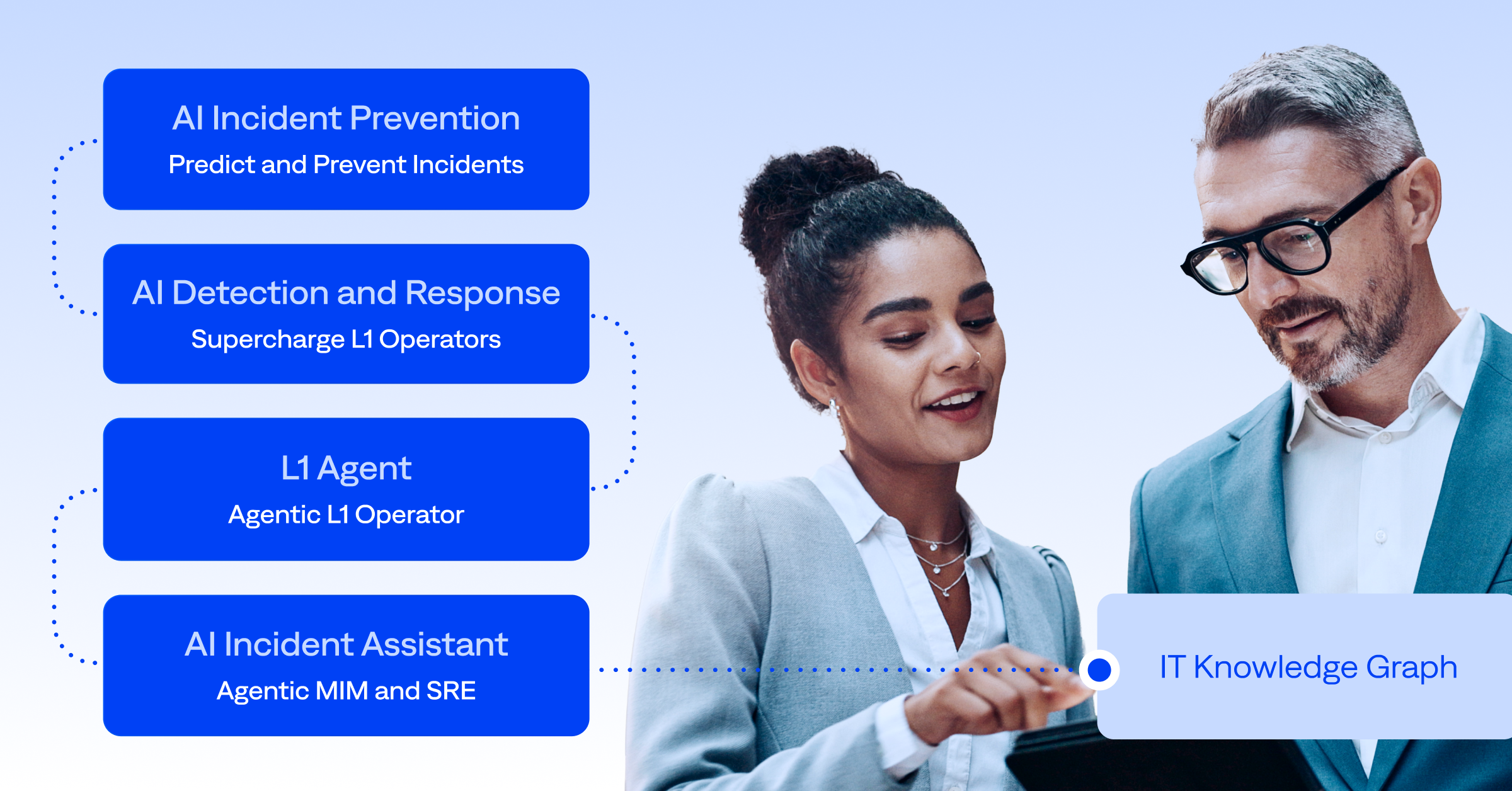
- AI incident prevention: Analyzing change tickets, historical patterns, and affected systems to score risk and recommend mitigation steps before changes are deployed, preventing incidents before they occur.
- AI detection and response: Autonomously detecting, triaging, and routing incidents across complex and distributed environments, reducing escalations to L2 and L3, and improving MTTR.
- L1 workflow automation: Handling routine incidents end-to-end without human intervention. This frees L1 teams from repetitive toil and allows them to focus on higher-value work.
- AI incident assistance: Augmenting L2 and L3 engineers with AI-generated summaries, similar incident history, root cause analysis, and suggested next steps during active incidents accelerates resolution and boosts service reliability.
- Change risk management: Providing clear guardrails to help teams predict and prevent change-related failures, reduce incidents, and shift toward proactive reliability.
Learn more about the BigPanda agentic ITOps platform.
Frequently asked questions about agentic ITOps
What is the difference between agentic ITOps and AIOps?
AIOps uses AI and machine learning to augment human decision-making in IT operations and surface insights, correlations, and recommendations. Agentic ITOps goes further, using agentic AI to autonomously detect incidents, execute remediations, and manage end-to-end workflows with minimal human intervention. Agentic ITOps is the next evolution of AIOps.
Does agentic ITOps replace human IT teams?
No. Agentic ITOps doesn’t remove humans from the loop. It automates needless, redundant toil. By automating routine, repetitive work, agentic ITOps frees IT teams to focus on strategic initiatives and innovation rather than reactive firefighting. Agentic ITOps escalates to humans when situations require judgment, expertise, or accountability that falls outside confidence thresholds.
Does agentic ITOps require clean, structured data?
No. One of the key capabilities agentic AI offers is the ability to aggregate, analyze, and correlate data from previously unstructured or siloed sources. Agentic ITOps can work with messy, incomplete data such as chat histories, runbooks, ITSM records, and meeting transcripts, regardless of its state. There is no need to clean your data before getting started.
What is the difference between agentic ITOps and traditional automation?
Traditional automation follows predefined rules and requires structured inputs. It executes instructions but cannot reason, adapt, or handle novel situations. Agentic ITOps can reason through ambiguous or incomplete situations, handle unstructured data, adapt based on new information, and decide when to escalate to a human. Traditional automation executes instructions; agentic ITOps exercises judgment.
How does agentic ITOps reduce mean time to resolution (MTTR)?
Agentic ITOps reduces MTTR by automating the most manual, time-consuming phases of incident management: detection, triage, routing, and initial remediation. By correlating alerts in real time, surfacing probable root cause, and either executing fixes autonomously or providing responders with AI-generated context and recommended next steps, agentic ITOps dramatically compresses the time between incident onset and resolution.
How is agentic ITOps used in enterprise IT?
In enterprise IT, agentic ITOps automates the detection, triage, and response to incidents; scores and flags high-risk changes before they cause outages; and assists engineers with real-time context, root cause analysis, and suggested next steps during active incidents. It is the foundation of a shift from reactive, manual IT management to intelligent, autonomous systems that scale with the complexity of modern enterprise environments.
See also
Check out more related content

PLATFORM
BigPanda Agentic ITOps
See how BigPanda uses agentic AI in IT operations.