





What is agentic AI?
Agentic AI refers to artificial intelligence systems that can perceive their environment, make decisions, and take goal-directed actions with minimal or no human intervention. Unlike rules-based automation, agentic AI can reason through ambiguous or incomplete inputs, execute multi-step tasks, and adapt to new information or feedback, escalating to humans only when necessary.
Why agentic AI matters
Enterprise IT environments have grown too fast and too complex for human-driven operations to keep up. Alert volumes are overwhelming, incidents escalate faster than teams can respond, and manual review processes create bottlenecks that slow detection, triage, and resolution.
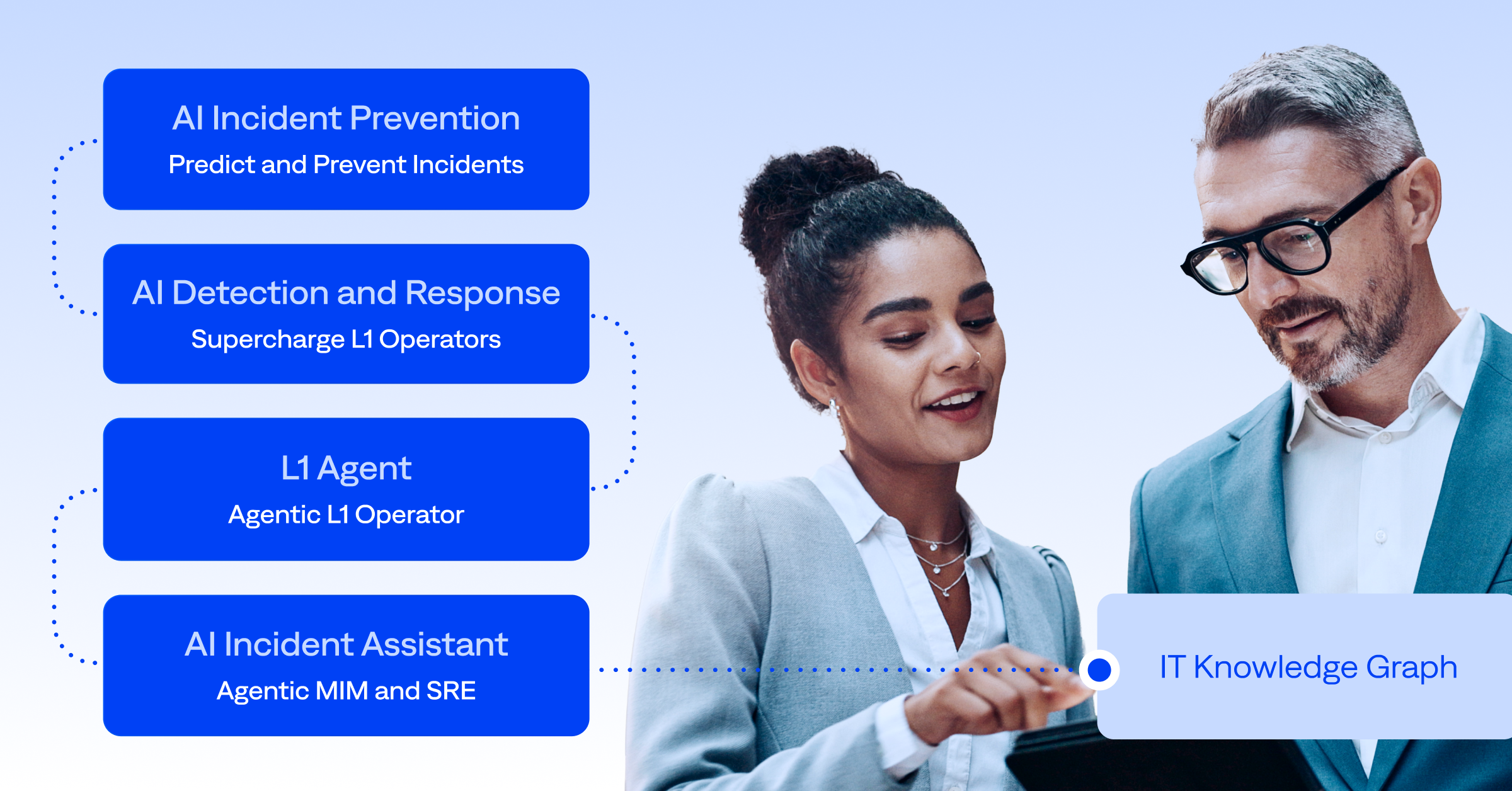
Agentic AI changes this by operating at machine speed and scale. It can ingest signals from dozens of IT monitoring, observability, and ITSM tools simultaneously, correlate them across systems, and take or recommend action—without waiting for a human to connect the dots. That means preventing high-risk changes before they cause outages, surfacing and triaging incidents faster with less noise, autonomously resolving routine incidents at L1, and giving L2, L3, and SRE engineers real-time context and suggested next steps when complex incidents do escalate. The result: fewer escalations, lower MTTR, and a meaningful reduction in the repetitive, low-value toil that consumes L1 capacity.
How agentic AI works
Agentic AI systems combine large language models (LLMs) or other AI models with the ability to take actions—such as calling tools, querying systems, and executing workflows—in pursuit of a defined goal. They operate through a continuous cycle of four steps:
- Perception: The agent receives inputs from its environment—data, events, tool outputs, or human instructions—and builds a contextual understanding of the current state.
- Reasoning: The agent determines what goal it is pursuing, what information it needs, what actions are available, and which sequence of actions is most likely to achieve the goal.
- Action: The agent executes actions—querying databases, calling APIs, triggering automations, updating records, or coordinating across systems—using the tools available to it.
- Adaptation: The agent observes the results of its actions, updates its understanding, and determines the next step, repeating the cycle until the goal is achieved or a situation requires human input.
What makes agentic AI distinct is its ability to handle unstructured, incomplete, or ambiguous data throughout this cycle. It does not require clean, structured inputs or pre-defined rules to function. In an IT operations context, this means it can work with noisy alert streams, fragmented ITSM records, chat histories, and runbooks—not just structured databases—to build a coherent picture of what’s happening and what should be done about it.
Key characteristics of agentic AI
Agentic AI systems share three core properties:
- Awareness: They understand context, their environment, and the goals they’re working toward.
- Autonomy: They can break down complex tasks, make decisions, and act independently without requiring step-by-step human direction.
- Adaptability: They learn and improve from new data, experience, and feedback over time.
Agentic AI vs. traditional automation
Agentic AI is often conflated with automation, but the two are meaningfully different. Traditional automation executes predefined instructions on structured data; it follows rules, but it cannot reason, adapt, or handle situations it hasn’t been explicitly programmed for.
Agentic AI can reason through novel situations, handle incomplete or unstructured inputs, and decide what to do next based on context and goals. It can also determine when a situation falls outside its confidence threshold and escalate to a human, which is something rules-based automation cannot do.
| Dimension | Traditional automation | Agentic AI |
|---|---|---|
| Instruction style | Fixed rules and scripts | Natural language goals |
| Adaptability | Brittle, breaks on novel inputs | Adaptive, reasons through new situations |
| Multi-step capability | Limited, predefined sequences | Flexible, plans and replans dynamically |
| Tool use | Hardcoded integrations | Dynamic, selects and uses tools as needed |
| Human involvement | Required for exceptions and changes | Minimal, escalates only when necessary |
Comparison of traditional automation and agentic AI
Agentic AI vs. generative AI
Another common point of confusion is the relationship between agentic AI and generative AI. Generative AI (such as an LLM) produces text, code, or other content in response to a prompt. Agentic AI uses generative AI models as one component, but adds the ability to take actions in the world, such as querying systems, executing workflows, updating records, and coordinating across tools.
Agentic AI use cases in IT operations
Agentic AI is well-suited to IT operations because ITOps workflows are high-volume, repetitive, and time-sensitive—and because the data involved is inherently messy and distributed across IT monitoring tools, ITSM platforms, collaboration channels, and documentation systems.
Common ITOps use cases include:
- Incident detection and incident triage: Correlating alerts across tools, surfacing probable root cause, and routing incidents to the right team without manual review.
- L1 automation: Autonomously handling routine incidents end-to-end, reducing escalations to L2 and L3.
- Change risk management: Analyzing change tickets, historical incident patterns, and affected systems to score risk and recommend mitigation steps before deploying code.
- Incident response augmentation: Providing L2 and L3 engineers with AI-generated summaries, similar incident history, and suggested next steps during active incidents.
Frequently asked questions about agentic AI
What is the difference between agentic AI and AI agents?
Agentic AI describes AI systems that can act autonomously toward a goal. It is the broader category. AI agents are the specific implementations: software components that perceive inputs, make decisions, and take actions as part of an agentic AI system. In practice, the terms are often used interchangeably, but “agentic AI” typically refers to the capability or approach, while “AI agents” refers to the individual components doing the work.
Is agentic AI the same as automation?
No. Traditional automation follows predefined rules and requires structured inputs. Agentic AI can reason through ambiguous or incomplete situations, handle unstructured data, adapt based on new information, and decide when to escalate to a human. Automation executes instructions; agentic AI exercises judgment.
Is agentic AI the same as autonomous AI?
No. Autonomous AI is a broad term for any AI that operates independently, while agentic AI is more specific, emphasizing goal-directed behavior, multi-step reasoning, and the ability to take actions in the world. Agentic AI is a type of autonomous AI, but not all autonomous AI is agentic.
What is the difference between agentic AI and generative AI?
Generative AI produces content in response to a prompt, including text, images, code, or other outputs. Agentic AI uses generative AI as a reasoning engine, enabling it to pursue goals, take actions, and adapt across multiple steps. Generative AI responds; agentic AI acts. All agentic AI relies on generative AI models, but not all generative AI is agentic.
What does “agentic” mean in AI?
“Agentic” refers to agency—the capacity to act independently toward a goal. In addition to responding to prompts, an agentic AI system pursues objectives by perceiving its environment, planning, taking actions, and evaluating outcomes, with minimal human direction.
How is agentic AI used in IT operations?
In IT operations, agentic AI automates the detection, triage, and response to incidents; scores and flags high-risk changes before they cause outages; and assists engineers with real-time context, root cause analysis, and suggested next steps. It is the foundation of agentic ITOps—a shift from reactive, manual IT management to intelligent, autonomous systems.
See also
Check out more related content

PLATFORM
BigPanda Agentic ITOps
See how BigPanda uses agentic AI in IT operations.