






1
What is network topology?
Network topology is defined as how a network’s nodes, connections, and devices are arranged and connected. It also explains how they communicate. This can be through shared connections like buses or direct links in a point-to-point topology.
The arrangement or configuration of a network’s components plays a crucial role in ensuring smooth ITOps with minimum downtime. Any issues in the network can disrupt operations, potentially leading to severe consequences. To prevent this, you need to understand your network functionality and structure.
At a high level, there are two primary network topology types, physical and logical:
- Physical network topology means the real connections between the network and its nodes. These include cables and wires, as well as devices like switches, routers, and repeaters.
- Logical network topology refers to the arrangement of a network’s components. It looks at why the network is arranged that way and how data moves through it.
2
Six network topology types
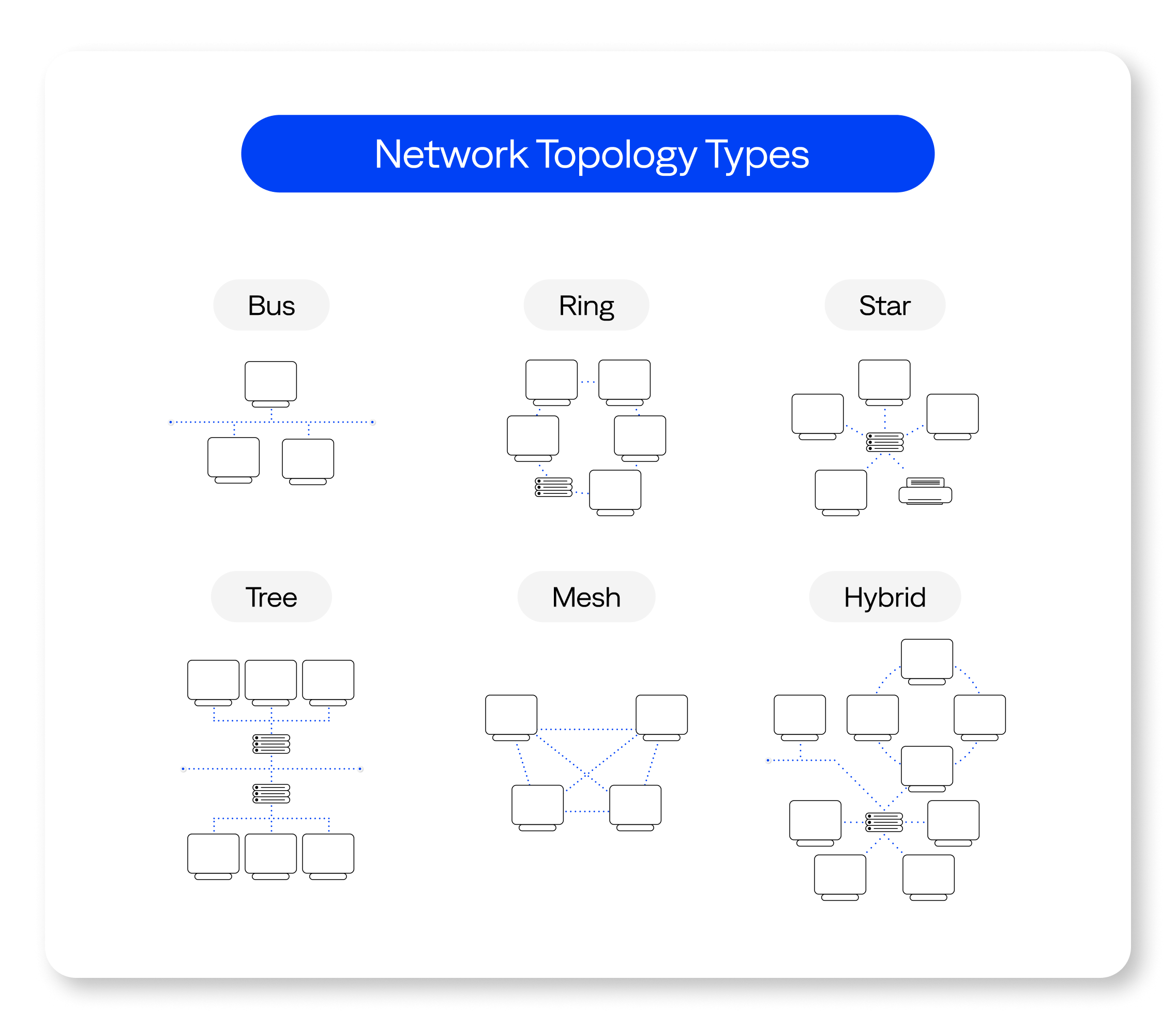
The various physical network topology types employ different node-and-link configurations, offering unique advantages and disadvantages. For example:
Bus network topology
In a bus topology, all network devices connect to a single central cable. This cable is referred to as the bus or backbone. Data can travel in both directions on the bus. Each device can talk to every other device on the network.
- Bus topology advantages: Simple and cost-effective, a bus topology needs fewer cables than other options. It’s easy to set up for small networks.
- Bus topology disadvantages: This approach has limited scalability and efficiency. Performance levels degrade due to increased data collisions as more devices are added. If the central cable fails, the entire network goes down.
Ring network topology
A ring topology forms a circular data path, with each device connecting to two other devices. Data travels in one direction around the ring network until it reaches its destination.
- Ring topology advantages: The main benefit of a ring topology is its ability to manage high traffic. This is because it has a clear data transmission path. It’s also relatively easy to install and troubleshoot.
- Ring topology disadvantages: It is essential to utilize a dual-ring topology for redundancy and backup. If one device or connection fails, it can disrupt the whole network. Adding or removing devices can cause temporary network disruption.
Star network topology
In a star topology, a central hub or switch connects all devices. Each device has a dedicated connection to the hub, allowing for direct communication through a central point. A typical example is a traditional local area network (LAN) in which all devices connect to a central hub. Each device connects to a central hub using a point-to-point topology. This allows direct and separate communication between the hub and each device.
- Star topology advantages: Star networks are easy to manage and troubleshoot. If one device or its connection fails, it doesn’t affect the rest of the network. They allow high scalability, enabling your network to accommodate additional devices without disruptions.
- Star topology disadvantages: The central hub is a single point of failure. If it fails, the whole network stops working. Star topologies may require additional cabling and hardware, which can inflate costs.
Tree network topology
A tree topology connects several star topologies with a bus structure. It looks like a tree with branches. This makes it a good example of a hierarchical branch of topology. It combines different network structures. Groups of star-configured devices connect to a linear bus backbone, utilizing features from both bus and star topologies.
- Tree topology advantages: The hierarchical structure is the most significant benefit of the tree topology. This approach simplifies network management and expansion. You can segment network resources to enhance overall efficiency and performance.
- Tree topology disadvantages: This network design can be complex to configure and is dependent on the central bus. A backbone failure can isolate and potentially disable parts of the network.
Mesh network topology
A mesh topology features a network structure in which each device connects to every other device, creating a web. You can implement this approach in two ways. In a full mesh topology, every device directly connects to all others. In a partial mesh topology, only some devices have multiple connections.
- Mesh topology advantages include high reliability and redundancy. In the event of a connection failure, the network can redirect data through an alternate path, ensuring continuity. Mesh topologies support high data traffic, making them ideal for environments requiring robust data transmission.
- Mesh topology disadvantages: Installing and managing a mesh network is expensive and complex because it requires extensive cabling and configuration.
Hybrid network topology
Not surprisingly, a hybrid topology combines elements of two or more topologies, integrating their strengths and mitigating weaknesses. For example, a hybrid topology might combine star, ring, and bus configurations.
- Hybrid topology advantages: You can tailor a hybrid topology to address diverse needs. Resilience to single points of failure makes it ideal for large, complex networks with varying performance and reliability demands.
- Hybrid topology disadvantages: A hybrid approach can be complicated and costly to design, implement, and maintain. This is especially true for large networks.
3
What is the role of network topology in observability?
Network topology is integral to observability, the ability to monitor and manage a network’s health, performance, and behavior.
Network topology shows how components are arranged and interact. This helps IT teams understand system behavior, performance, and possible network problems. This perspective helps them monitor and optimize network performance more effectively.
Here are three ways network topology contributes to observability:
Mapping system components and their relationships: A clear network topology diagram illustrates the system’s parts and their connections. This helps administrators locate each device and observe how they interact. This clarity is crucial for proactive IT infrastructure monitoring, network health, and performance management.
Tracing data flows and predicting bottlenecks: Network topology allows you to trace data flows across the network. By understanding data movement from node to node, administrators can detect potential bottlenecks or congestion points. This insight helps diagnose performance issues and optimize data paths, reducing latency and enhancing overall network performance.
Understanding system interconnections and dependencies: Network topology clarifies a system’s dependencies and interconnections, illustrating how components rely on one another. Administrators can better manage changes, troubleshoot issues, and plan upgrades or expansions. They can also predict the impact of changes and ensure effective dependency management. This holistic view supports proactive management, enabling IT teams to develop comprehensive network maintenance, disaster recovery, and capacity planning strategies.
4
Seven benefits of topology-driven observability
Your organization can benefit from topology-driven observability in the following ways:
Comprehensive visibility of the IT environment: With topology-driven observability, ITOps have a complete picture of the network’s structure and components. Visibility enhances the understanding of how unique elements interact, preventing any overlooked areas. At the same time, it facilitates effective monitoring and management of the entire IT infrastructure.
Faster incident detection and triage: By understanding the typical data flows and configurations, teams can identify problems more quickly. This helps in detecting incidents faster. Speed is crucial for incident triage, allowing you to prioritize and address issues before they escalate.
Better impact analysis and prioritization: When an issue arises, topology-driven observability helps determine its impact on the overall network. By understanding component interdependencies and relationships, you can assess incident severity more accurately. This way, you can promptly prioritize and resolve critical issues that affect vital services.
Streamlined root-cause analysis and troubleshooting: Mesh network topology-driven observability simplifies root-cause analysis. By finding the exact location and source of problems, you can save time and effort when troubleshooting. This improves the speed at which you can resolve issues and reduces downtime.
Proactive identification of potential issues and bottlenecks: Continuous network topology monitoring lets you identify possible problems and bottlenecks before they impact performance. With early detection, you can take steps such as adjusting network traffic or upgrading systems. This helps prevent problems and keeps everything running smoothly.
Improved collaboration: A well-documented mesh network topology fosters knowledge sharing among ITOps teams. A common reference point helps teams understand the network structure. This makes it easier for them to discuss issues or changes. A shared understanding enhances teamwork and accelerates problem-solving.
Support for resource optimization and capacity planning: You need to know how you are currently using resources. This helps you identify areas where demand may grow. With this information, you can make better choices about scaling and distribution.
Ultimately, this helps keep the network running smoothly and prevents wasteful use or resource shortages.
5
Gain full-stack visibility with mesh network topology
BigPanda Real-time Mesh Network Topology provides your ITOps teams with a detailed, always up-to-date view of your entire IT stack. BigPanda creates a unified real-time mesh topology model by integrating configuration, cloud, and virtualization management data, along with service discovery, APM, and CMDB tools. It also has built-in integrations and a strong REST API. This ensures complete full-stack visibility in one view.
The real-time model enables you to quickly understand connections and patterns. This is useful even in complex environments. It makes it easier to assess the impact of incidents and prioritize responses. Moreover, the topology-driven correlation accurately links alerts to the mesh, identifying missing issues. It speeds up and refines root-cause analysis using contextual and change data across the topology.
6
Key takeaways
- Network topology is foundational to incident management: with no understanding of how systems are connected, root cause analysis is essentially guesswork
- Modern enterprise IT topologies are dynamic, not static: containers, Kubernetes, and cloud-native architectures mean topology can shift minute-to-minute, making manual tracking impossible
- Traditional CMDBs struggle to keep pace with dynamic topologies: they were designed for slow-moving, on-prem infrastructure
- Network topology data enriches alerts with context: knowing what connects to what is what transforms a raw alert into an actionable incident
- AIOps platforms use real-time topology data to automatically correlate alerts across layers — application, service, infrastructure — and surface root cause faster
- Topology visibility gaps directly increase MTTR: teams without a unified topology view spend more time manually tracing dependencies during incidents
- No single monitoring tool provides full topology coverage: enterprises typically need to stitch together topology data from multiple sources (CMDB, APM, cloud management, service discovery)