






What is IT operations?
IT operations (ITOps) refers to the processes, practices, people, and tools that an organization uses to manage and maintain its IT infrastructure, systems, and services. ITOps teams are responsible for ensuring that networks, servers, applications, and cloud environments are available, reliable, and performing as expected. This includes monitoring system health, detecting and resolving incidents, managing infrastructure changes, and maintaining the availability of services the business depends on.
Why ITOps matters
Every modern enterprise runs on IT. When systems are slow, unavailable, or degraded, the business consequences are immediate: lost revenue, breached SLAs, damaged customer trust, and strained engineering teams. IT operations is the function responsible for preventing those outcomes and keeping critical services available, detecting problems early, and restoring normal service as quickly as possible when incidents occur.
As enterprises have adopted hybrid cloud, microservices, CI/CD pipelines, and distributed architectures, the complexity of IT environments has grown dramatically. Alert volumes have surged, incidents propagate faster, and the volume of data that ITOps teams must process has outpaced what human-driven workflows can reliably handle. The result is a function under extreme pressure, with more systems to manage, more signals to process, and higher expectations for uptime and response time, but with the same or fewer resources.
This pressure is driving enterprises to invest in AI and automation to make ITOps more scalable, efficient, and proactive.
What do ITOps teams do?
ITOps teams are responsible for the end-to-end health and reliability of an organization’s IT environment. Core responsibilities include:
- Incident detection and response. Monitoring systems and alerts to identify service degradations or outages, triaging incidents to determine root cause and impact, routing them to the right teams, and working to restore normal service as quickly as possible.
- Change management. Reviewing, approving, and governing changes to infrastructure and applications to minimize the risk of change-related incidents. High-risk changes are assessed before deployment to prevent outages.
- Event and alert management. Ingesting and processing signals from monitoring, observability, and ITSM tools. Deduplicating and correlating noisy alert streams to surface actionable, high-fidelity incidents rather than overwhelming responders with raw data.
- Problem management. Identifying recurring incident patterns and eliminating their root cause to reduce the frequency and impact of future disruptions.
- Service and infrastructure management. Maintaining the availability, performance, and capacity of networks, servers, storage systems, cloud environments, and the applications that run on them.
- Reporting and continuous improvement. ITOps teams track key operational metrics such as mean time to resolution (MTTR), alert volume, escalation rates, and SLA compliance to identify bottlenecks and improve operational efficiency over time.
Key roles in IT operations
IT operations teams are typically organized into tiers based on the complexity of the issues they handle:
- L1 (first-line) operators handle high-volume, routine incidents. They monitor alert queues, perform initial triage, execute standard remediation steps, and escalate issues that require deeper investigation. L1 teams are often the first point of contact for detected incidents.
- L2 engineers handle escalated incidents that require deeper investigation. They diagnose root cause, coordinate across teams, and own the resolution of complex or high-priority issues.
- L3 engineers and SREs tackle the most complex incidents and systemic reliability issues. They own root cause analysis for major incidents, drive post-incident reviews, and work to eliminate recurring failure patterns through engineering improvements.
- NOC (Network Operations Center) teams continuously monitor IT environments, often around the clock. NOC operators watch for anomalies and alerts, coordinate incident response, and escalate to L2 and L3 as needed.
- ITOps managers and directors set operational strategy, manage team capacity and performance, and oversee relationships with vendors, tools, and service providers.
IT operations vs. IT service management (ITSM)
IT operations and IT service management (ITSM) are related but distinct disciplines. ITOps focuses on the technical work of keeping systems running: monitoring, incident detection, alert management, and infrastructure maintenance. ITSM is the broader framework of processes and practices used to plan, deliver, manage, and improve the IT services that the business relies on.
In practice, ITOps teams depend on ITSM platforms such as ServiceNow or Jira Service Management to manage incident records, track changes, and maintain service desk workflows. The two functions are deeply interconnected. ITOps generates the signals and events that ITSM processes, and ITSM provides the operational framework and accountability structure within which ITOps teams work.
| Dimension | IT operations (ITOps) | IT service management (ITSM) |
|---|---|---|
| Primary focus | Infrastructure availability and incident response | Service delivery and process management |
| Key activities Tools |
Monitoring, alerting, incident triage, and change governance Monitoring, observability, AIOps platforms |
Incident management, change management, and service desk ServiceNow, Jira Service Management, ticketing systems |
| Orientation | Technical and operational | Process and service-oriented |
| Outcomes | System reliability and uptime | Service quality and customer satisfaction |
Comparison of IT operations and IT service management
IT operations and AIOps
The volume and complexity of modern IT environments have made traditional, manual ITOps unsustainable. AIOps—the application of AI and machine learning to IT operations—was developed to help teams cope with the scale and speed of modern alert streams by automating correlation, anomaly detection, and root cause identification.
AIOps platforms ingest signals from monitoring, observability, and ITSM tools and apply AI to surface actionable incidents from noisy alert data, reducing the manual triage burden on L1 teams and accelerating response. For many enterprises, AIOps has become a foundational capability for keeping pace with the demands of complex, distributed IT environments.
IT operations and agentic ITOps
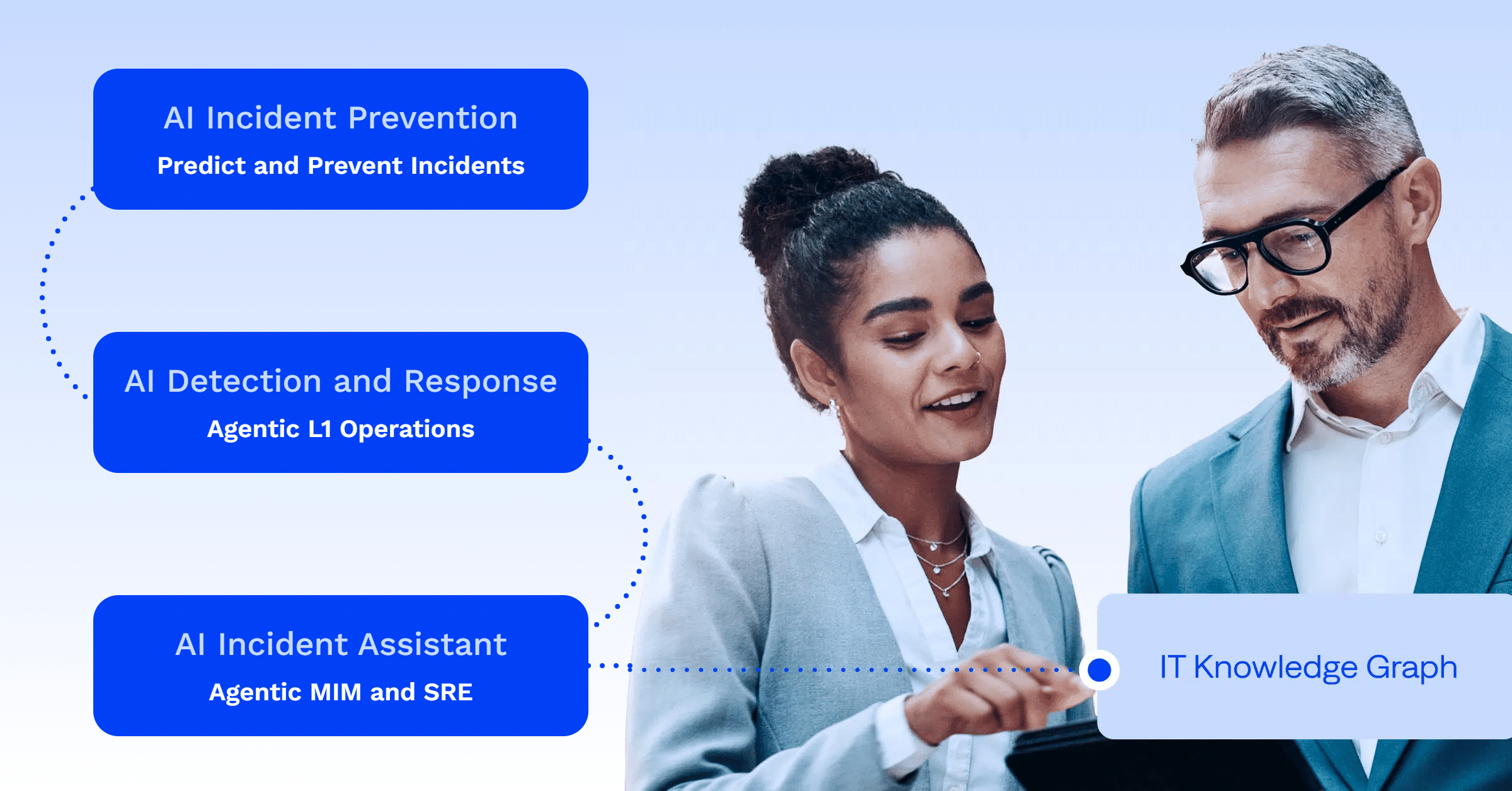
Agentic ITOps represents the next evolution of IT operations—moving beyond AIOps-assisted human workflows toward intelligent, autonomous systems that can proactively detect, diagnose, respond to, and prevent IT incidents with minimal human intervention.
Where traditional ITOps relies on human operators to connect the dots between alerts, and AIOps provides recommendations that humans act on, agentic ITOps can act autonomously to triage incidents, execute remediations, update ITSM records, and escalate only when human judgment is required. This shift allows ITOps teams to scale with the complexity of modern environments, reduce MTTR, and free responders from repetitive, low-value toil so they can focus on strategic work.
Learn more about the BigPanda agentic ITOps platform.
Frequently asked questions about agentic AI
What does ITOps stand for?
ITOps stands for IT operations. It refers to the people, processes, and tools responsible for managing and maintaining an organization’s IT infrastructure and services. ITOps teams keep systems available, detect and resolve incidents, and ensure that the technology the business depends on performs reliably.
What is the difference between ITOps and DevOps?
ITOps focuses on maintaining the stability, availability, and performance of existing systems and services. DevOps is a set of practices that brings development and operations teams closer together to accelerate software delivery and improve deployment reliability. In practice, the two disciplines overlap significantly, and many organizations have IT operations teams that work closely with DevOps and SRE functions to manage reliability across the full software lifecycle.
What is the difference between ITOps and ITSM?
ITOps is the technical practice of running and maintaining IT infrastructure and services. ITSM is the broader framework of processes used to plan, deliver, and manage those IT services in alignment with business needs. ITOps teams do the operational work, while ITSM provides the process structure, accountability, and service management practices that govern how that work is organized and tracked.
What is the difference between ITOps and AIOps?
ITOps is the function, and AIOps is an approach to improving it. AIOps applies AI and machine learning to IT operations data to automate alert correlation, anomaly detection, and incident triage, helping ITOps teams manage higher alert volumes and respond faster. AIOps tools don’t replace ITOps teams. They augment them by reducing manual toil and surfacing insights that would be difficult for humans to identify at scale.
What are the biggest challenges facing IT operations teams?
The most common challenges include overwhelming alert volumes, slow and manual triage and escalation processes, fragmented data across monitoring and ITSM tools, difficulty identifying root cause in complex distributed environments, and pressure to reduce costs while maintaining or improving service reliability. Agentic AI is increasingly being applied to address these challenges by automating the most repetitive and time-intensive aspects of ITOps workflows.
How is AI changing IT operations?
AI is transforming ITOps by enabling automation at a scale and speed that human-driven workflows cannot match. AI-powered platforms can ingest and correlate signals from dozens of monitoring and ITSM tools simultaneously, surface probable root cause, and either recommend or execute remediation steps—without waiting for a human to review each alert. The most advanced implementations use agentic AI to handle routine incidents end-to-end, freeing L1 teams from repetitive work and allowing L2 and L3 engineers to focus on complex, high-value problems.
See also
Check out more related content

PLATFORM
BigPanda Agentic ITOps
See how BigPanda uses agentic AI in IT operations.