






What is an incident postmortem?
An incident postmortem is a structured, blameless review conducted after a significant IT incident is resolved. It documents the timeline, root cause, contributing factors, and owner-assigned actions to prevent recurrence. It’s also called a post-incident review (PIR) or postmortem review. Many organizations require a postmortem for every P0 and P1 incident, then extend the practice to any incident that triggered a formal response.
Why IT incident postmortems matter
The postmortem is the mechanism that converts a painful outage into actionable prevention. Without a consistent IT incident postmortem process, teams repeat the same failures because no one captured what actually went wrong the first time. Unplanned downtime costs large enterprises an average of $23,750 per minute, or roughly $1.4 million per hour, according to EMA research.
Postmortem quality directly shapes MTTR trends over time. SRE teams feel this most acutely. A sharp postmortem protects SLOs by eliminating the recurring patterns that erode reliability month over month. A vague one just defers the next incident.
What a postmortem typically includes
Most IT incident postmortems cover six components. Each one feeds the next, so a weakness early in the chain undermines everything that follows.
- Incident timeline: A chronological record of what happened and when, from first signal to full resolution.
- Root cause analysis: The underlying system or process failure, not the symptom that triggered the alert.
- Contributing factors: The environmental, tooling, or process conditions that made the incident worse or harder to detect.
- Impact summary: The users, systems, and SLAs affected, and for how long.
- Response actions: The steps the team took to detect, triage, and resolve, including what worked and what didn’t.
- Action items: The specific, owner-assigned changes, with deadlines, that prevent recurrence.
A weak timeline produces a weak root cause. A weak root cause produces vague action items. Vague action items don’t get done. That chain is where most IT incident management postmortems quietly fail.
The blameless postmortem standard
Blameless postmortems focus on system and process failures rather than individual fault. When blame enters the process, engineers stop reporting near-misses and root cause findings default to “human error,” which closes the investigation without fixing anything. For a full treatment of the principles and how to run them, see Blameless Postmortem.
Postmortem vs. root cause analysis
Root cause analysis is one component of a postmortem, not a synonym for it. The IT incident root cause analysis identifies the underlying system or process failure. The postmortem wraps around it, adding the incident timeline, contributing factors, impact summary, response actions, and owner-assigned action items.
Root cause analysis explains why something broke. The postmortem explains what happened, who was affected, how the team responded, and what changes will prevent recurrence.
| Dimension | Root cause analysis | Incident postmortem |
|---|---|---|
| Scope | One underlying failure | Full incident lifecycle |
| Output | Cause identified | Cause + timeline + impact + action items |
| Question answered | Why did this break? | What happened, who was affected, and what changes prevent recurrence? |
| Used in | Engineering, quality, operations | IT incident management, SRE, NOC |
| Standalone? | Yes | No. Contains RCA as one component |
Where IT incident root cause analysis goes wrong is when it’s speculative, built on incomplete data rather than actual system telemetry and correlated event records.
The postmortem vs. retrospective distinction is also worth clarifying. Agile and DevOps teams use retrospectives to examine team process and delivery velocity. A postmortem is incident-specific and technical, focused on a failure event and its causes, not on sprint cadence or workflow. Both are useful. They’re not the same meeting.
The most painful parts of running a postmortem
Memory degrades
Anyone who has run a 3am P1 call knows the postmortem that follows is rarely clean. By the time the team convenes, days may have passed and the details are already fuzzy. People remember what they did, but not necessarily in what order, or why a particular decision seemed right at 2:47am. Memory degrades fast, and so does the root cause analysis built on top of it.
Tribal knowledge walks out the door
The engineer who knows exactly why that service behaves oddly under load is on PTO, or left the company six months ago. That context lives in someone’s head, not in the runbook. The Slack thread from the incident has fifty replies, no timestamps anyone can reconcile, and a few critical decisions that never made it into the ticket. Manual postmortems capture a fraction of what actually happened.
Action items never close
Then there are the action items that get written and never closed. The postmortem document gets filed. The follow-up ticket sits in a backlog. Six weeks later, the same failure pattern surfaces again. Major incident bridge calls drag on for the same reason. Without a unified timeline, the incident commander spends the opening of the call just establishing what happened and when, before anyone can start working the problem.
How Agentic ITOps changes the postmortem process
Postmortems are one of the most manual and time-consuming processes in ITOps, which makes them a natural target for Agentic ITOps. The BigPanda platform automates data capture, correlation, and report generation across the incident lifecycle.
AI Incident Assistant
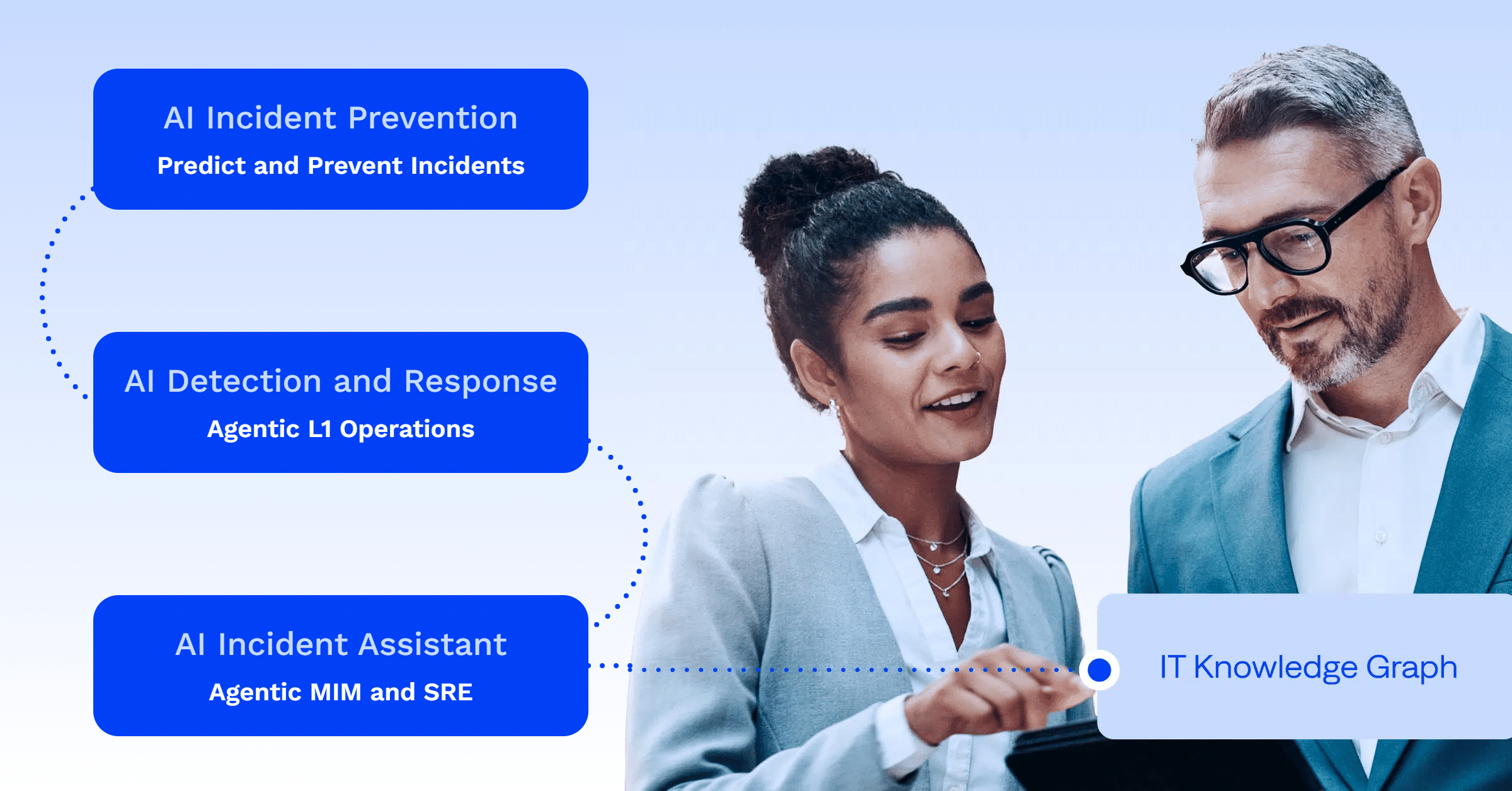
AI Incident Assistant automatically generates post-incident reports, including an after-action review, executive summary, and customer-facing root cause analysis. Timeline reconstruction, normally a multi-hour manual effort pieced together from logs, tickets, and memory, is automated because the platform captures structured event data throughout the incident lifecycle. The draft can be ready before the postmortem meeting starts.
IT Knowledge Graph
The IT Knowledge Graph addresses tribal knowledge loss by turning historical resolution patterns, runbooks, and past incident data into a shared intelligence layer that improves with every closed incident. Teams can start with what they have; the graph refines from there.
From postmortem to prevention
The postmortem sits between resolution and prevention in the incident lifecycle. Poor postmortems produce vague action items that nobody owns. Structured root cause analysis with assigned owners feeds change risk management and problem management processes that reduce repeat failures. One healthcare organization cut change-related outages by 45% within a year. AI Incident Prevention uses context from the IT Knowledge Graph to assess high-risk changes before they ship.
IT incident postmortem in practice
Named outcomes from teams operating at enterprise scale give a clearer picture than any benchmark. The California DMV reduced incident response from four to eight hours down to under 15 minutes. FreeWheel saved 20 hours per incident with auto-remediation. Cambia Health Solutions automated 83% of alerts. Autodesk reduced incidents by 69% in an environment generating 100,000 monthly application alerts across 25 tools.
Across 23 customers assessed in The Business Value of the BigPanda Platform report, average ROI is 430% with payback in under a year.
Frequently asked questions about incident postmortems
What is an incident postmortem?
An IT incident postmortem is a structured, blameless review conducted after a significant incident is resolved. It documents what happened, the underlying root cause, how the team responded, and what specific actions will prevent the same failure from recurring. P0 and P1 incidents typically require one. The terms post-incident review and postmortem review refer to the same process.
What is the difference between a postmortem and a retrospective?
A postmortem is incident-specific. It analyzes a particular IT failure: its timeline, technical root cause, and the conditions that made it possible. A retrospective, in Agile and DevOps contexts, examines team process and delivery practices over a sprint or release cycle. An IT outage postmortem focuses on system and operational failures; a retrospective focuses on team workflow and collaboration.
What should an IT incident postmortem include?
A complete IT incident postmortem covers six areas: an incident timeline, an IT incident root cause analysis, contributing factors, an impact summary, response actions taken, and owner-assigned action items with deadlines. Each component feeds the next. The outage root cause report is only as accurate as the timeline it’s built on, and the action items are only as useful as the root cause that generated them.
What is a blameless postmortem?
A blameless postmortem focuses on system and process failures rather than individual fault. It produces more accurate root cause analysis because participants describe what actually happened rather than what protects them professionally. See Blameless Postmortem for the full framework.
Check out more related content


PLATFORM
Incident postmortem in BigPanda
BigPanda automates timeline reconstruction through event correlation and intelligent change tracking, enabling teams to focus on root cause analysis rather than manual log review and reducing postmortem overhead.