






A structured post-incident review that examines the systems, processes, and conditions that allowed an incident to occur, rather than assigning fault to individuals. Also called a blameless post-incident review.
What is a blameless postmortem?
A blameless postmortem treats human error as a signal pointing to systemic gaps, not as the root cause itself. It shifts the investigation from “who ran the failing script” to “what made running that script dangerous.” Incidents are rarely caused by a single person making a mistake. They happen because conditions existed that made the mistake possible.
This framing draws from Sidney Dekker’s New View of human error and from Just Culture frameworks developed in safety-critical industries like aviation and healthcare. Google’s SRE Book brought those ideas into software operations and gave the IT industry a common name for the practice.
The practical payoff is direct. When engineers know a postmortem won’t become a performance review, they tell the full story. Complete timelines surface the decisions and gaps that drive prevention. Sanitized timelines produce action items that address symptoms and nothing more.
Blame vs. blameless: what actually changes?
The difference isn’t cultural niceness. It’s the quality of data the review produces.
| Dimension | Blame-focused review | Blameless review |
| Core question | Who caused the failure? | What conditions made the failure possible? |
| Timeline quality | Edited before the meeting, because no one wants to be the person holding the bag | Complete, because the process protects the people who share it |
| Contributing factors | Stay invisible, since naming a confusing runbook or a monitoring gap reads as deflection | Surface openly, including tool failures, process gaps, and organizational pressure |
| Action items | Target the individual | Target the system |
| Result | The next similar incident arrives on schedule | The failure mode gets closed |
That’s what blameless culture in IT operations means in practice: a process designed to produce better data, not just a friendlier meeting room.
Core principles of a blameless postmortem
Systemic focus
A systemic investigation doesn’t stop at the human action. It asks which conditions in the environment, the tooling, or the process allowed that action to cause harm.
Psychological safety
Without psychological safety, the postmortem is theater. The hardest part of blameless culture isn’t the template. It’s the leadership behavior, sustained over months, that makes honesty safe before anyone walks into the room.
Factual timelines
Disputed facts produce disputed conclusions. The more objective the source data, the less room for defensive reconstruction.
Accountability through action items
Removing blame doesn’t remove accountability. It moves from reprimand to owner, action item, and due date, which produces a fixed system rather than a chastened engineer.
Prevention as the measure
The measure of a postmortem is whether the failure mode recurs, not whether a document was filed. That makes recurrence the metric to track, and it’s the one most postmortem processes rarely instrument.
How to run a blameless postmortem in IT operations
- Assemble the incident timeline before the meeting: Collect alert data, change records, runbook activity, and communications before anyone walks in. This is where manual postmortems lose the most context.
- Set ground rules at the start: The facilitator states plainly that this is a system review, not a performance review, and that questions will be about what happened rather than who caused it.
- Walk the timeline chronologically: Move through events in sequence. Identify each decision point and note where information was missing, delayed, or misleading.
- Ask “why was this possible?” not “who did this?”: Apply five-whys questioning to the system, not the individual, and expect it to open more than one chain. Each answer should point to a condition that can be changed.
- Document contributing factors, not a single root cause: Modern distributed systems rarely fail from one cause. Capture the chain.
- Assign action items with owners and due dates: This is where accountability lives. Vague action items with no owners are how postmortem findings disappear.
- Follow up and track completion: Put a review date on every action item and check it on that date. Findings nobody revisits are indistinguishable from findings nobody wrote.
Is blameless a myth? The case for blame-aware postmortems
“Blameless” as a perfect state isn’t achievable for most teams. Some practitioners argue that the pull toward blame is wired into how people process failure, not a symptom of weak culture. What you can build is a blame-aware process that acknowledges that pull and uses facilitation structures to counteract it.
David Marx’s Just Culture framework distinguishes between human error (unintended action), at-risk behavior (risk not recognized or believed justified), and reckless behavior (risk recognized and consciously disregarded). Many IT incidents fall in the first two categories and call for system fixes, not disciplinary responses. Blame-aware means the facilitator redirects blame language when it surfaces, and leadership demonstrates through behavior that systemic findings matter more than scapegoating.
Why manual postmortems lose context
The most common failure mode of postmortems isn’t blame focus. It’s incomplete context and no follow-through.
Three days after a major incident, the team reconstructs events from Slack threads, ticket comments, and monitoring dashboards. Engineers are tired and recall has already drifted. Decisions made under pressure don’t get captured accurately, and tribal knowledge almost never makes it into the written record.
Then follow-through fails on top of it. Action items get written without clear owners, and the follow-up meeting never happens. Blameless intent can’t survive a broken assembly process.
How Agentic ITOps supports blameless postmortems
The most direct way to reduce blame in a postmortem is to reduce what requires subjective reconstruction. When the timeline comes from objective data rather than memory, there’s less room for defensive distortion.
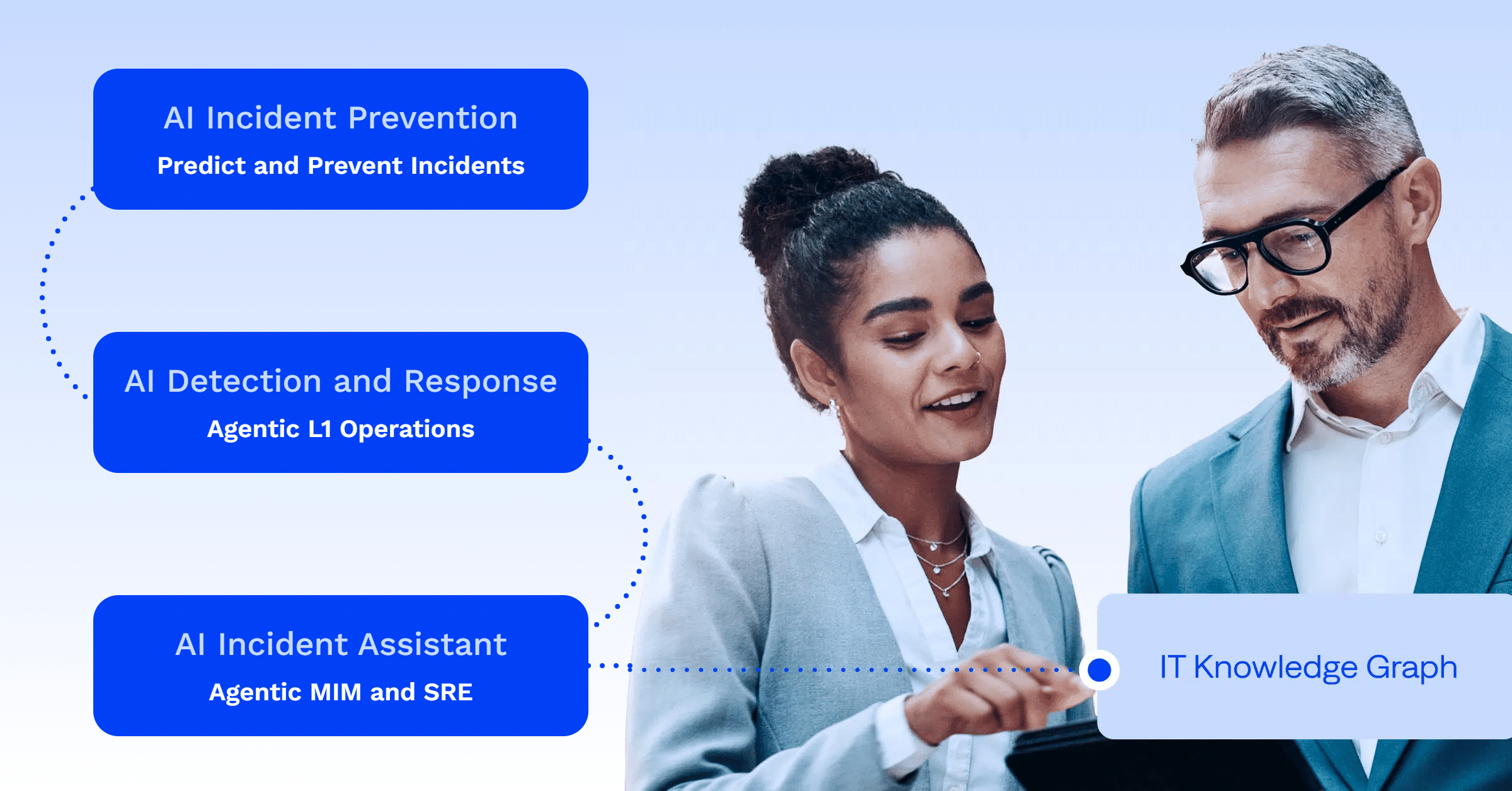
IT Knowledge Graph
The IT Knowledge Graph connects change records, observability data, and service desk activity with the informal knowledge that normally lives only in ticket comments and collaboration history, so context exists before the review begins rather than being reconstructed during it.
AI Incident Assistant
AI Incident Assistant generates the after-action review from the incident record and from bridge call and incident channel conversations, producing the timeline, lessons learned, and action items from objective data rather than recall.
AI Detection and Response
AI Detection and Response correlates signals as the incident unfolds, so the alert chain is a record produced during the event rather than an account assembled afterward. The review conversation shifts from “who got alerted and when” to “what in the system should we change.”
AI Incident Prevention
AI Incident Prevention runs root cause and trend analysis across recurring incidents so repeat failure modes get named once instead of rediscovered one postmortem at a time. Change risk management then scores upcoming changes against that history before they deploy.
Postmortem time savings
The AI Incident Assistant automates tasks such as real-time incident summaries and after-action reports, saving an average of 35 minutes per interaction.
Blameless postmortem vs. standard IT incident postmortem
A standard incident postmortem documents what happened, what it affected, and what was done about it. Whether it assigns blame depends entirely on organizational culture and on who is running the meeting.
A blameless postmortem removes individual fault-finding from the process by design, through facilitation practices, explicit process structure, and cultural norms that have to be built before the meeting starts. The removal is structural, not just aspirational.
In site reliability engineering practice, “postmortem” and “blameless postmortem” are used interchangeably because the blameless standard is assumed. In traditional ITSM and enterprise IT environments, that assumption isn’t always shared, which is exactly why the qualifier still matters.
Frequently asked questions about blameless postmortem
What is the difference between a blameless postmortem and a root cause analysis?
A root cause analysis is the method used to identify contributing factors. A blameless postmortem is the structured review process in which that analysis happens, with individual blame explicitly removed. You can run an RCA inside a blame-focused review, and a blameless postmortem without rigorous root cause analysis won’t prevent the next incident.
Does blameless mean no one is accountable?
No. Accountability moves from reprimand to action item, owner, and due date. Removing blame focuses responsibility on changing the system rather than punishing the person.
How do you get engineers to be honest in a postmortem?
Psychological safety has to be built before the meeting, not manufactured during it. Engineers share complete timelines when they trust that honesty leads to system improvements, not performance consequences. That trust comes from leadership behavior over time, not a statement at the start of the meeting.
How does AI improve the blameless postmortem process?
AI builds the timeline and after-action review from objective incident data rather than recall. That removes the memory-dependent reconstruction step that introduces both inaccuracy and blame into manual postmortems.
When should you run a blameless postmortem?
Run it while recall is still reliable, which in practice means within a day or two of resolution rather than at the end of the week. When the timeline is assembled automatically, the scheduling pressure largely disappears.
Check out more related content

PLATFORM
BigPanda Agentic ITOps
See how BigPanda uses agentic AI in IT operations.