






What is alert enrichment?
Alert enrichment is the automated process of adding context to raw IT monitoring events before a responder ever sees them. That context includes service ownership, topology relationships, recent changes, and historical incident data, so responders can assess severity and business impact without manually querying multiple systems. It’s a foundational AIOps capability and the step that makes alert correlation accurate.
Also known as alert context enrichment or event enrichment.
Raw monitoring events carry very little context on their own. A CPU spike from Datadog or a threshold breach from Prometheus arrives with a hostname, a metric value, and a timestamp. No service owner, no topology relationships, no change history, no sense of whether this affects a revenue-critical service or a test environment.
Alert enrichment closes that gap. It automatically pulls context from CMDBs, topology maps, change management systems, service ownership records, and historical incident data, then attaches that context to the event before anyone sees it.
Consider a concrete example. A CPU alert fires on a host. Without enrichment, the L1 analyst sees a hostname and a threshold breach. With enrichment, that same alert surfaces the affected service name, its downstream dependencies, a change deployed three hours earlier, the owning team, and the historical incident rate for that host. The analyst goes from “I need to investigate this” to “I know what this is and who to call” in seconds.
Alert enrichment vs. alert correlation, deduplication, and normalization
These four terms show up together in almost every AIOps evaluation, and they get conflated constantly. Each one does something different, and each happens at a different point in the pipeline. The distinction matters when you’re assessing whether a platform genuinely enriches alerts or just lists enrichment as part of a bundle.
| Term | What it does | Pipeline order | What it enables |
|---|---|---|---|
| Normalization | Converts raw event payloads from different tools into a common schema | 1. Before all other processing | Consistent field names and formats across every data source |
| Deduplication | Removes duplicate events representing the same condition | 2. After normalization | Fewer redundant records moving downstream |
| Enrichment | Attaches ownership, topology, change history, and severity context to normalized events | 3. After deduplication, before correlation | Responders see what an alert means, not just what fired |
| Correlation | Groups related enriched events into a single incident | 4. After enrichment | One incident view with accurate root cause context |
Without enrichment, a correlation engine can only pattern-match on hostnames or timestamps. With topology and service context attached, it groups events that are genuinely related rather than just close together in time. That difference is what separates a tight, accurate incident from a large group of loosely connected alerts.
How alert enrichment works
Event enrichment in IT operations follows a consistent pipeline, even if the implementation varies by platform.
- Raw events arrive and are ingested: Monitoring tools push events into the enrichment pipeline via API, webhook, or direct integration.
- Events are normalized into a common schema: Raw payloads get converted into structured key-value pairs. In many AIOps platforms, these are called tags. Normalization makes events from Nagios, Dynatrace, and Prometheus comparable to each other.
- Duplicate events are removed: Multiple events describing the same condition collapse into a single record, so the enrichment engine does the work once instead of repeating it for every copy.
- The enrichment engine queries external data sources: It pulls from CMDBs, topology maps, change management systems, service ownership records, and historical incident logs to find relevant context for each event.
- Contextual data is attached to the event as additional tags or metadata fields: The event now carries service name, owner, environment type, recent changes, and dependency relationships.
- Enriched events are scored for severity and business impact: Historical patterns and topology relationships inform a risk score that reflects actual blast radius, not just raw metric severity.
- Enriched, scored events pass to the correlation engine: The engine groups them into incidents and routes each incident to the appropriate team or automated handler.
The quality of those external data sources determines everything downstream. An enrichment engine with narrow or stale sources produces shallow context. One connected to fresh, broad sources produces context an L1 analyst can actually act on. This is where most enrichment projects succeed or fail.
What data sources feed alert enrichment?
The breadth and freshness of data sources directly affect enrichment quality. Common sources include the following categories.
| Data source | What it contributes |
|---|---|
| CMDB | Asset and configuration relationships, environment classification, service mapping |
| Topology maps | Upstream and downstream service dependencies, cluster and data center relationships |
| Change management systems | Recent deployments, configuration changes, planned maintenance windows |
| Service ownership records | Owning team, on-call rotation, escalation path |
| Historical incident data | Past incidents on the same host, service, or tag combination |
| Runbook and knowledge base systems | Resolution guidance linked to known patterns |
Freshness matters as much as breadth. A CMDB that was accurate six months ago will attach the wrong owner to today’s alert, and a topology map that predates a migration will point responders at dependencies that no longer exist. Stale context is worse than no context, because responders act on it.
Why alert enrichment matters for AIOps and IT operations teams
The operational impact breaks down into three connected outcomes.
Faster triage
This is the most immediate outcome. Responders see service context, change history, and ownership before they open a ticket, and the manual step of querying multiple systems to understand a single alert disappears.
Noise reduction
This follows directly from the first. Enriched alerts can be grouped, suppressed, or deprioritized based on context that raw events simply don’t carry. An alert from a test environment during a known maintenance window doesn’t need a human. Without enrichment, that call still goes to someone at 2 a.m.
Correlation quality
Enrichment gives correlation engines the shared context they need to group events that are genuinely related, so correlation quality tracks enrichment quality closely. A 2023 EMA survey found that 43% of respondents named prioritization and routing as the phase of incident management most in need of improvement, and both depend directly on context that enrichment supplies.
The detection gap compounds the problem: end users, not telemetry, still report 65% of all incidents. Better correlation feeds back into the first two outcomes, since tighter incidents mean less triage work and less noise.
Alert enrichment use cases in enterprise IT environments
Enrichment shows up across the incident lifecycle, but four use cases account for most of the operational value.
NOC triage during a major incident
An L1 analyst receives an alert that already shows affected services, recent change activity, downstream dependency impact, and a runbook link. Triage that would take several minutes of investigation happens in seconds.
Automated routing and escalation
Enriched service ownership tags let the platform route alerts to the correct team without anyone having to ask who owns the affected service. The routing happens before a human is involved.
Change-triggered event suppression
When enrichment attaches change window context to an event, the platform can automatically suppress or acknowledge alerts that fire during planned maintenance. The result is fewer false escalations and less overnight noise.
Risk scoring for incident prioritization
Enriched topology data lets the platform calculate the blast radius of an event, surfacing high-impact events to senior responders while routing low-impact ones to automated handlers.
Common challenges with alert enrichment at scale
Enrichment is straightforward in principle and difficult in practice, usually for one of three reasons.
CMDB quality and completeness
Most large enterprises have CMDBs that are partially outdated, inconsistently maintained, or missing records for newer services. Enrichment tools that assume a complete, well-structured CMDB will struggle here, which means they struggle in the majority of real enterprise environments.
Data source sprawl
Average customers run more than 20 observability and monitoring tools. Normalizing and enriching events consistently across all of them is technically complex, and integration gaps leave whole categories of events unenriched.
Static enrichment rules that age poorly
Manually maintained enrichment rules drift out of alignment as services change, teams reorganize, and infrastructure evolves. A rule that correctly tagged a service two years ago may silently misfire today.
How to approach alert enrichment
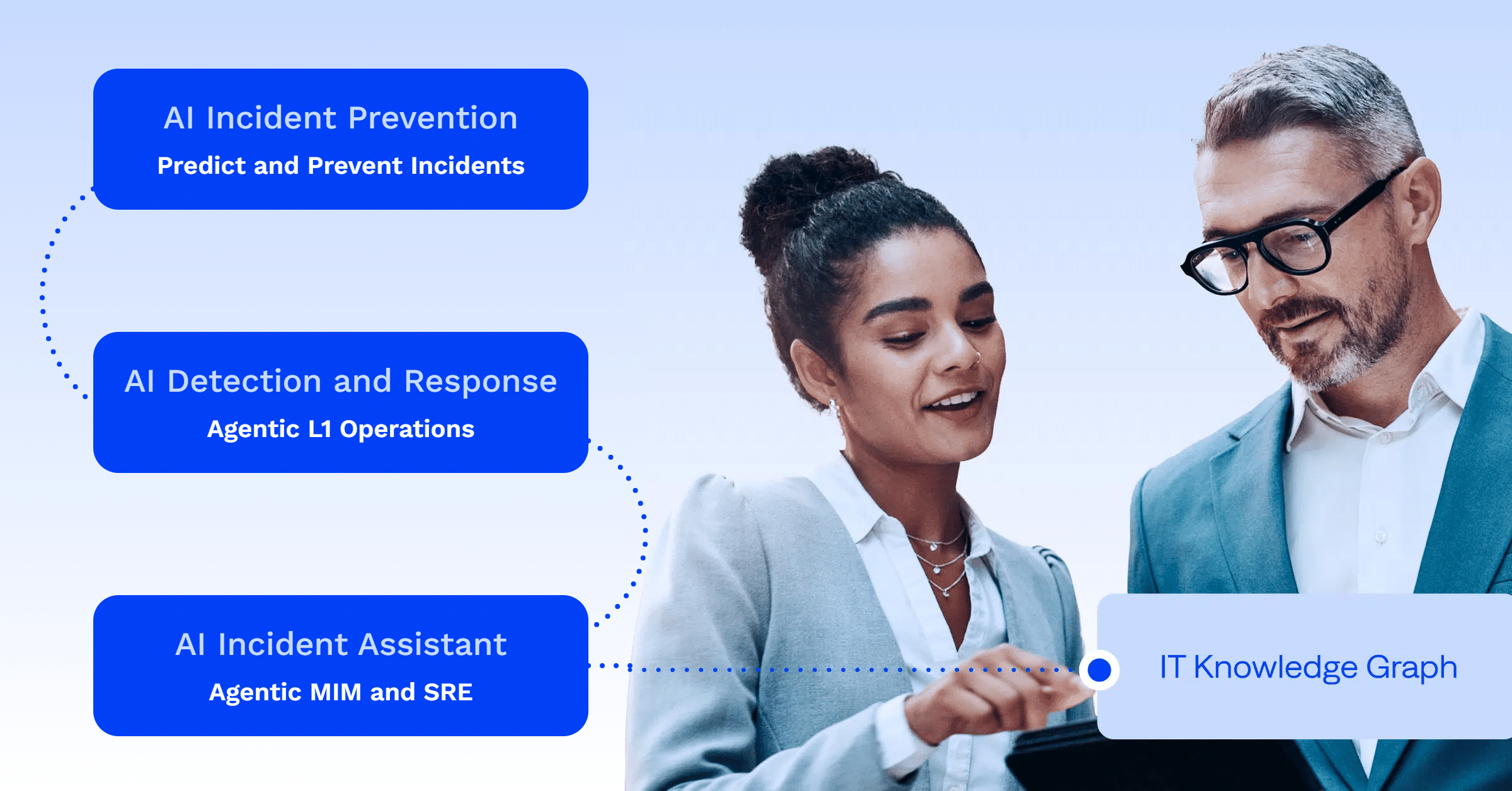
In AI Detection and Response, raw events are normalized into key-value tags that drive both enrichment and correlation across fragmented tools, teams, and clouds. Context comes from the IT Knowledge Graph, which works with messy, incomplete data from day one, with no requirement to clean your CMDB first. It also captures tribal knowledge from runbooks and past incidents, so enrichment can improve as more incidents are resolved instead of drifting the way hand-maintained rules do.
Open-box ML makes the enrichment logic transparent. Responders can see and control the tag logic and priority reasoning, which matters for regulated and compliance-sensitive teams.
Results from production deployments back this up with over 95% alert noise reduction and a median 43% reduction in ticket volume. Cambia Health Solutions automated 83% of alerts at the L0 and L1 layer and now identifies critical alerts in 30 seconds. Bungie achieved 99% alert compression.
Frequently asked questions about alert enrichment
What is the difference between alert enrichment and alert correlation?
They’re sequential steps, not alternatives. Enrichment attaches context to individual events. Correlation then uses that context to group related events into a single incident. Run correlation without enrichment and the engine has nothing to group on except hostnames and timestamps, which produces incidents that are large, loose, and hard to act on.
Does alert enrichment require a clean CMDB?
No. Most enterprises have partially outdated or incomplete CMDBs. Enrichment systems designed for real-world ITOps should work with what you have from day one and improve data quality as a byproduct of daily operations, not as a prerequisite for getting started.
How does alert enrichment reduce MTTR?
Enriched alerts arrive with service context, ownership, change history, and runbook links already attached. Responders skip the manual investigation step of querying multiple systems and reach the right action faster. Less investigation time per alert means shorter mean time to resolution. For how enrichment fits into the full incident lifecycle, see Automated Incident Response and Management.
What is alert context enrichment?
Alert context enrichment is the same process, named for what it produces rather than what it does. The goal is to ensure every alert carries enough context for a responder to act without pulling information from external systems. Service ownership, topology relationships, change history, and runbook links are the core context elements.
How is IT alert enrichment different from security alert enrichment?
IT alert enrichment adds operational context to help incident responders triage faster. The data attached includes service ownership, topology relationships, change history, and environment classification. Security alert enrichment adds threat intelligence context, such as IP reputation, CVE data, and known attack signatures, to help SOC analysts assess threats. Both use the term “enrichment,” but they serve different operational contexts, different platforms, and different audiences.
What data sources does an alert enrichment tool typically use?
CMDBs, topology maps, change management systems, service ownership records, historical incident logs, and runbook systems are the standard set. In practice they aren’t used equally. An analysis of 130 enterprise organizations found that ServiceNow CMDB was the most-integrated source and accounted for the largest share of enrichment maps at 42%, followed by Dynatrace at 30%. The same report found that 60% of alerts were enriched across all incidents, rising to 77% for actioned incidents, in line with its finding that higher enrichment leads to better-quality incidents.
Check out more related content

PLATFORM
Implement alert enrichment with BigPanda
Automatically enrich every alert with critical context—service owner, criticality tier, affected dependencies, related incidents—enabling faster triage and incident response.