






Your incidents cross teams,
tools, and systems.
Enterprise AI SRE sees it all.
Prevent avoidable incidents. Resolve the rest faster.
Free your SREs from manual firefighting.
Nobody owns the incident. Everybody escalates it.
Incidents span infrastructure, applications, services, cloud, and third parties. So teams pass them along, one escalation at a time, until someone finally owns the problem.

Change risk is invisible until it isn’t
Teams ship changes with no reliable way to predict which one causes the next incident — risk stays invisible until something breaks.

Every repeat incident is treated like a new one
Patterns, recurring causes, and proven fixes never get captured, so nobody learns from the last time this happened.

This is the gap AI SRE exists to close.
Your best people are doing dispatcher work.

No clean owner
Incidents cut across infrastructure, apps, services, cloud, and third parties — so teams escalate in sequence until someone claims it.

Your experts do dispatcher work
Spinning up channels, paging people, tracking status, asking who changed what — all of it eats time that should go to preventing the next incident.

Root cause is scattered
The knowledge to resolve an incident lives across tools, tickets, runbooks, chat, and people’s heads — diagnosis means manual assembly under pressure.
This is how you burn out your best engineers.

Your best experts become the bottleneck

Reactive work crowds out reliability work

Incidents last longer than they should
What changes with AI SRE for the enterprise
Before
- Nobody owns the incident until someone finally claims it.
- Your SREs spend the incident coordinating, not fixing.
- Root cause is scattered across five tools and three people’s heads.
- Risky changes ship blind. You find out when it breaks.
- Every repeat incident gets investigated like it’s brand new.
After
- The right owner is identified and engaged immediately.
- Coordination runs itself — responders just respond.
- Agents investigate in parallel and hand back the likely cause.
- Risky changes get flagged, with why, before they ship.
- Recurring problems get fixed at the root, not re-diagnosed every time.
How it works
This is what AI SRE looks like when it’s built for enterprise IT, not a demo environment.
Automated incident response
The team assembles itself.
Assembles the team automatically
The moment an incident opens, the right channel stands up and the right responders get paged. No one stops to figure out who’s needed.
Keeps everyone posted without a human relay
Responders get a live, current summary; execs, support, and customers get simple, audience-appropriate updates.
Writes it up after, automatically
Call transcript, root cause summary, and post-mortem generated directly from the incident record.


Automated incident investigation
Ask it. Don’t dig for it.
You can just ask it
Describe the problem in plain language, get an answer back. No dashboards to interpret, no query language to learn.
It investigates everywhere at once
Agents check monitoring, code, history, and topology simultaneously, testing multiple leads in parallel instead of one after another.
It knows your systems
Every answer is grounded in your actual architecture and past incidents, not a generic model guessing at “normal.”
Predict change-related incidents
Know what’s risky before it ships.
Flags risky changes early
Conflicts, collisions, and risky deployment windows caught before a change ships, not discovered after it causes an outage.
Makes CAB reviews easy
Risk shows up on the change record automatically, before the meeting starts, so reviewers focus only on what actually needs scrutiny.
Learns what’s risky over time
Risk is predicted from what’s actually happened in your environment, not a static checklist that treats every change the same.


Prevent repeat incidents
Stop solving the same incident twice.
Surfaces recurring patterns
Analyzes incident history to identify recurring themes, related incidents, and likely root causes that would be nearly impossible to track manually.
Gives you the fix, not just the finding
Recommends solutions with implementation steps, estimated effort, and expected operational impact.
Helps you prioritize
Combines frequency, severity, related-ticket volume, and business impact so teams fix what matters most first.
This is how BigPanda does it.
Most AI SRE tools were built for one service — this one was built for your reality.
1
Built for enterprise IT, not one team’s service
2
Operational knowledge, not just code and telemetry
3
Prevention first, not just faster remediation

Analyst recognition · Gartner® Market Guide
Gartner’s take: reactive tools aren’t enough.Without Doubling Your Budget
BigPanda is recognized in Gartner®’s Market Guide for AI Site Reliability Engineering Tooling, which explains how organizations must evaluate and invest in AI SRE tooling to lower the cost of SRE adoption and ensure reliability at scale.
What your CFO actually cares about.

Lower the cost of manual incident work
Automate response and investigation, cut unnecessary escalations, stop paying to re-solve the same incident.
Engineering capacity goes up, not headcount
Automated coordination and investigation free teams to improve reliability and ship faster instead of hiring to keep pace.
Customer experience and revenue stay protected
Fewer preventable incidents reach customers, which means less SLA exposure, less brand damage, less revenue risk.
This is the return enterprise IT gets from doing AI SRE right.
See what your SREs stop doing on day one.
Bring a real incident. We’ll show you exactly what BigPanda catches, predicts, and automates — before you ever page anyone.


- PlatformPlatform
- Agentic IT Operations
- Platform Overview
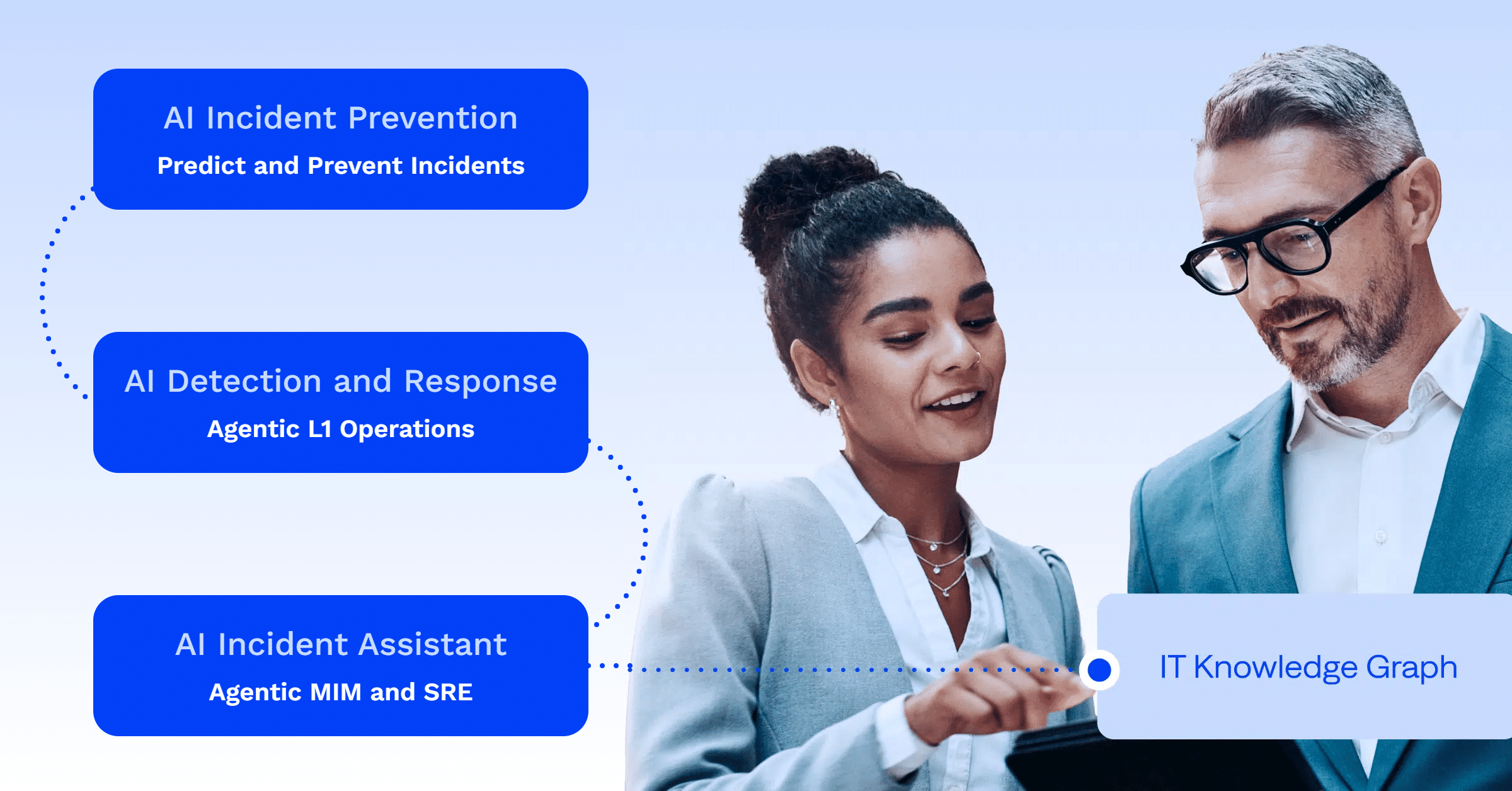
- AI Incident Prevention
- AI Detection & Response
- AI Incident Assistant
- IT Knowledge Graph
- BigPanda AIOps
- BigPanda Core
- Advanced Insight
- Biggy AI
- Rebranding Matrix
- Integrations
- Security & Compliance
- Features
- Detection
- Open Integration Hub
- AI Detection
- Diagnosis
- Service Desk Correlation
- Suggested Actions
- Incident Correlation
- Triage
- Automated Incident Triage
- Root Cause Analysis
- Similar Incidents
- Prevention
- Change Risk Management
- Problem Management
- Solutions
- Automating L1 Detection & Response
- Empowering Experts with AI Assistance
- Predicting & Preventing Disruptions
- Personas
- IT operations
- Incident management
- IT service management
- Site Reliability Engineering
- Industries
- Financial services
- Manufacturing
- Insurance
- Media and entertainment
- Managed services
- Airlines
- All industries
