






AI DETECTION & RESPONSE · L1 NOC AUTOMATION
Transform L1 NOC.
Automate what you outsource.
BigPanda AI Detection and Response supercharges L1 NOC today, and automates it end to end tomorrow – reducing escalations, shrinking outsourced spend, and recovering the real dollars behind it.
The autonomous operations transformation, side by side
See exactly what changes when AI Detection and Response takes the first pass on every incident.
Before
- Alert noise buries real incidents.
- Context is scattered. Escalation becomes the default.
- Misrouted tickets get reworked, again and again.
- Outsourcing preserves the broken model.
After
- One prioritized view. Real incidents surface first.
- Full context in seconds. Every operator, every shift.
- Routed right the first time – every time.
- Routine L1 NOC work – automated.
ONE PLATFORM, YOUR PACE
Supervise it, or automate L1 NOC entirely.
Some teams want a confident co-pilot. Others are ready to automate end to end. AI Detection and Response supports the whole spectrum – and moves with you as trust builds.

Supervise

Recommend
& approve

Full
automation
Your team stays in the driver’s seat
AI Detection and Response surfaces full context – correlated signals, root causes, similar incidents – the moment an incident opens. Your team decides and acts, faster, with the tools they already use.
Best for teams building trust in AI, or under strict change control.
AI proposes, your team confirms
AI Detection and Response stages the fix – runbook, routing, resolution – and waits for one-click approval before acting. Automation’s speed, with a human checkpoint on every action.
Best for teams ready to automate, but wanting oversight at first.
Routine incidents run themselves
Incidents are assigned, suppressed, or resolved without a human touch. Escalation happens only when it’s genuinely needed, context already attached.
Best for teams ready to reclaim L1 NOC headcount for higher-value work.
How AI Detection and Response works
One continuous loop, from first signal to resolution or a well-briefed handoff – built on the BigPanda IT Knowledge Graph.

1 Detect · event intelligence
Correlate
the signal
Alerts across every tool are normalized, grouped, and enriched into one prioritized incident – noise stripped before it reaches anyone.
Event correlation
ITSM ticket enrichment
Workflow integration

2 TRIAGE · INVESTIGATION
Diagnose with
full context
Root cause changes, historical incidents, and runbook context – even the undocumented kind – synthesize into clear next steps in seconds.
Recommendations
Runbook matching
Root cause changes
Historical incidents
Incident correlation
Service desk observability
External observability

3 Act · autonomous execution
Resolve it,
or escalate it well
Routine incidents are assigned, suppressed, or resolved automatically. Anything else escalates with full context attached.
Automated assignment
Automated suppression
Automated runbook execution
WHAT L1 NOC SEES
One prioritized view. Not eleven browser tabs.
The IT Knowledge Graph unifies observability, ITSM, change, and institutional knowledge into one incident record – AI reasoning and recommended next steps attached – before anyone opens the incident.
- Built on the data you actually have
- Reasoning that improves with every incident
- Accuracy that compounds
One workflow automated. Then another. Then another. That’s how the agentic NOC earns your trust.

Start where it hurts most
Five ways ITOps and NOC leaders put AI Detection and Response to work. Select one.
- Supercharge L1 NOC confidence
- Reduce outsourced L1 NOC spend
- Cut MTTR on every incident
- Reduce alert noise
- Eliminate misrouted tickets
THE PAIN
My operators know the process but lack context to decide quickly – so they escalate rather than risk the SLA.
How AI Detection and Response does it
Enriched context – observability data, change history, similar incidents, runbooks – arrives the instant an incident is identified, regardless of experience.

THE PAIN
My GSI contract grows every year with alert volume. I need costs down without pushing the work back onto my team.
How AI Detection and Response does it
Alerts are correlated, enriched, and suppressed before they reach L1 NOC. Capacity scales with volume, not with headcount or outsourcing spend.

THE PAIN
My L1 NOC team takes too long to resolve incidents – the first fifteen minutes go to gathering context, not acting.
How AI Detection and Response does it
AI-generated summaries and recommended next steps arrive the moment an incident opens – operators act, they don’t investigate.

THE PAIN
My L1 NOC team is buried in alerts. Volume keeps growing, and there’s no way to tell what’s real from noise.
How AI Detection and Response does it
Raw alerts correlate into one prioritized view. Noise is suppressed before it reaches the queue – real incidents surface with full context.

THE PAIN
My L1 NOC team keeps misrouting tickets. Every misroute gets reworked, and L2/L3 spend hours on incidents L1 NOC should have closed.
How AI Detection and Response does it
AI Detection and Response routes every incident using real-time data and historical outcomes – improving over time and freeing L2/L3 for real engineering work.

Proven in NOCs already running at scale

Large FinServ Organization
OPEX reduction after decreasing NOC headcount to three people with BigPanda.
Financial
Services
Insurance
Managed Service Providers
Retail
Manufacturing
Airlines

webinar
L1 Agent: Double ITOps Capacity
Without Doubling Your Budget
In this session:
- Why “hire more L1s” breaks under scale
- What autonomous ITOps looks like in practice
- Live demo: automated ticket assignment
Questions IT leaders ask first
What signals does AI Detection and Response actually use?
Everything you already collect – observability data, service desk tickets, CMDB records, knowledge base articles. It correlates across all of them instead of watching one tool at a time.
Does it get smarter over time, or is it static rules?
It draws on institutional knowledge – including the undocumented kind your best operators carry around – and refines recommendations as more incidents resolve.
What happens when something genuinely needs a human?
It escalates automatically, with full context attached – L2 starts diagnosing, not starting over.
Do we need to replace our existing monitoring stack?
No – AI Detection and Response sits on top of what you already run. It’s additive, not a rip-and-replace.
See agentic NOC in action – at your pace.
We’ll show you exactly what changes, whether that’s a co-pilot or full autonomy.

The high cost of low-quality L1 NOC outsourcing
Enterprises spend millions on outsourced IT support, but higher spending doesn’t guarantee improved outcomes.


- PlatformPlatform
- Agentic IT Operations
- Platform Overview
- AI Incident Prevention
- AI Detection & Response
- AI Incident Assistant
- IT Knowledge Graph
- BigPanda AIOps
- BigPanda Core
- Advanced Insight
- Biggy AI
- Rebranding Matrix
- Integrations
- Security & Compliance
- Features
- Detection
- Open Integration Hub
- AI Detection
- Diagnosis
- Service Desk Correlation
- Suggested Actions
- Incident Correlation
- Triage
- Automated Incident Triage
- Root Cause Analysis
- Similar Incidents
- Prevention
- Change Risk Management
- Problem Management
- Solutions
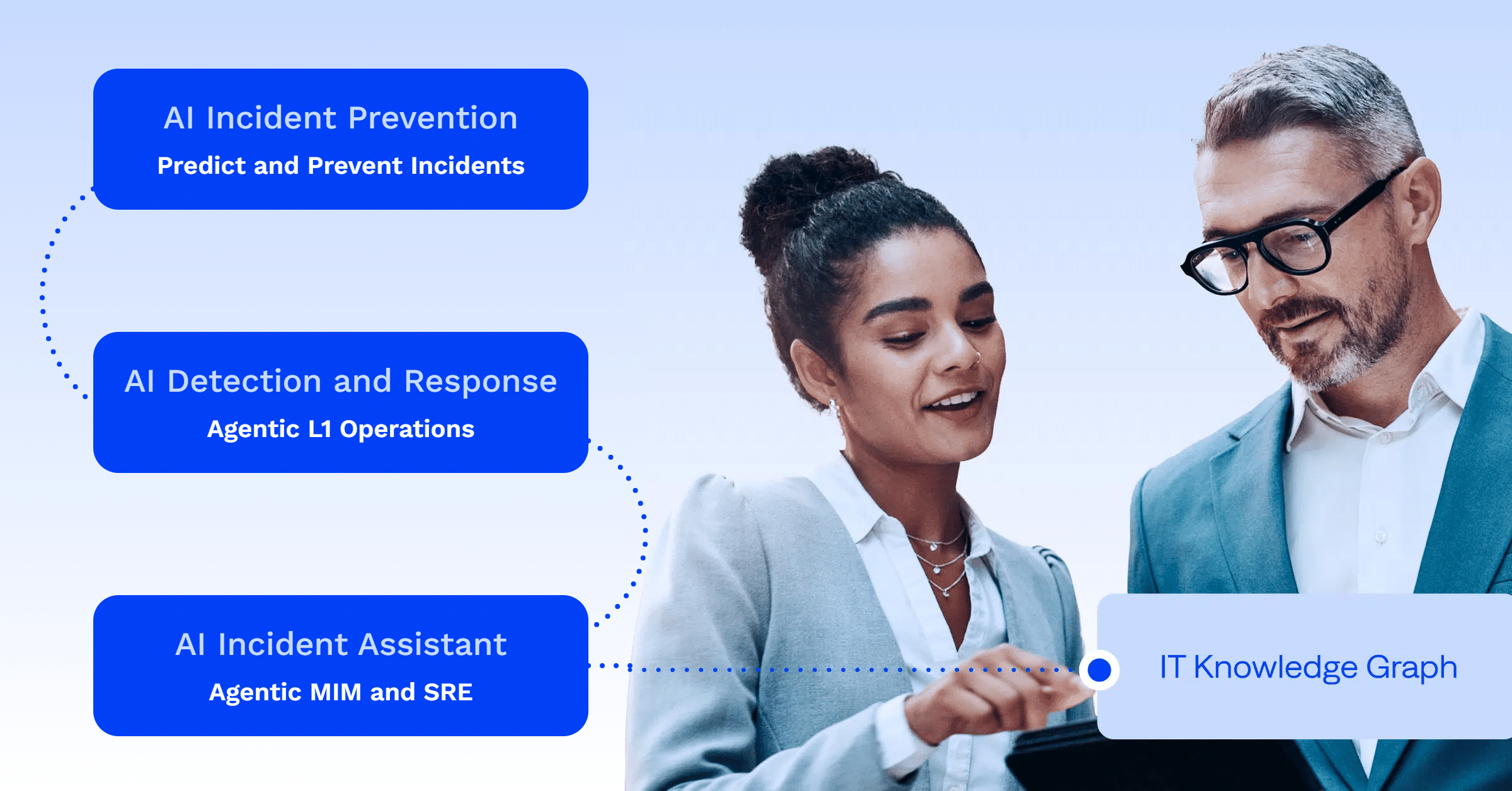
- Automating L1 Detection & Response
- Empowering Experts with AI Assistance
- Predicting & Preventing Disruptions
- Personas
- IT operations
- Incident management
- IT service management
- Site Reliability Engineering
- Industries
- Financial services
- Manufacturing
- Insurance
- Media and entertainment
- Managed services
- Airlines
- All industries
