This Week in IT Operations: Nov. 16–22, 2026

Sam OsbornWriter and Content Strategist · Nov 24, 2026 · 14 min read
In this post
- This week in IT Operations at a glance
- 1. Is AI behind the wave of outages? Officials point to patching, and experts say there’s no evidence yet
- 2. JPMorgan Chase outage stalls transfers and Zelle payments across US banks
- 3. The NSA’s classified network goes down after vulnerability patching
- 4. The FAA pauses router installs as the investigation into the ground stop continues
- 5. After a week of outages, CIOs rethink resilience and incident communications
- 6. Microsoft’s final report: testing gaps and safeguards that spread the outage
- 7. Cloud Security Alliance: no evidence AI-driven patching caused the outages, but change management is under strain
- 8. Microsoft Ignite 2026: Azure gives AI agents more control over operations
- On the calendar: upcoming ITOps events
- Meet BigPanda at Gartner IOCS 2026 in Las Vegas
Welcome back to This Week in IT Operations, our weekly roundup of the critical news shaping IT operations. Every week, we curate the stories that matter most to ITOps, AIOps, SRE, and incident management leaders, then tell you why each one matters.
It was another busy week in the IT industry. After the Microsoft 365 outage and the FAA ground stop, JPMorgan Chase stalled transactions across US banks, United Airlines and Apple experienced disruptions, and the NSA’s classified internal network went down.
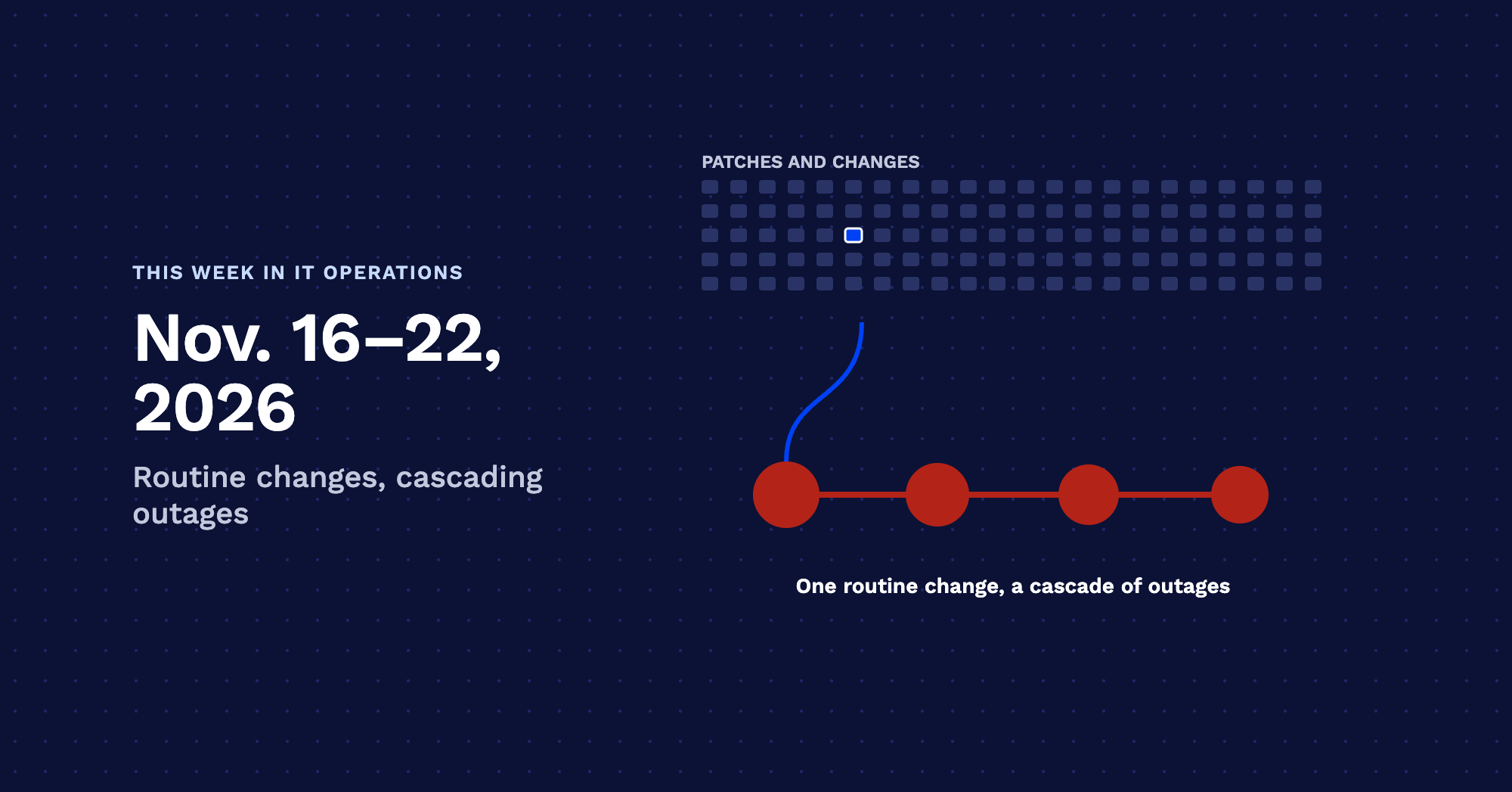
With so many high-profile outages in such a short span, mainstream outlets spent much of the week asking the same question: is AI behind all this? So far, the evidence points to the outages not being connected, and there’s no proof that AI caused them. However, they did follow a pattern, with each outage starting with something routine such as a change, a failover, a software release, or a patch. These routine operations, and the failures they caused, then cascaded across tightly coupled systems. Recovery was slow, and providers took criticism for their communication.
Meanwhile, AI is driving patch volumes sharply higher, and vendors are giving AI agents more power to change infrastructure on their own. That combination makes change-aware correlation, blast-radius visibility, and governed automation more important than ever.
So without further ado, here’s what happened this week, and why it matters. And from all of us at BigPanda, we wish you a happy, healthy, and safe Thanksgiving!
This week in IT Operations at a glance
- AI and the outages: Officials pointed to patching of AI-discovered vulnerabilities, but PolitiFact found no evidence the outages were connected, and Microsoft fixed 1,235 vulnerabilities in November alone.
- JPMorgan Chase: A software bug in on-premises systems stalled transactions and delayed Zelle payments across several US banks.
- NSA: Its classified internal network went down after patching for PHP vulnerabilities.
- FAA: The agency paused Juniper router installs while the investigation into the November 13 ground stop continues.
- CIOs: Technology leaders told Fortune they’re adding redundancy for critical tools and backup communication channels.
- Microsoft: Its final report shows a regional routing glitch and automated traffic redirection turned a dormant bug into a global outage.
- Cloud Security Alliance: No evidence AI-driven patching caused the outages, but change management is under growing strain.
- Microsoft Ignite: Azure gave AI agents write access to infrastructure, alongside new identity and governance controls.
1. Is AI behind the wave of outages? Officials point to patching, and experts say there’s no evidence yet
After a week in which Microsoft services went down, flights were grounded nationwide, bank services stalled, and an NSA network went dark, PolitiFact examined whether artificial intelligence was to blame. In a November 17 Fox Business interview, Director of National Intelligence Jay Clayton pointed to flaws that AI had detected in a programming language used in systems worldwide, saying the patching that followed caused some systems not to come back up as expected, including at the NSA. Sen. Mark Warner said some of the recent outages were AI-related, because AI tools have been able to spot vulnerabilities across existing systems. At a House Homeland Security Committee hearing, administration witnesses repeatedly cited patching rather than hacking as the cause and said there was no evidence of malicious cyberattacks.
PolitiFact found no evidence so far that the outages are connected to each other. However, the patching pressure is real, with security firm Qualys reporting that Microsoft addressed 1,235 vulnerabilities in November, compared with 68 in November 2025.
Sources: PolitiFact (via Bytes Europe), CyberScoop, SecurityWeek
Key takeaways
- AI’s biggest operational impact may be indirect. Even without AI-driven outages, AI-driven vulnerability discovery is multiplying the number of patches teams must apply. Every patch is a change, and every change is a chance for something to break.
- Patch volume needs change intelligence to match. When patch counts jump by an order of magnitude, manual review of what changed, where, and when can’t keep up. Teams need automated ways to connect every patch to the systems it touches and to any resulting symptoms.
- Speed and stability have to coexist. Defenders can’t keep up with patching when attackers move faster. The answer is better visibility into the impact of each change, so teams can patch quickly and spot problems before they cascade.
2. JPMorgan Chase outage stalls transfers and Zelle payments across US banks
On Monday, November 16, an hours-long JPMorgan Chase outage disrupted online banking, payments, and transactions. Chase said it experienced “a temporary issue related to a software bug in on-premises hardware systems” and that there was no evidence it was cyber-related. The effects spread beyond Chase, with customers of Bank of America, Wells Fargo, and U.S. Bank reporting delays on transactions involving Chase, and some Zelle payments were delayed even though Zelle said its own network was operating normally.
Chase said transactions were posting normally again by about 6:30 p.m. ET, but it hasn’t disclosed which component failed or what triggered the bug. Outlook India, citing Fox Business, reported that an FBI official traced the disruption to a software release Chase rolled out earlier that day.
Sources: Al Jazeera, TechRepublic, Outlook India
Key takeaways
- Your outage is everyone’s outage when you’re a hub. A problem at one bank delayed payments at several others. If your systems sit at the center of a network of partners, your blast radius includes theirs, and your incident communications should too.
- On-premises isn’t immune to change-related issues. Much of the conversation about concentration risk focuses on the cloud, but this incident came from on-premises systems. Change and release risk applies everywhere you run software.
- Clear status messages reduce confusion. Zelle had to explain that its network was fine while customers couldn’t send money. When an incident spans organizations, fast, specific statements about who’s affected and why help customers and partners respond correctly.
3. The NSA’s classified network goes down after vulnerability patching
On Tuesday, November 17, NSANet, the NSA’s classified internal communications network, suffered an outage, first reported by CNN. Only essential staff were reportedly told to remain on the agency’s Maryland campus while teams worked to restore the network. The NSA described the event as a temporary degradation during scheduled routine maintenance and said mission-critical capabilities remained operational. Director of National Intelligence Jay Clayton linked the outage to patching for recently disclosed vulnerabilities in PHP, the programming language behind a large share of websites, saying patched systems weren’t coming back up as expected. He also confirmed the outage wasn’t the result of a coordinated or state-sponsored attack.
The NSA wasn’t the only one experiencing issues: on November 16, United Airlines resolved an internal system outage that delayed departing flights, and on November 17, an internal update at Apple caused outages affecting account sign-in, iCloud, and retail systems.
Sources: SDxCentral, Business Standard, Atlanta News First (AP), Forrester
Key takeaways
- Patches are changes, and changes need verification. The patch itself wasn’t the whole problem; systems failing to come back up afterward were. Post-change health checks that confirm services have actually returned to a good state are as important as the change itself.
- Scheduled maintenance is still a risk window. The NSA called this routine maintenance. Even planned work deserves real-time monitoring, clear rollback plans, and fast escalation when systems don’t recover on schedule.
- Urgent patching requires a staged approach. When critical vulnerabilities require rapid patching, rolling changes out in waves and closely monitoring each wave limits how much can break at once.
4. The FAA pauses router installs as the investigation into the ground stop continues
In last week’s edition, we covered the November 13 ground stop that halted all US departures for more than 4 hours. This week, the FAA told Network World it had paused installation of the Juniper routers at the center of the investigation, without saying how long the pause will last. The agency said the outage wasn’t related to its ongoing network modernization but rather to its legacy time-division multiplexing (TDM) system, a 1960s-era transmission method, which caused instability.
Hewlett Packard Enterprise, which owns Juniper, said its equipment functioned as configured by the installer and did not fail or act improperly. Officials haven’t yet determined whether the problem came from the equipment, the installation, the configuration, or the limits of the legacy network, though FAA Administrator Bryan Bedford said investigators are “very close” to finding the cause.
Sources: Network World, SDxCentral, WSVN (CNN)
Key takeaways
- New equipment meets old assumptions. Whatever the final finding, this incident sits at the boundary between modern equipment and a legacy network. Changes that connect new and old systems deserve extra testing for how each side behaves under the other’s traffic patterns.
- Configuration is a change too. A feature that’s appropriate in one environment can be harmful in another. Track configuration settings as carefully as hardware and software changes, and make them visible to responders during an incident.
- Change management is where network outages start. Uptime Institute research found that configuration and change management failures are the most common drivers of network-related outages. Connecting change records to live network telemetry is one of the fastest ways to shorten the diagnosis time.
5. After a week of outages, CIOs rethink resilience and incident communications
Fortune’s CIO Intelligence newsletter spoke with technology leaders about how the run of disruptions is changing their plans. At New Jersey health system AtlantiCare, the Microsoft outage spurred internal conversations about building more redundancy for tools employees have come to rely on, including Copilot. AtlantiCare’s chief information and digital officer, Jordan Ruch, described resilience as something organizations build by planning with operations before an incident happens, not something that comes from a document or a backup system.
Communication was a recurring theme. Lockton CIO Shreyas Mysore said one challenge was that Microsoft was slow to tell clients its outage could have global implications. At Lockton, the first priority during an incident is to encourage brokers to proactively update their clients while also keeping information flowing internally.
Source: Fortune
Key takeaways
- Critical tools are a moving target. AI assistants like Copilot went from experiments to tools employees depend on in a short time. Revisit your list of business-critical services regularly and give the new ones the same resilience planning as the old ones.
- Set up backup communication channels before you need them. You can’t build a fallback channel in the middle of an outage that took down your primary one. Decide in advance how you’ll reach employees, customers, and partners when email and chat are down.
- Status communication is part of the recovery. Customers judge an incident not just by how long it lasts, but by how well they’re kept informed. Fast, honest updates, even before you have all the answers, protect trust while the technical work continues.
6. Microsoft’s final report: testing gaps and safeguards that spread the outage
Last week, we covered Microsoft’s preliminary explanation of its November 12 outage. On November 20, Microsoft released its final post-incident report, which adds important detail about how a dormant defect became a global failure. The chain started in one region: about 15 hours before the outage, a routing glitch on the Teams gateway in Microsoft’s US East region triggered an automatic switch that moved all Teams traffic worldwide onto the servers that handle email.
The report also explains how the failure spread. As servers stopped responding, Microsoft’s systems automatically rerouted traffic to nearby healthy servers, which also carried the same bug and buckled under the extra load. At the low point, more than 80% of the gateway’s servers in North America were unresponsive, and within about two hours, servers in every region were affected. Microsoft also acknowledged that its testing didn’t adequately represent the combination of hardware and traffic it encountered during the incident.
Microsoft outlined 13 remediation steps. By the end of 2026, it plans to change how it distributes traffic so a failure in one region stays there, and to limit Teams failovers to the affected region rather than shifting traffic globally. By the first quarter of 2027, it will split gateway capacity into separate pools for each workload, so a surge in one service can’t starve another.
Sources: GeekWire, Archyde, 365Fanatic
Key takeaways
- Automated safeguards can spread failures. Traffic redirection intended to protect the service caused the problem to spread to every region. When you automate recovery, also define the conditions under which automation should stop and hand control back to people.
- Blast radius should be designed, not discovered. A regional routing glitch shouldn’t be able to move global traffic. Isolation boundaries between regions and workloads are what keep one problem from becoming everyone’s problem.
- Test the combinations, not just the components. The defect only surfaced under a specific mix of hardware, load, and traffic. Realistic load testing, including failover scenarios, is how latent bugs get caught before customers find them.
7. Cloud Security Alliance: no evidence AI-driven patching caused the outages, but change management is under strain
The Cloud Security Alliance (CSA) examined whether AI-assisted vulnerability discovery and accelerated patching could be contributing to the recent disruptions. According to Virtualization Review, the CSA’s November 18 investigation found no evidence connecting AI-related patching to the outages, but it identified growing pressure on enterprise change-management processes as a legitimate concern.
The same week brought fresh reasons to patch quickly. Broadcom warned of a VMware vCenter vulnerability that was exploited before its public disclosure, and the Cybersecurity and Infrastructure Security Agency (CISA) added four actively exploited vulnerabilities to its Known Exploited Vulnerabilities catalog, including one in the BerriAI LiteLLM AI gateway. Neither announcement has been linked to the outages.
Source: Virtualization Review
Key takeaways
- Ordinary causes still dominate. Software defects, network changes, and maintenance problems explain most of what went wrong. The fundamentals of change, release, and failover management matter more than any single new threat.
- Change management is the pressure point. As AI speeds up vulnerability discovery, the number of urgent changes rises while the time to plan them shrinks. Processes built for a slower pace of change need automation to keep up.
- AI infrastructure is now part of your patch surface. A vulnerability in an AI gateway landing in CISA’s catalog is a reminder that AI tooling needs the same vulnerability management as any other production system.
8. Microsoft Ignite 2026: Azure gives AI agents more control over operations
At Microsoft Ignite, which opened November 17, Microsoft expanded its tools for agent-driven cloud operations. One of the biggest changes is expanded write access through the Azure Resource Manager (ARM) MCP Server, so agents can now create, manage, and update Azure resources, not just read them. Azure SRE Agent gained public preview features including Entra Agent ID integration and cross-agent communication, plus Microsoft Teams integration for investigations across multiple clouds. Azure Monitor health models, now generally available, connect infrastructure telemetry with application dependencies and business impact. On the governance side, Microsoft Entra added discovery of local AI agents, automated lifecycle management for agent identities, and an MCP firewall in preview to govern communications between agents and the tools they use.
Source: Virtualization Review
Key takeaways
- Agents are moving from reading to changing infrastructure. Write access through the control plane means agents can now make the kinds of changes that caused many of this month’s outages. Governance has to keep pace with that new power.
- Context is what makes agent actions safe. Connecting telemetry to dependencies and business impact gives agents, and the people supervising them, a view of the blast radius before anything changes.
- Agent identity is becoming core infrastructure. Giving each agent its own identity, lifecycle, and policy controls makes agent actions traceable and auditable. That’s the foundation for trusting agents with more autonomy over time.
On the calendar: upcoming ITOps events
| Date | Event | Why it matters |
|---|---|---|
| Nov 30–Dec 4 | AWS re:Invent, Las Vegas | Expect resilience, agentic AI, and capacity to dominate after a month of high-profile outages |
| Dec 8–10 | Gartner IT Infrastructure, Operations & Cloud Strategies Conference, Las Vegas | The year’s biggest gathering of I&O leaders, and where you can meet BigPanda |
Meet BigPanda at Gartner IOCS 2026 in Las Vegas
This week showed how quickly a single change can become a global incident, and how much depends on how quickly we understand what’s happening. Let us show you how agentic ITOps shortens that time for your team.
We’d love to talk about what these issues mean for your team, so please come meet us at the Gartner IT Infrastructure, Operations & Cloud Strategies Conference, December 8–10, 2026, at The Venetian in Las Vegas. Stop by booth 301 to see how BigPanda helps enterprises detect, triage, and resolve incidents with agentic AI, or learn more about meeting BigPanda at the show.
Sam has more than a decade of experience helping B2B tech companies tell compelling stories about their customers and products. Before joining BigPanda, Sam spent three years as a content marketing leader for Unity Technologies’ Core Games division.
More from Sam →